viernes, 28 de noviembre de 2025

Orfeo's tragic quest, by a dazzling primadonna: Orfeo ed Euridice with Cecilia Bartoli in Madrid.


Madrid, November 27, 2025.

Cecilia Bartoli is one of the very few operatic divas who raises admiration similar to those of the past. Throughout her 38-year career, she has sold millions of discs, and is admired by music lovers around the world. In Europe, where she mainly spends her career due to her fear of flying, her performances arouse the delirium of her followers, some of whom spend fortunes to follow her in all her performances across the continent. During a performance of Giulio Cesare in Salzburg in 2012, at the end of each aria, a fan screamed, before the rest of the audience dared to applaud: "Great!" "Unique!" are some of the compliments that can be heard in this function immortalized on video, always from the same fan. Her virtuosity and vocal pyrotechnics, alongside her stage personality, drive all audiences crazy, with his devilish repertoire: baroque, Mozart, bel canto... the 18th century and the first third of the 19th century are his specialty. Thanks to her albums, the public has discovered musical gems that used to lay in unjust oblivion, and new approaches to classic scores. Celebrated are her renditions of the castrati repertoire, whose devilish tessitura she assumes without problems, dazzling the listener; as well as Mozart and Rossini. She has also dared to sing bel canto roles such as Norma and Amina from La Sonnambula, from a historicist point of view, trying to reconstruct as much as possible how these works sounded in their time, written for divas who had a vocal range as heterogeneous as hers. And in our country, all her concerts are sually sold out in a matter of days and even hours.


At 59 years old, the Italian mezzo-soprano still maintains a busy schedule both as a singer and as artistic director of the Monte Carlo Opera and the Salzburg Whitsun Festival. Precisely in this Austrian city in 2023 she presented a new production of Orfeo ed Eurydice, the famous opera by Christoph Willibald Gluck, in which she herself starred. He did it in a rare version of the many that this opera has: the one from 1769, called "Act of Orpheus", within the framework of a great gala called "The Festivities of Apollo" that took place that year on the occasion of the wedding of Ferdinand of Bourbon-Parma and Maria Amalia of Austria. This version reduces the three-act opera to seven scenes. The present musical edition shows with a sad ending in which the famous aria "Che Farò senza Euridice" is performed with faster tempi than normal in the first stanza, turning the beautiful aria into an initial moment of rage, and then performed with slow pace, showing Orfeo's collapse. In addition, it adds the ballets from the Paris version of 1774.

This modified version is the one that she is presenting in Spain in a semi-staged version, in her European tour: Madrid, Barcelona and Seville are the stops she makes in our country. Along with her, the same performers as the Salzburg version: the orchestra she founded.

Bartoli did not disappoint, despite the fact that her voice is matured after decades of career, and that this opera doesn't offer many numbers that would allow her to showcase the devilish coloratura she usually displays in her concerts. Her voice isn't particularly large, and the enormous Auditorio Nacional is certainly not the most suitable venue, but some things are still recognizable, such as her middle register, still well preserved. And what remains intact is her magnetism on stage. As an actress, her ease on stage is striking, moving from one side of the stalls to the other, or from the choir seats, as if reflecting her journey through the afterlife, as well as her moments of euphoria, joking with the musicians when Orfeo waits for the spirits to return Euridice to him. The third act was a moment of dramatic intensity, when the lovers argue because he cannot see her and she doesn't understand him. Bartoli successfully conveys Orfeo's despair, as well as the heart-rending cry in"  Saziati, sorte rea! Son disperato!"  before her famous aria.

The first great moment was the third scene, in which Orfeo is in Hades, singing a delightful rendition of "Deh, placatevi con me ," where, in the line "Vi renda almen pietose Il mio barbaro dolor," she offered a brief but splendid coloratura. Another spectacular moment was in the grand final scene, in the duet with Eurydice, "Vieni: appaga il tuo consorte", where she delivered a spectacular high note linked with coloratura, something truly amazing. The most anticipated moment was undoubtedly the famous aria  "Che Farò senza Euridice", which in this version is performed first with verve, as a moment of anguish, and then sung at the usual measured pace, as the character breaks down. It was in the second half of the aria that Bartoli, displaying his beautiful and velvety piano singing, moved the audience deeply. As in this tragic version, Euridice dies, Orfeo ends his intervention looking for her in Hades (in the traditional version with a happy ending he tries to stab himself but Cupid stops him), with the words  Aspetta! Aspetta!, and in the last of them, Bartoli left the stage while intoning a beautiful and prolonged pianissimo, thus evaporating her character in the underworld.


Alongside her, Mélissa Pétit was better in the role of Euridice, where she demonstrated a beautiful lyric voice with a lovely timbre and a touch of darkness, than in the role of Amore, which she performed well but not at the same level. Perhaps inspired by Bartoli, the chemistry between them in the third act was striking. As Euridice her acting is convincing, portraying a confused and fragile character, with her beautiful singing.

Bartoli probably knew what she was doing when he spearheaded the creation of his orchestra, Les Musiciens du Prince-Monaco, conducted by Gianluca Capuano. And indeed, it has surprised everyone with its powerful sound and Capuano's excellent conducting. The flute and oboe soloists gave masterful performances of their solo passages in the exquisite Dance of the Spirits. The brass sounded terrifying and impactful in the scenes of Hades, and the strings were piercing, energetic, and spirited in the Dance of the Furies, as well as in the aria "Che farò senza Euridice." The ensemble was truly inspired. Equally remarkable was the choir  Il Canto di Orfeo , sounding with the beauty characteristic of sacred music in the opening chorus and the tragic finale, as well as in the Heaven scene; and at the same time energetic in the Underworld scenes. 

Even though it was a semi-staged version, the aim was to create the greatest possible sense of staging, such as Orpheus changing from a black to a white suit, Cupid's red dress and plush heart, or Eurydice's white dress. But what truly created a unique atmosphere was the powerful lighting. The auditorium was almost completely dark, save for minimal stage lighting, giving an unprecedented sense of intimacy and concentration on the drama seen in this venue. The organ was illuminated in red during the scenes in the infernal Hades, and in white during those in the heavenly Elysium. The chorus waved lights when portraying the Furies, and at the end, in addition to their excellent performance, they approached Eurydice's body and slowly placed candles around it. 


The hall wasn't full, partly due to the high ticket prices (some were offered at a discount and through raffles in places like the newspaper El País), and possibly because the organizing company, IMPACTA, is still establishing itself, although it's already putting on top-notch concerts, like a beautiful Dido and Aeneas last year with Sonya Yoncheva. Even so, the occupancy was quite high. The entire audience rose to their feet, cheering and rewarding Bartoli with a standing ovation, demonstrating how admired she is in Madrid, as well as for the rest of the cast. Thanks to everyone involved, we enjoyed a moving and high-quality Orpheus at the Auditorium. Well done.

My reviews are not professional and express only my opinions. As a non English native speaker I apologise for any mistake.

Most of the photographs are from the internet and belong to its authors. My use of them is only cultural. If someone is uncomfortable with their use, just notify it to me.

El trágico poeta, por la gran diva: Orfeo ed Euridice con Cecilia Bartoli en Madrid.


Madrid, 27 de noviembre de 2025.

Cecilia Bartoli es de las escasas divas operísticas de la actualidad que despierta una admiración parecida a las del pasado. A lo largo de sus 38 años de carrera, ha vendido millones de discos, y es admirada por melómanos de todo el mundo. En Europa, donde principalmente transcurre su carrera debido a su miedo a volar, sus interpretaciones despiertan el delirio de sus seguidores, algunos de los cuales gastan fortunas en seguirla en todas sus actuaciones por el continente. Durante una función de Giulio Cesare en Salzburgo en 2012, al final de cada aria, un admirador se desgañitaba en ovaciones antes de que el resto del público se atreviera a aplaudir: "¡Grande!" "¡Única!", son algunas de los halagos que se pueden oír en esta función inmortalizada en vídeo, siempre del mismo espectador. Su virtuosismo y pirotecnia vocales, junto a su personalidad escénica, enloquecen a todos los públicos, con su endiablado repertorio: barroco, Mozart, bel canto... el siglo XVIII y el primer tercio del siglo XIX son su especialidad. Gracias a sus discos, el público ha descubierto joyas musicales que yacían en el injusto olvido, y nuevos enfoques de partituras clásicas. Celebradas son sus interpretaciones del repertorio de los castrati, cuya tesitura endiablada asume sin problemas, así como de heroínas del repertorio barroco y clasicista, impresionando al oyente; así como de Mozart y Rossini. También se ha atrevido con roles belcantistas como Norma y Amina de La Sonnambula, desde un punto de vista historicista, tratando de reconstruir al máximo cómo sonaron estas obras en su tiempo, escritas para divas que tenían un rango vocal tan heterogéneo como el suyo. Y en nuestro país, todas sus actuaciones agotan localidades en cuestión de días e incluso horas.


Así, a sus 59 años, la mezzosoprano italiana mantiene aún una apretada agenda tanto como cantante, como directora artística de la Ópera de Montecarlo y del Festival de Pentecostés de Salzburgo. Precisamente en esta ciudad austríaca presentó en 2023 una nueva producción de Orfeo y Eurídice, la famosa ópera de Christoph Willibald Gluck, que ella misma protagonizó. Lo hizo en una versión poco frecuente de las muchas que tiene esta ópera: la de 1769, llamada "Acto de Orfeo", en el marco de una gran gala llamada "Las fiestas de Apolo" que tuvo lugar ese año con motivo de la boda de Fernando de Borbón-Parma y María Amalia de Austria. Esta versión reduce la ópera de tres actos a siete escenas. La presente edición musical presenta un final triste, con la famosa aria "Che Faró senza Euridice" interpretada con tempi más rápidos de lo normal en la primera estrofa, y en el que Eurídice muere por segunda vez. Además, añade los ballets de la versión de París de 1774. Esta modificada versión es la que la diva italiana presenta en España en versión semiescenificada, en el marco de una gira europea: Madrid, Barcelona y Sevilla son las paradas que hace en nuestro país, con los mismos intérpretes que en las funciones salzburguesas.

La Bartoli no defraudó, aunque los años no pasaran en balde y que esta ópera no abunda en números que le permitan lucir la coloratura endiablada que suele exhibir en sus conciertos. La voz no es muy grande, y desde luego el enorme Auditorio Nacional no es el espacio más adecuado, pero hay cosas que aún son reconocibles, como el centro, que aún mantiene bien. Y desde luego lo que se mantiene intacto es su magnetismo en escena. Como actriz, sorprende su soltura en escena, yendo de un lado a otro del patio de butacas o de los asientos de coro, como reflejando su viaje por el más allá, así como sus momentos de euforia, bromeando con los músicos cuando Orfeo espera a que los espíritus le devuelvan a Eurídice. El tercer acto fue un momento de intensidad dramática, cuando Orfeo y Eurídice pelean porque él no puede verla y ella no lo entiende. La desesperación de Orfeo es transmitido por Bartoli con éxito, así como el desgarrador grito en Saziati, sorte rea! Son disperato! antes de su famosa aria.

El primer gran momento fue la escena tercera, en la que Orfeo está en el Hades, cantando una deliciosa interpretación del Deh, placatevi con me, en la que en la frase "Vi renda almen pietose Il mio barbaro dolor" se atrevió a dar una coloratura breve pero espléndida. Otro momento espectacular fue en la gran escena final, en el dueto con Euridice, Vieni: appaga il tuo consorte, dio un agudo espectacular enlazado con coloratura, algo tremendo. El momento más esperado era sin duda la famosa aria Che Farò senza Euridice, la cual es interpretada en esta versión primero con brío, como un momento de ansiedad, para luego cantar en el pausado ritmo habitual, cuando el personaje se rompe. Fue en la segunda mitad del aria, cuando Bartoli, exhibiendo su bello y aterciopelado canto en piano, conmovió al público. Como en esta versión trágica, Eurídice muere, Orfeo termina su intervención buscándola en el Hades (en la versión tradicional con final feliz intenta apuñalarse pero Cupido le detiene), con las palabras Aspetta! Aspetta!, y en la última de ellas, Bartoli abandonaba la escena mientras entonaba un bello y prolongado pianissimo, evaporándose así su personaje en el inframundo.


Junto a ella, Mélissa Pétit estuvo mejor en el rol de Eurídice, donde demostró una bella voz lírica, con un precioso timbre con un toque oscuro, que en el de Cupido, donde cumplió. Quizá inspirada por Bartoli, la química con ella en el tercer acto era impactante, y estuvo a la altura también en lo actoral, convenciendo, junto a su bella voz, en el retrato de su confundido y frágil personaje.

Bartoli probablemente sabría lo que estaba haciendo al impulsar la creación de su orquesta Les Musiciens du Prince-Monaco, dirigida por Gianluca Capuano. Y es que ha sorprendido por su potente sonido, y por la excelente dirección de Capuano, Los solistas de flauta y oboe dieron una interpretación magistral en la bellísima danza de los espíritus. El metal sonó aterrador e impactante en las escenas del Hades, y las cuerdas sonaron hirientes, enérgicas, briosas, en la Danza de las furias, así como en el aria Che farò senza Euridice. El conjunto estuvo inspiradísimo. Igualmente notable el coro Il Canto di Orfeo, sonando con belleza propia de la música sacra en el coro inicial y en el trágico final , así  como en la escena en el cielo; y al mismo tiempo enérgico en las escenas en el inframundo. 

Aun siendo una versión semiescenificada, se buscó la mayor sensación de escenificación, como que Orfeo se cambia de traje de uno negro a uno blanco, el vestido rojo y el corazón de peluche de Cupido, o el vestido blanco de Eurídice. Pero lo que creó un ambiente único fue la poderosa iluminación. El auditorio estaba casi en total oscuridad, salvo por una mínima iluminación escénica, dando una inédita sensación de cercanía y concentración en el drama. El órgano se iluminaba de rojo en las escenas en el infernal Hades, y de blanco en las del celestial Elíseo. El coro agitaba luces cuando interpretaba a las Furias, y en el final, sumado a su excelente interpretación, se acercaban al cuerpo de Eurídice a dejar velas lentamente a su alrededor. 


No estaba llena la sala, en parte debido al alto precio de las localidades (algunas se ofrecieron con descuento y sorteo en sitios como el periódico El País), y que posiblemente la empresa organizadora, IMPACTA, aún está dándose a conocer, aunque ya está ofreciendo conciertos del más alto nivel. Aun así, la ocupación era bastante alta. Todo un auditorio puesto en pie premió en ovaciones a Bartoli, demostrando lo admirada que es en Madrid, así como para el elenco. Gracias a todos los implicados, hemos disfrutado en el Auditorio de un emotivo Orfeo, de alto nivel. Buen trabajo.

martes, 11 de noviembre de 2025

Magic music, black, empty staging: Bartók's Bluebeard's Castle at the Teatro Real.


Madrid, November 8, 2025.

The Teatro Real often organizes opera cycles, within its seasons. This year, there's a cycle centered on Bluebeard, and another one on Shakespeare. Regarding the former, we'll have two classics by two 20th-century composers: Bluebeard's Castle, in a double program with The Miraculous Mandarin, in November 2025 both by Béla Bartók, and Ariadne et Barbebleue by Paul Dukas in January 2026. 

Bartók is one of the most popular composers of the 20th century, and one of those who did the most for the study and dissemination of Central European regional music in his time. This opera has never before been performed at the Teatro Real. In 2018, it was performed in concert by the Spanish National Orchestra at the National Auditorium, conducted by David Afkham, with Elena Zhidkova and Bálint Szabó; and also in concert that same year by the Spanish Radio and Television Orchestra, under the baton of Miguel Ángel Gómez-Martínez, with Vladimir Chernov and Ana Ibarra. Given its short duration, the first part is preceded by a the pantomime ballet "The Marvelous Mandarin", which also includes the first movement of the Music for Strings, Percussion and Celesta by the same author.

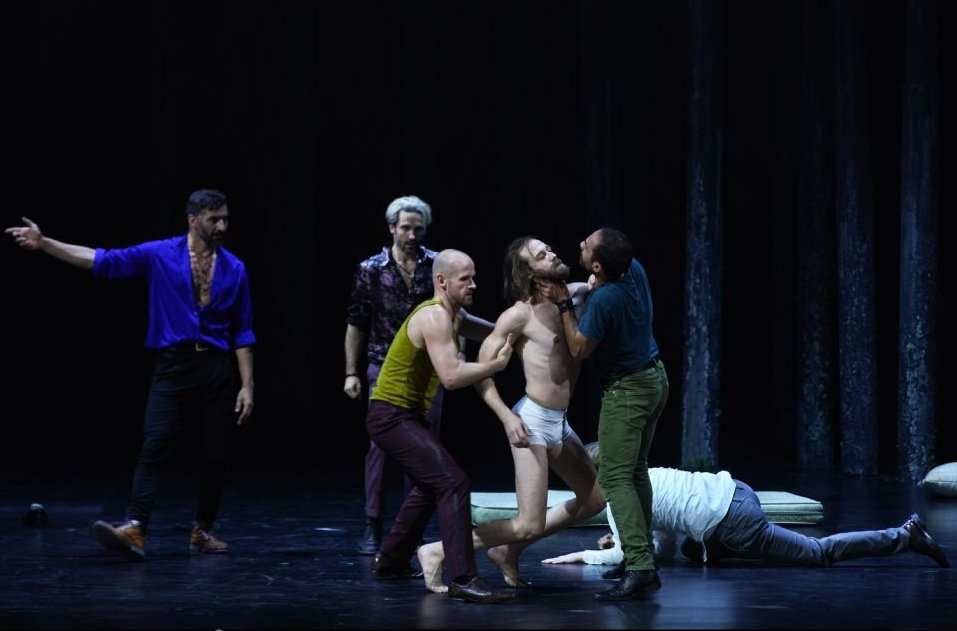
This time, the production comes from the Basel Opera, directed by Christof Loy, a regular at the Teatro Real. This combination of ballet and opera features a dark and minimalist production that has garnered little enthusiasm both from critics and audiences. The Miraculous Mandarin is a pantomime ballet about the story of a woman forced into prostitution by three pimps, meeting a mandarin falls in love with her, only to be killed, dying in his beloved's arms. At the time, it was so scandalous at its premiere in Cologne in 1926 that the then-mayor, Konrad Adenauer, banned performances for being immoral. In this version, the story continues; their love proves stronger than death, and he is ultimately resurrected. Both in this work and in Bluebeard's Castle, the stage is a vast emptiness, dominated by an old telephone booth, an old mattress, clothes strewn on the floor, a small pond, and, to the right, a sort of forest of wooden poles. Márton Agh's choreography seemed rather reduced, telling the story but expanding it with a possible homoerotic attraction of the pimps towards the mandarin, but with a not very attractive choreography, seeming more like a choreographed drama than a ballet. 

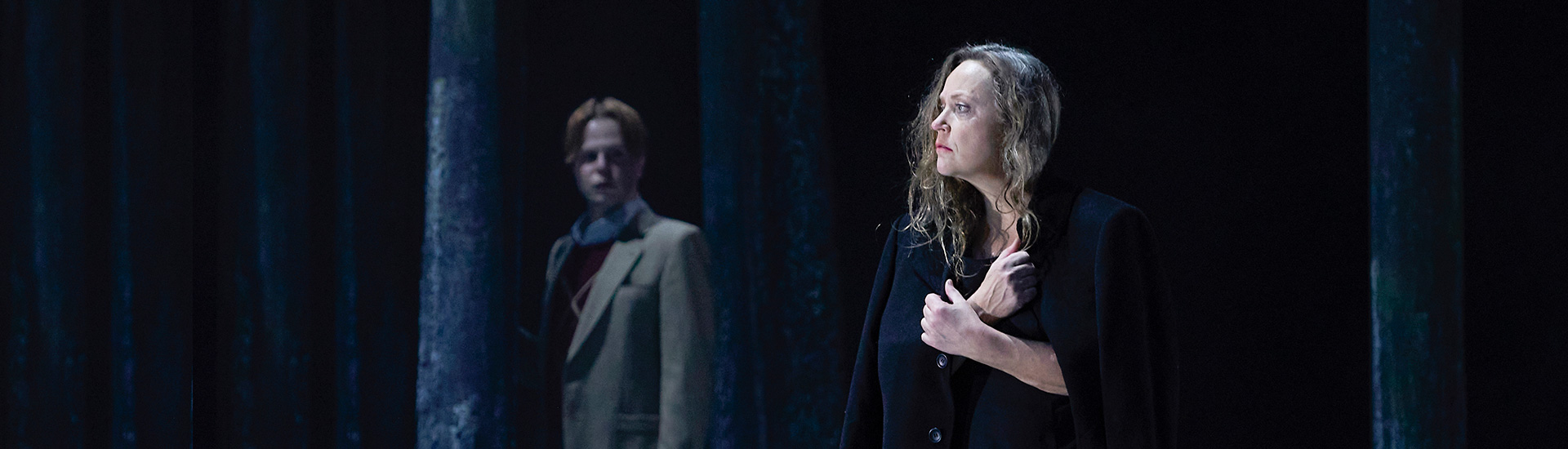
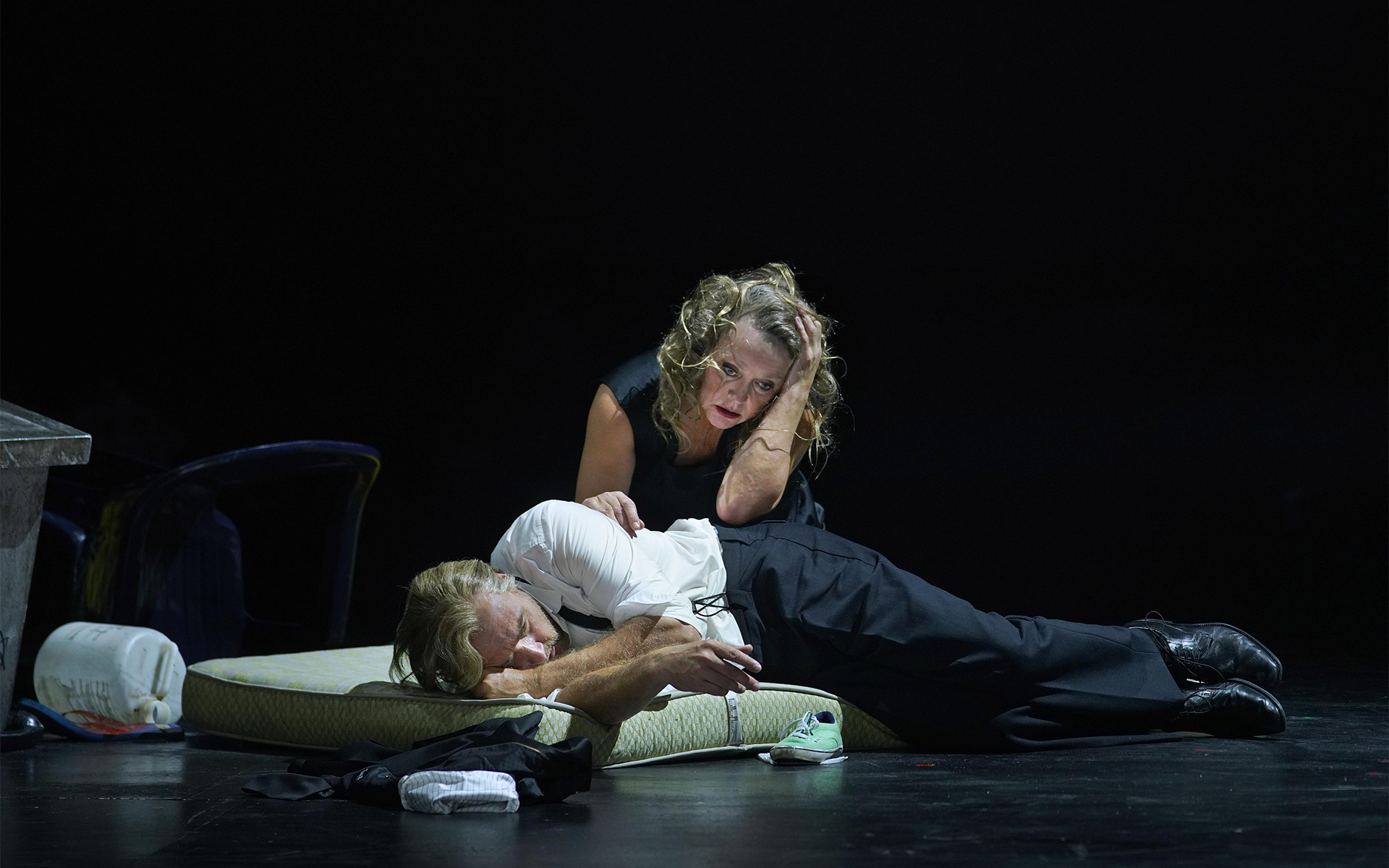
As for Bluebeard's Castle, it's a variation with a tragic ending on Perrault's tale, difficult to stage due to its constant set changes. Judith's curiosity to know what lies behind the seven doors of Bluebeard's gloomy castle will lead to her doom, making her a kind of "cousin" to Elsa in Lohengrin, but Bluebeard's secret is terrible, compared to the holy secret of the Wagnerian hero. To the challenge of how to represent this fairy tale, Loy's production has a simple, and simplistic, answer: darkness. The darkness of Bluebeard's castle, where no light enters. But here there are neither keys nor doors (which do appear in the trailer for the performances). The set is the same as in the previous play: now the phone booth appears almost completely buried, and the same things and the mattress are still scattered on the floor. There are no keys, no doors, nothing to suggest that they are in a castle or what lies behind each of the rooms. Only the two singers are present, dressed in black, as if their performance were meant to leave the magical atmosphere described in the music to the spectator's imagination, contrasting sharply with the absolute blackness of what is seen on stage. In fact, while the beautiful music of Bluebeard's treasure room plays, we see him placing his jacket on Judith and embracing her tenderly, and nothing else. Does the production intend for us to think that the castle rooms are actually the traumas and past experiences of the characters? Finally, under the watchful gaze of the narrator from the prologue, Judith sits gazing at the horizon, while the stage darkens and Bluebeard enters the trapdoor where the pond was in the previous play. 

Starting this season, Maestro Gustavo Gimeno will be the music director of the Teatro Real. The Valencian conductor takes the helm of the Teatro Real Orchestra, delivering a fine performance, although some harshness can be discerned in the clarinets and flutes in Bluebeard's Castle. Bartók's music is opulent and richly orchestrated, and both works have striking moments, such as the violin and celesta in the magical third gate scene of Bluebeard's, or the powerful music that evokes his dominions in the fifth gate scene. Despite the aforementioned limitations, the orchestra performed admirably.

Evelyn Herlitzius, a German soprano known for her powerful Wagnerian interpretations, celebrated more for her stage presence and vocal volume than for the beauty of her voice, has rarely sung in Spain. In Barcelona, ​​she sang in Die Walküre in 2008 and Elektra in 2016, the latter being her last appearance there, as she was unable to sing in the Liceu's Lohengrin, scheduled for 2020 (and finally premiered in March of this year, but with Okka von der Damerau and Miina-Liisa Värelä taking her role), due to the Covid-19 pandemic that forced the theater to close. In 2007 she sang in Verdi's Oberto in Bilbao. In 2009 she sang Isolde in Seville, and the brief role of Venus in Tannhäuser in Las Palmas de Gran Canaria. However, this is her Madrid debut. At 62, Herlitzius's stage presence remains undiminished. She's a performer who fully immerses herself in the strong-willed heroines she portrays. Although her voice is now mature, and she may have lost some volume due to the repertoire she's undertaken throughout her career (roles like Elektra, where she's a benchmark, Brunhilde, or Isolde), her passionate performing style remains untouched. She still possesses some powerful and impressive high notes, her low notes are equally remarkable and perfectly suited to the tormented character, and her middle register still sounds remarkably. Furthermore, in every phrase, one senses the character's fragility and dangerous curiosity, in a total commitment to the drama. In fact, I wondered if she still sounded the same as on recordings from her prime. Just seeing her on stage makes this production a must. It's a pity she hadn't sung here before, specially her signature roles.

Alongside her, the bass Christoph Fischesser, who has been seen before on this stage in Capriccio and The Magic Flute, was also a well-sung Bluebeard, with a pleasant timbre.

I can add little, given my ignorance of the subject, and the fact that most of what happened took place in the corner of the stage I couldn't see, regarding the group of dancers in the first part, except that their beautiful bodies tried to tell the story, within the limitations of the limited choreography. Nor can I say much about the Hungarian introductions recited by the Dutch actor Nicolas Franciscus, except to express my gratitude that the Bluebeard is presented in its entirety.

I wouldn't say that Mr. Loy won over the audience this time, nor that this is his best work, as the atmosphere didn't suit the beautiful, descriptive music, turning what should have been evocative and magical into something tedious. This was especially true in Bluebeard's Castle, where the lack of atmosphere was even more jarring, prompting one to wonder if a concert version wouldn't have been more honest. Despite this, there were generous ovations for both singers, as well as for the ballet company. This has been (as the last performance took place yesterday) a unique opportunity to see Bela Bartók's brilliant stage work performed in Madrid, but I hope it returns with a better production.


My reviews are not professional and express only my opinions. As a non English native speaker I apologise for any mistake.

Most of the photographs are from the internet and belong to its authors. My use of them is only cultural. If someone is uncomfortable with their use, just notify it to me.

lunes, 10 de noviembre de 2025

Mágica música, negra atmósfera: El Castillo de Barbazul en el Teatro Real.


Madrid, 8 de noviembre de 2025.

Al Teatro Real le da muchas veces por hacer ciclos operísticos. Este año hay un ciclo entorno a Barbazul, y otro a Shakespeare. En lo concerniente al primero, tendremos dos clásicos de dos autores del siglo XX: El Castillo de Barbazul, en programa doble con El mandarín maravilloso, ambos de Bela Bartók, y Ariadna y Barbazul, de Paul Dukas. Este mes tenemos el programa doble en cartel. Bartók es uno de los compositores más populares del siglo XX, y uno de los que más hizo por el estudio y la difusión de la música regional centroeuropea en su tiempo. Nunca antes se ha representado esta ópera en el Teatro Real. En 2018, se vio interpretado en concierto por la Orquesta Nacional de España en el Auditorio Nacional, dirigida por David Afkham, con Elena Zhidkova y Bálint Szabó; y también en concierto ese mismo año por la Orquesta de Radio Televisión Española, bajo la batuta de Miguel Ángel Gómez-Martínez, con Vladimir Chernov y Ana Ibarra. Dada su corta duración, viene precedida en la primera parte por una coreografía del ballet pantomima "El Mandarín Maravilloso", que incluye también el primer movimiento de la Música para cuerda, percusión y celesta del mismo autor.

En esta ocasión se ha contado con una producción procedente de la Ópera de Basilea, dirigida escénicamente por Christof Loy, habitual en el Teatro Real. Este combinado de ballet y ópera viene con una producción oscura y minimalista, que ha despertado poco entusiasmo en crítica y público. El Mandarín Maravilloso es un ballet pantomima, sobre la historia de una mujer obligada por tres proxenetas a prostituirse, de la que se enamora un mandarín al que finalmente matan, y muriendo éste en brazos de su amada. En su tiempo, fue tan escandaloso en su estreno en Colonia en 1926, que el entonces alcalde Konrad Adenauer la prohibió por inmoral. En esta versión, la historia se prolonga, su amor resulta ser más fuerte que la muerte y él finalmente resucita. Tanto en esta obra como en la posterior, es un enorme vacío, presidido por una vieja cabina telefónica, un colchón viejo, ropas tiradas por el suelo, un pequeño estanque, y a la derecha, una suerte de bosque de palos de madera. La coreografía de Márton Agh parecía más bien reducida, contando la historia, pero ampliándola con una posible atracción homoerótica de los proxenetas hacia el mandarín, pero con una coreografía no muy atractiva, pareciendo más un drama coreografiado que un ballet. 

En cuanto a El Castillo de Barbazul, se trata de una variación con final trágico del cuento de Perrault, pero al parecer más cercano a la leyenda original, difícil de representar debido a sus contínuos cambios de ambientación. La curiosidad de Judit por saber qué hay detrás de las siete puertas detrás del tenebroso castillo de Barbazul, la llevará a su perdición, convirtiéndola en "prima hermana" de la Elsa de Lohengrin, solo que el secreto de Barbazul es terrible, frente al sagrado secreto del héroe wagneriano. Al reto de cómo representar este cuento de hadas, la producción de Loy tiene una respuesta simple, y simplista: oscuridad. La oscuridad del castillo de Barbazul, en la que no entra luz. Pero aquí no hay llaves ni puertas (que sí aparecen en el vídeo trailer de las funciones). El decorado es el mismo de la obra anterior: ahora la cabina de teléfono parece enterrada, y sigue habiendo las mismas cosas y el colchón desparramados por el suelo. No hay llaves, no hay puertas, no hay nada que sugiera que se esté en un castillo ni lo que hay detrás de cada una de las habitaciones. Solo están los dos cantantes, vestidos de negro, como si con su interpretación quisieran dejar a la imaginación del espectador los mágicos ambientes que se describen en la música, que contrasta con el negro absoluto de lo que se ve en escena. De hecho, mientras suena la bella música de la habitación de las riquezas de Barbazul, vemos cómo este le coloca su chaqueta a Judith y la abraza tiernamente, y nada más. ¿Querrá la producción hacernos pensar que las estancias del castillo son en realidad los traumas y experiencias pasadas de los personajes?  Al final, ante la atenta mirada del narrador del prólogo, Judit se sienta mirando al horizonte, mientras que el escenario se oscurece y Barbazul se adentra en la trampilla donde en la obra anterior estuvo el estanque. 

Desde esta temporada, el maestro Gustavo Gimeno será el director musical  del Teatro Real. El maestro valenciano se pone al frente de la Orquesta Titular del Teatro Real, para realizar un buen trabajo, aunque se puede advertir alguna estridencia en clarinetes y flautas en el Barbazul. La música de Bartók es opulenta y tiene una rica orquestación, además de que ambas obras tienen momentos impactantes, como el violín y la celesta en la mágica escena de la tercera puerta en el Barbazul o la poderosa música que evoca sus dominios en la escena de la quinta puerta. Pese a las mencionadas limitaciones, la orquesta cumplió notablemente.

Pocas veces en España ha cantado Evelyn Herlitzius, soprano alemana conocida por sus grandes interpretaciones wagnerianas, celebradas por su arrojo escénico y su volumen vocal, más que por la belleza de su voz. En Barcelona cantó en La Valquiria en 2008 y Elektra en 2016, siendo esta su última vez ya que no pudo cantar en el Lohengrin del Liceu previsto para 2020 (finalmente estrenado en marzo de este año), debido a la pandemia del Covid-19 que cerró el teatro. En Bilbao cantó en el Oberto de Verdi en 2007. En Sevilla cantó Tristán e Isolda en 2009 y el breve rol de Venus en Tannhäuser en Las Palmas también en ese año. Sin embargo, este es su debut en la capital, la cual parece habérsele resistido. A sus 62 años, Herlitzius mantiene intacto su magnetismo en escena, es una intérprete que se mete al cien por cien en los roles de heroínas fuertes que interpreta. Aunque vocalmente esté ya madura, y que puede haber perdido algo de volumen debido al repertorio asumido en su carrera (roles como Elektra, donde es referencial, Brunilda o Isolda), la señora mantiene el tipo. Aún tiene algún agudo potente e impresionante, el grave es igualmente apreciable y encaja en el perfil atormentado del personaje, y el centro aún se parece mucho al de sus días de gloria. Además en cada frase se siente la fragilidad y la curiosidad peligrosa del personaje, en una entrega total al drama. De hecho me preguntaba si aún seguiría sonando igual que en grabaciones. Solo por verla, ya era una cita ineludible esta producción. Una pena que no haya venido antes.

A su lado, el bajo Christoph Fischesser, al que se ha visto antes en este escenario en Capriccio y en la Flauta Mágica, fue también un Barbazul bien cantado, con un timbre agradable.

Poco puedo añadir, dada mi ignorancia sobre el tema, y que la mayoría de lo que pasaba sucedía en la esquina del escenario que no veía, sobre el conjunto de bailarines de la primera parte, salvo que sus bellos cuerpos trataban de contar la historia, dentro de lo que les permitía la reducida coreografía. Tampoco puedo decir mucho sobre las introducciones en húngaro recitadas por el actor holandés Nicolas Franciscus, salvo agradecer que en el Barbazul se ofrezca la obra en su integridad.


No diría que esta ocasión el señor Loy haya conquistado al público ni que este sea el mejor de sus trabajos, ya que el ambiente no casaba con la bella, descriptiva música; convirtiendo en aburrido algo que debería ser sugerente y mágico. Más aún en El Castillo de Barbazul, donde la falta de ambientación era aún más lacerante, lo que invitaba a reflexionar si no era más honesta una versión en concierto. Pese a todo, hubo ovaciones generosas a los dos cantantes, así como al cuerpo de ballet. Aun así, esta era una oportunidad única para ver representada en Madrid la genial obra escénica de Bela Bartók. Ojalá volviera con un montaje mejor.


Las fotografías y vídeos no son de mi autoría, si alguien se muestra disconforme con la publicación de cualquiera de ellas en este blog le pido que me lo haga saber inmediatamente. Cualquier reproducción de este texto necesita mi permiso.