
Madrid, February 10, 2026.
The Teatro Real is offering, in the last two seasons, a series of priceless concert performances of operas from Giuseppe Verdi's "anni di galera": those years of intense work, subjected to the demands of the theaters, but which, with Rossini retired and Bellini and Donizetti deceased, ultimately cemented his fame as Italy's most important composer. Last season, Attila and I Lombardi alla prima crociata, were presented in concert version, the latter magnificently presented. Now it is the turn of I Masnadieri , an opera premiered in London in 1847, whose opening performance was attended by Queen Victoria, her husband Albert, and the entire British aristocracy. Despite the success of that performance, whose cast featured the legendary singers such as Jenny Lind and Luigi Lablache, the work failed to make a place for itself in the repertoire. The story is based on the play The Robbers by Friedrich Schiller, one of Verdi's favorite authors, about the tragedy of a family: a student, Carlo, who chooses the life of a bandit after being tricked by his wicked and ambitious brother, who tells him that their father has disowned him, in order to get his father's possessions and the affections of Amelia, a beautiful young woman in love with Carlo. Schiller's story is a romantic melodrama that exposes the murkiness of the soul, fascinated Verdi, although the dramaturgy of this opera is implausible to modern audiences. But what does that matter if the music is beautiful?
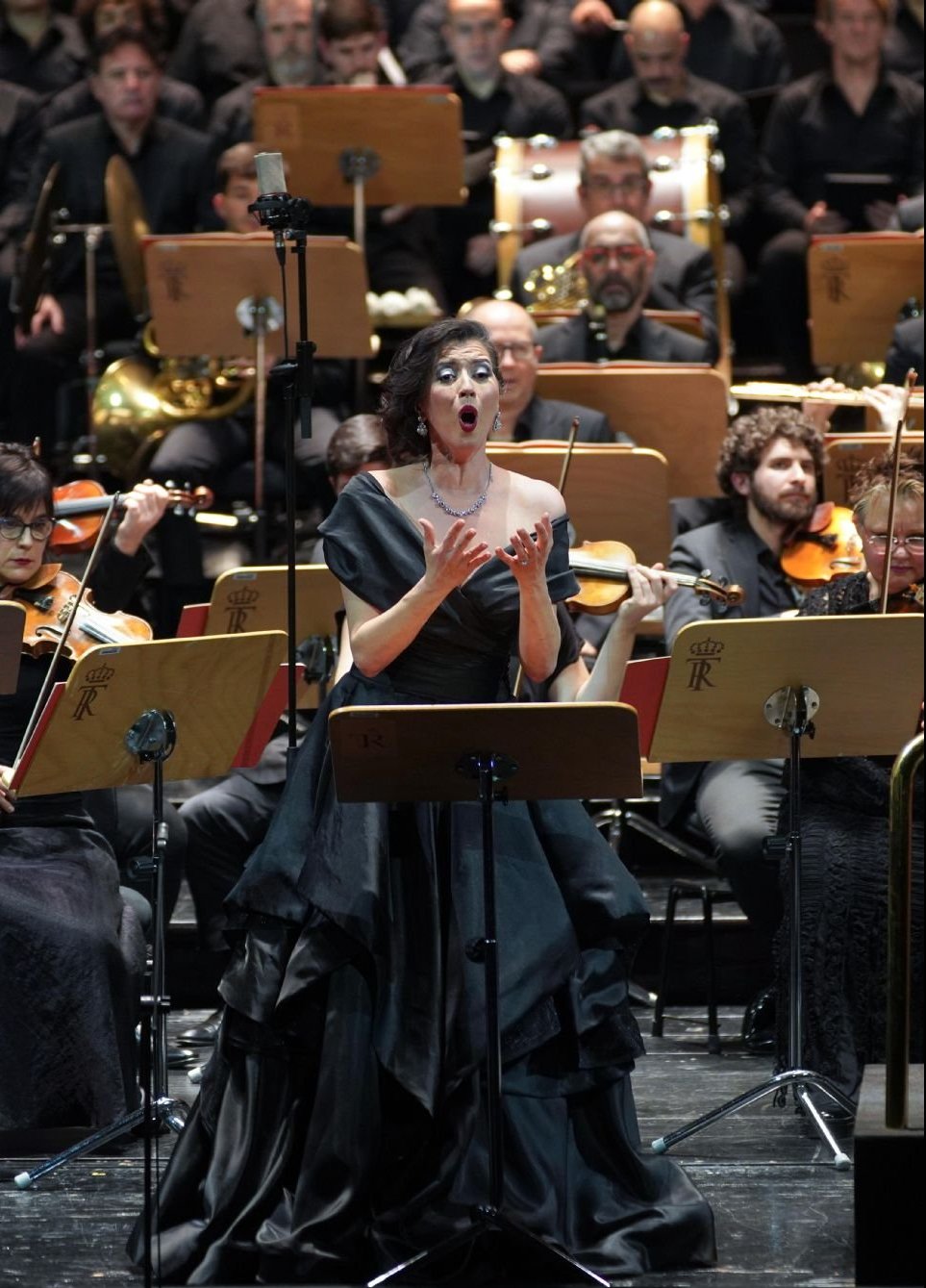
This opera was premiered at the Teatro Real in 1854, without much success, although its Madrid premiere took place shortly before, by a smaller company. Now it returns with two concert performances and an all-star cast led by the world-famed American soprano Lisette Oropesa, a favorite of the Madrid audiences, in the role of Amalia. Whenever Oropesa sings at the Teatro Real, the performance becomes a major event. Last night the theater was nearly full, and the main reason was her, with many familiar faces among the local opera-goers, including many of her admirers. Oropesa sang this role in 2019 at La Scala in Milan and at the Munich Opera in 2023, and now reprises it with a big success. At 42, she still possesses a fresh, beautiful, youthful-toned voice, with exquisite and spectacular high notes, excellent coloratura, and remarkable legato in all her appearances — all this enhanced by her stage presence and elegance. In her first aria "Lo sguardo avea degli angeli," despite the final high note, in which she had a moment of fragility, but that's only human. In all her other appearances, she was magnificent. The real delirium, however, came in her great scene in the second act. After a beautiful rendition of the aria "Tu del mio Carlo al seno," came the spectacular and lively cabaletta "Carlo vive," in which she displayed her impressive coloratura. After finishing the number, she received a long , outstanding ovation, and Oropesa encored the da capo of the cabaletta, a true gift for the ecstatic audience, displaying all her vocal pyrothecnics. In the second part, although the character doesn`t have as much solo scenes as in the previous ones ( but it still has nice moments such as the duet with Carlo), Oropesa maintained her excellent level. No wonder that she became the most applauded and ovationed at the end of the show.
If Oropesa was the main attraction of this performance, the rest of the cast, choir and orchestra weren't less shining.

I had never seen Piero Pretti live before. He is an Italian tenor who regularly performs at the Teatro Real, but mostly in second casts. I enjoyed his youthful voice and his very committed performance as Carlo, although it had its ups (for much of the performance) and downs (at times the orchestra drowned him out, and there were moments when his voice faltered). He was excellent in the first part and in the final act.
But the main male star in the show was undoubtedly the Italian baritone Nicola Alaimo (a last-minute replacement for the scheduled Mattia Olivieri), whose portrayal of the villainous Francesco was enhanced by his powerful voice. Alaimo managed to his voice above the orchestra, and his full vocal commitment contributed to creating a convincingly brutal portrait of the character. However, this didn't work in his favor when, in the duet with Amalia, he sounded rather rough when declaring his love for her, musically speaking. Every appearance by Alaimo was spectacular, especially his mad scene in Act Four, after which he received a thunderous applause, not only from the audience but also from the orchestra, whose strings struck their bows. The emotional impact of that moment culminated in a hug between him and the conductor.
As Count Massimiliano, Alexander Vinogradov went from less (with a vibrant and somewhat guttural voice) to more in the performance, culminating in a devoted rendition in the fourth act, where he shone alongside Pretti.
The rest of the cast completed the excellent performance: Alejandro del Cerro as Arminius and Albert Casals as Rolla were remarkable. George Anguladze, with his excellent voice and beautiful low notes in his brief portrayal of Moser, was able to make himself heard against an Alaimo who dominated the performance.
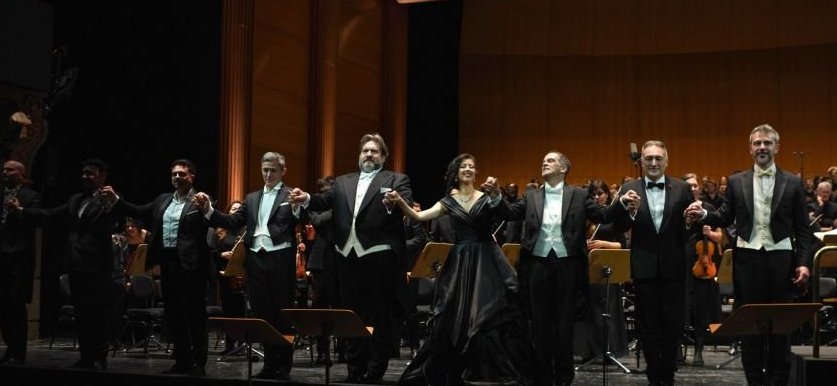
The inspiration was also evident in the orchestra. Maestro Francesco Lanzillotta delivered a powerful—and perhaps even a bit too loud—performance leading the Teatro Real Orchestra. The overture, with its beautiful cello solo played in this occasion by Simon Veis, was fine, but all sections of the orchestra stood for themselves in the following acts, resulting in an enjoyable performance that rose the passions of the plot: the strings, with their remarkable tremolos, and the brass, competing with the chorus, in power. In this work, the chorus portrays dark characters, and as such, their music is powerful. The Teatro Real Chorus, under the direction of José Luis Basso, gave an unforgettable performance, as passionate and electrifying as those of the soloists. From their very first appearance, they displayed vigor, even managing to overpower the orchestra. Since they are the ones who give the work its title, the male section strove to sound resounding in their portrayal of the violent thieves. The a cappella chorus from the second act, a festive, bacchanalian number, sounded breathtaking from both sections, conveying chills of how murky, libertine, Francesco's court is.

Performances like this confirm one's passion for opera, reconciling with the magic of performance if previously missed. Possibly, we the Madrileño operagoers haven't enjoyed ourselves as much as we did last night, in the current season. Because this is the repertoire that Madrid audiences love, and because this is the diva that Madrileños acclaim. And also because Verdi without passion isn't Verdi, even if it's a "minor" work, and we were given a brimming passion last night.

My reviews are not professional and express only my opinions. As a non English native speaker I apologise for any mistake.
Most of the photographs are from the internet and belong to its authors. My use of them is only cultural. If someone is uncomfortable with their use, just notify it to me.
Any reproduction of my text requires my permission.

It wasn't just the regular Madrid Opera goers, many travelled to be there. Lisette was simply outstanding and Nicola Alaimo was stunning in his mad scene and deserved his ovation. You are correct performances like this confirm the passion of opera it was a wonderful evening in the theatre and worth the trip from Ireland!
ResponderEliminarThank you for your comment! I supposed many people could have travelled as Lisette has fans worldwide. I hope you have enjoyed not only hers but also our orchestra and chorus' performances! They were amazing. I hope you liked this review and found as faithful as possible to the performance.
Eliminar