
Madrid, February 21, 2026.
The passion for Baroque opera is deeply rooted in Spain. Our theaters and concert halls are usually included in the European tours of major Baroque ensembles. Furthermore, operas by George Frideric Handel are regularly performed in Spanish major opera houses. In Madrid, several Handel operas have been staged in recent times, including Partenope, Orlando, and Theodora (the latter an oratorio) in the post-COVID years, at the Teatro Real, not to mention the opera concert performances that the Universo Barroco cycles bring to the Auditorio Nacional each year.
Of the forty-two operas composed by the Anglo-German genius, Giulio Cesare in Egitto (Julius Caesar in Egypt) is the most popular with audiences. The opera seria, a genre to which Giulio Cesare belongs, is often accused of being mostly a mere succession of beautiful and virtuosic arias, to the detriment of plot development. However, this opera transcends these conventions, despite complying them: all its arias are so beautiful that when one is cut to avoid lengthening the performance, there is always someone who laments it. It seems that none are superfluous: all of them brilliantly reflect, through beautiful music, the psychology and depth of those seemingly one-dimensional characters. In this way, the brilliant music blends seamlessly with the intricate plot of the recitatives, imbuing this opera with a level of theatricality unmatched by the composer's other works. Cleopatra is the most popular character, as her arias are the most beloved in the opera—a true tour de force for the greatest sopranos who have contributed to its widespread acclaim. In the last year, it was performed in Barcelona in 2025 with a production by the controversial Calixto Bieito, and at the end of the month it will be performed in Valencia next month with the legendary Marc Minkowski conducting.

At the Teatro Real, Giulio Cesare premiered there in 2002 in a staged production by Luca Ronconi, who placed the orchestra at the back of the stage, beneath enormous screens. The renowned Rinaldo Alessandrini was the conductor, and the leading couple was outstanding: Jennifer Larmore (possibly the best modern Giulio Cesare) and María Bayo. I was 14 at the time, and although I already liked Wagner, I ruled out going to those performances because I considered Baroque music boring and repetitive. But soon after, I heard this opera for the first time in René Jacobs's legendary version, and I regretted my decision to this day, because until these performances, it hadn't returned to the Teatro Real. However, it was seen twice in concert at the Auditorio Nacional: in 2008 by the Freiburg Baroque Orchestra with the legendary Jacobs conducting, and in 2021, when I was finally able to see it live for the first time, by La Cetra Barockorchester Basel, conducted by Andrea Marcon and with a brilliant cast.
Twenty-four years after those 2002 performances, Giulio Cesare returns to the Teatro Real with two concert version performances, on a tour that the famous orchestra Il Pomo d'Oro has been doing these weeks in Europe, its Spanish stops being Madrid, Barcelona and Oviedo.
Leading the orchestra is Maestro Francesco Corti. The performance presented the work with cuts, but still lasted almost four hours. The cuts, apart from affecting the recitatives, included Cesare's arias "Alma del Gran Pompeo" and "Quel Torrente," and Cleopatra's arias "Tu la mia Stella sei" and "Venere bella." As for the orchestral fragments, the music from the Parnassus in Act II, when Caesar sees Cleopatra in mythological costumes, was played only in its first half, and what I find most unforgivable, half of the famous interlude before the grand finale was omitted too, with only the first part performed, leaving out the beautiful horn fanfares and the reprise of the resounding piece. I must admit that I am conditioned by Jacobs's 1991 recording, because pieces like the overture sound better with more musicians, and such a clamorous piece sounded insignificant in this performance with a smaller ensemble. But in Handel's time, opera orchestras weren't so large.

If the opera had been performed in its entirety, two intermissions would have been necessary, and the performance would have ended at midnight. Corti conducted an orchestra that was generally at the highest level, especially from the aria "Empio dirò tu sei" onwards. The maestro incorporated flourishes, portamentos, and other effective tricks into his rendition. The strings sounded with all the opulence and dramatic tension they could convey, as in Sesto's aria " L'angue offeso". The horn had its moment to shine in the famous aria " Va Tacito e Nascosto ," though less so in the final interlude, as did the violin in "Se in fiorito." But even with that liveliness, the first half lasted almost twenty minutes longer than expected.
The cast that has been assembled for these two performances is one of the best possible nowadays.
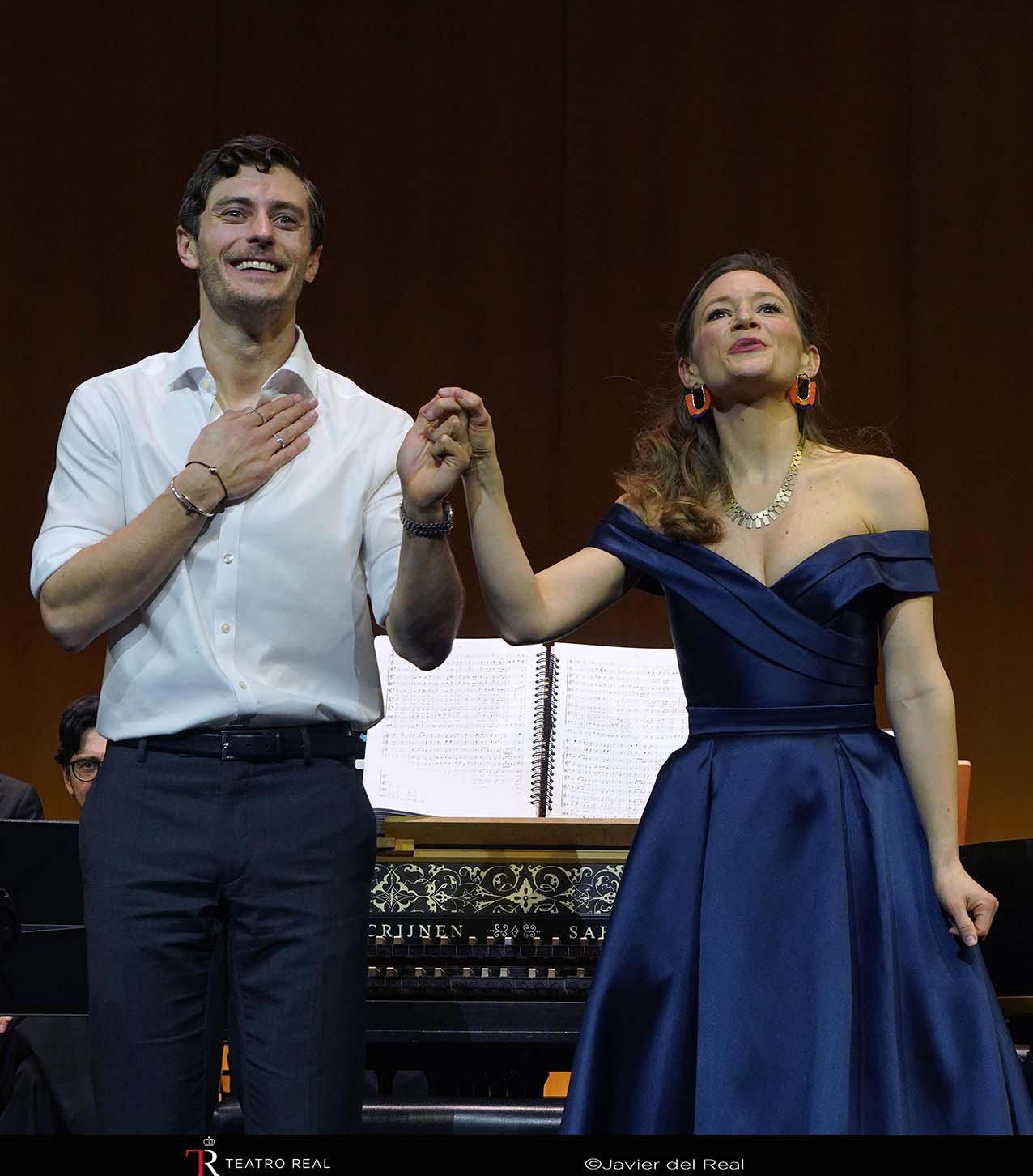
The star of the evening, as expected, was the French soprano Sabine Devieilhe as Cleopatra. As befits her role, she delivered the most cathartic moments of the night. Devieilhe showcased her powerful vocal pyrotechnics, adding high notes and portamentos of her own (just as was done in Handel's time) to make her portrayal of the character even more effective and impressive. All her interventions were a powerful display of her vocal resources, by her beautiful and exquisite voice. The highest point of the evening was her rendition of the Act II aria "Se pietà", a truly exquisite performance. This was followed in the second part by the opera's most famous aria, "Piangerò la sorte mia", in which she even ended the second stanza by sustaining the piano note until it flowed seamlessly into the da capo of the first one, creating a breathtaking effect. In the final duet, she seamlessly outcame Orliński's Cesare with her brilliant coloratura and stunning high notes.
The title role is that of Julius Caesar, the majestic Roman dictator. The role, first performed by the superstar castrato Senesino, demands vocal power from the singer, as his arias are the most important after Cleopatra's. The Polish countertenor Jakub Józef Orliński is one of the few young opera artists who have transcended the operatic stage, thanks to his angelic beauty, spectacular physique, and other artistic facets of his as a professional breakdancer and model for clothing brands, including the Polish edition of Vogue. As his operatic career is concerned, Mr. Orliński is one of the most important countertenors of the moment, possessing one of the most beautiful voices in his range. However, his portrayal of the Roman dictator had ups and downs. Besides the beauty of his voice, his mastery of coloratura, his powerful lower register, and his dramatic intent, are to be considered, sometimes reaching soaring vocal heights. However, his portrayal of the character often lacked authority, which affected bravura arias like "Empio dirò tu sei" and "Al lampo dell'armi", even though they were musically well-performed. The majestic " Va tacito e nascosto " and the delightful "Se in fiorito " (accompanied by bird sounds) were another matter, as in these he combined vocal virtuosity and beauty. His finest moment was the aria " Aure deh per pietà ," in which he delivered a beautiful and moving rendition.

The most outstanding performance of the evening, after Devieilhe's, was mezzo-soprano Beth Taylor's Cornelia , who reprised her magnificent 2021 performance at the Auditorio Nacional. Taylor not only possesses a beautiful voice with a lovely contralto timbre, but she also manages to turn her sorrowful and sensitive character into a strong tempered woman despite her captivity, thanks to her stage presence and her passionate performance in the recitatives, in which she was the most devoted member of the cast. Her renditions of "Priva son d'ogni conforto," of great beauty, and "Nel tuo seno" were delightful. And as five years ago, the melancholic aria "Deh piangete o mesti lumi " became one of the highlights of the show thanks to her deep, contralto timbre and powerful voice—the largest of the entire cast—which conveyed the character's pain.
Countertenor Yuriy Mynenko possesses a more appealing timbre than Orliński's, and his contralto voice is ideal for the role of Tolomeo though his vocal volume is smaller. Despite his efforts, he didn't truly shine until the second half. Against all odds, because it was omitted in previous performances, the second half opened with the exquisitely beautiful and intimate aria " Belle dee di questo core ," in which Mynenko conveyed all the sensuality, lasciviousness, and fragility of the character at this point in the opera, thanks to his beautiful singing. In what is perhaps the character's finest and final aria, "Domerò la tua fierezza ," he rose to the occasion, delivering a remarkable performance.
Soprano Rebecca Leggett was a Sesto with a beautiful voice and good singing, especially in arias like "Cara Speme" and "L'aura che spira".
American bass Alex Rosen , who sang an amazing Caronte in Monteverdi's Orfeo in 2022 , once again impressed with his powerful, resonant, and dark voice in the role of Achilla. Every time he appeared, it was impossible not to pay attention to him for this very reason, even though his timbre was sometimes a bit guttural. It was a shame that he wasn't applauded in most of his arias, although after his most important aria, "Dal Fulgor di questa spada", which he sang beautifully, the audience acknowledged him with enthusiastic applause.

Nireno and Curio are usually two characters who only recite and have no arias or duets, singing only in the choral sections, so they don't receive much attention. However, Nireno, as his mistress Cleopatra's sidekick, is important to the plot. In the 1730 revival, Handel composed a funny aria for him to open the second act, "Chi perde un momento". In the legendary 1991 recording by Jacobs and Larmore, the equally legendary countertenor Dominique Visse recorded the aria as an appendix on the final CD, in a benchmark performance. For all these reasons, in many current productions, this aria is performed to give the character some prominence. The French countertenor Rémy Brès-Feuillet, who showed comedic skills for the role in the recitatives, performed the aria well. Baritone Marco Saccardin in the role of Curio was adequate, but unfortunately he couldn't shine any more.

The popularity of this work, despite its length, was reflected in the fact that tickets were sold out for both performances, although there were some empty seats during the concert. Even so, the audience thoroughly enjoyed themselves, as the applause after Caesar's arias, and especially Cleopatra's, was enthusiastic. At the end of the performance, the entire cast was generously recognized with a strong applause, turning into standing ovations for Orliński and Devieilhe. It is wonderful that we were able to hear this operatic pinnacle so well performed, but it would be even better if the Teatro Real didn't stop there: if it is so clearly established that Giulio Cesare is the most popular Baroque opera, alongside Monteverdi's Orfeo and Purcell's Dido and Aeneas, the Teatro Real should consider staging it again. This is how the work truly comes alive in all its power, even if concert versions like this one, with their high quality, make us forget that for a moment.

My reviews are not professional and express only my opinions. As a non English native speaker I apologise for any mistake.
Most of the photographs are from the internet and belong to its authors. My use of them is only cultural. If someone is uncomfortable with their use, just notify it to me.
Any reproduction of my text requires my permission.

No hay comentarios:
Publicar un comentario