
Madrid, October 5, 2026.
Puccini achieved his first major success thanks to his perseverance. The popular story of the courtesan Manon Lescaut (in the classic novel written by Abbé Prévost), who sacrifices love for luxury and is ultimately deported to America, where she meets her death, had already been adapted into an opera by Daniel Auber, and into another one with much greater success by Jules Massenet. Puccini was captivated by the story, but encountered resistance from Ricordi, the great Italian opera publisher, precisely because of the success of the French version. However, the success this opera has enjoyed ever since (though not reaching the level of the maestro's four great works, and depending on the venue, not being performed as frequently) proves Puccini right; he sees Manon through his passionate, dramatic, and intense lens, accompanied by beautiful music.
In Madrid, Manon Lescaut is a complete rarity. It hasn't been performed at the Teatro Real since 1906, as Massenet's version was more popular. However, it was performed in 1978 at the Teatro de la Zarzuela with Plácido Domingo and Eva Marton. Since then, it hadn't been performed in the capital until now. Unconceivable, given the major productions of this opera around the world, including in Spain, as it was performed in Barcelona earlier this year, and even some time ago, the beautiful La Scala production by Liliana Cavalli was staged there. The closest thing Madrileños have had to seeing this opera in recent times were the excerpts performed by Anna Netrebko and Yusif Eyvazov in their concert in September 2024. Therefore, these performances, in a production from the Cologne Opera directed by Carlos Wagner , are a historic opportunity for local opera lovers. There's no longer any need to travel to see this opera.
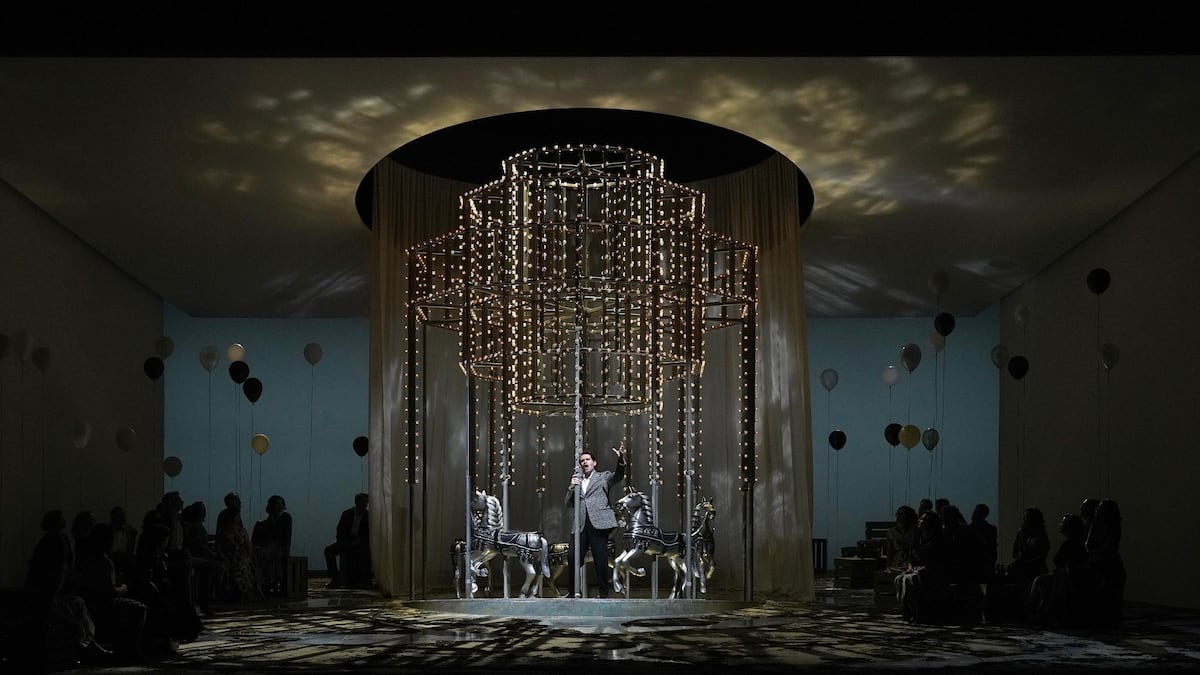
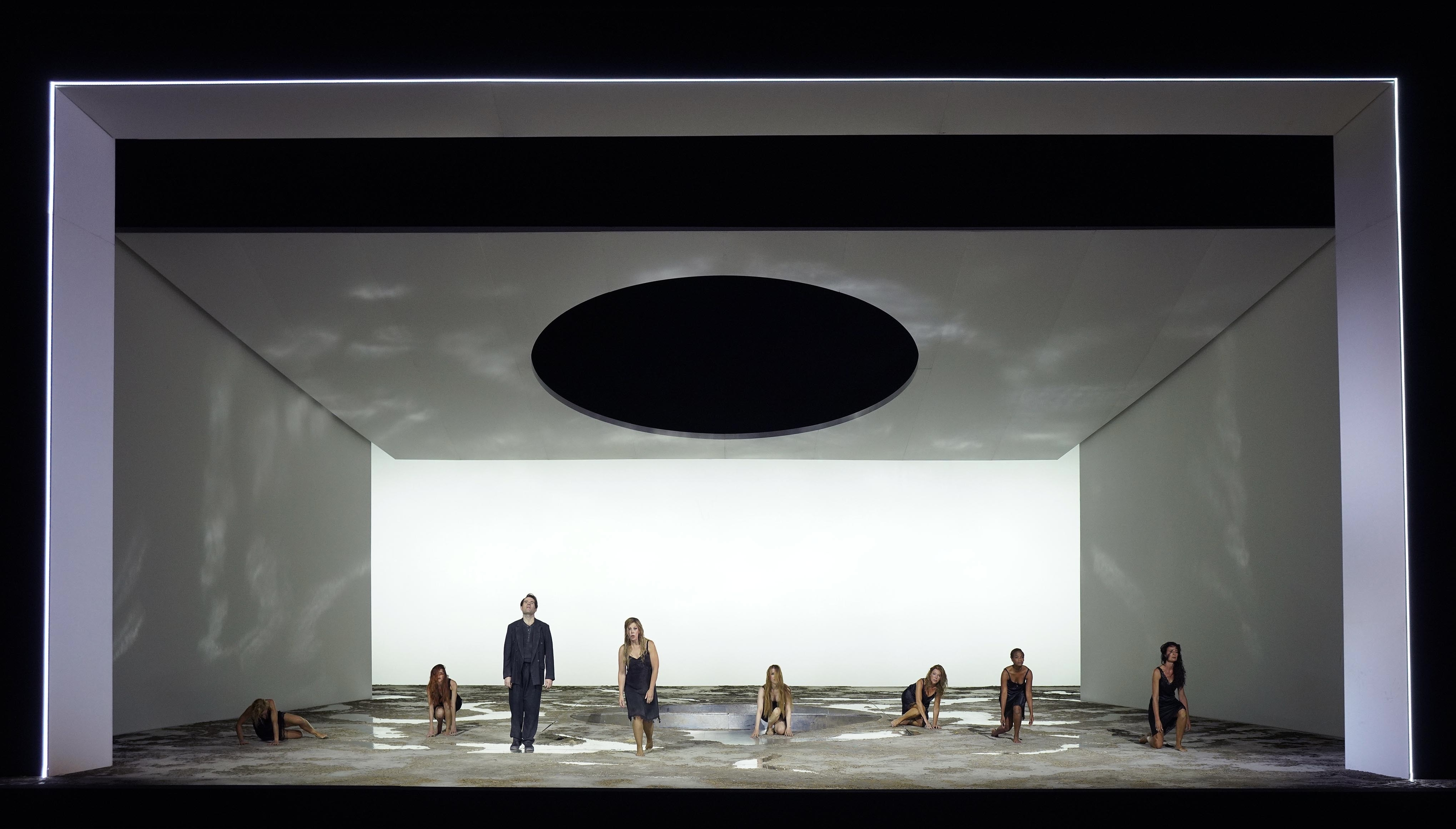
Mr. Wagner's production is visually striking, doesn't overly interfere with the action of the opera, and allows one to follow it without too many disruptions, although it does have its ups and downs, that is, some incomprehensible moments. The staging transports the action to the 1940s or 50s. The curtain rises, initially revealing a small stage: Edmondo is a singer, and on a small stage, in front of a microphone, he delivers his opening lines. Des Grieux does the same shortly after. Before Manon arrives, the curtain rises fully, revealing an enormous carousel. Manon makes her appearance, wearing a white dress that represents her initial purity, before life takes her down a different path. When the lovers escape, they board the carousel, which symbolizes their brief happiness before the tragedy. In the second act, we see Manon now provocatively dressed, transformed into De Revoir's mistress, with the complicity of her brother. Manon will dance sensually on a pole, alongside two male dancers, and then with a whole group of gentlemen, in a nod to the cabaret dance. In the third act, where the carousel once stood, there is now an enormous cage where Manon is imprisoned, awaiting deportation. The moment when the deported women are called one by one and undressed, leaving them only in black nightgowns, is particularly intense. During the performance of the famous Intermezzo, in a different location, ocean waves are projected, symbolizing the deportation. The final act depicts only the base of the carousel, while Manon and the other deportees, here a kind of evocation of her personality, advance alongside Des Grieux. Throughout the performance, the stage floor was decorated to appear waterlogged. Hence, it is puzzling that when Manon sends Des Grieux to fetch water, she suddenly sees her reflection in the supposed puddles and doesn't drink. It also makes little sense that Des Grieux sometimes embraces the other extras instead of Manon, or that he dies at the end of the play, shortly before she does. The theatrical intensity is there, but it doesn't fit the story at all.

At the helm of the Teatro Real Orchestra is the acclaimed Italian maestro Nicola Luisotti, who conducted it magnificently, making it sound intense from the very first moment. As in Trovatore a few months ago, the spectacular sound that Luisotti draws from the orchestra forces it to find its place and challenge the performers. Of course, this means that on more than a few occasions the singers are drowned out by the exuberant sonic tapestry of this work. The performances of the cellos and the solo viola in the symphonic interlude, by Ms. Olga González , were particularly noteworthy; she was fantastic. The Teatro Real Chorus, under the direction of José Luis Basso, dominated in all its appearances, overcoming the powerful orchestra beneath them: thus, the female section shone in the first act. Once again, we see this chorus, which, in addition to singing, acts brilliantly: their performances in the third act, when the women are deported, are heartbreaking.
Two casts were initially assembled for these performances, which have been modified more than once. Firstly, tenor Brian Jagde was slated to sing Des Grieux in the first cast, but due to health reasons, he had to withdraw from the production. His duties were then taken over by the American tenor Michael Fabiano, originally slated for the second cast. This would have featured one of the most acclaimed artistic pairings in this repertoire: Fabiano himself and the American soprano Sondra Radvanovsky, a beloved figure to the Teatro Real audiences. However, it was announced that due to illness of the soprano in the second cast, Saioa Hernández, Radvanovsky would be singing her scheduled performances on the 3rd and 6th of this month. Therefore, tonight's performance, originally intended for the American singer, was taken over by a rising star, the German soprano (daughter of an Albanian mother and a Bolivian father) Carolina López Moreno.
Those of us who went to tonight's performance were utterly disappointed by the news. In fact, I only found out as soon as I got my hands on the program. I haven't felt this angry since the same thing happened to me in 2007, when I learned that Francisco Casanova was replacing Roberto Alagna in Il Trovatore, just as I opened the program after settling into my seat.
Without Radvanovsky, Fabiano and the orchestra took over the performance. The American tenor, a regular at the Teatro Real, once again impressed with his powerful voice, possessing a more dramatic timbre and generous volume. Despite some difficulties in the first act with some high notes, he began to take control and sing beautifully from the famous aria "Donna non vidi mai ," to the end of the performance. His rendition was heart-wrenching and intensely sung, as in "O tentatrice, È questo l'antico fascino" in the second act, or his utterly moving plea at the end of the third, or in the final duet, desperately exclaiming "un soccorso, un soccorso"... completely convincing. It is a pleasure to see this tenor give his all on stage, especially in Puccini, his specialty.
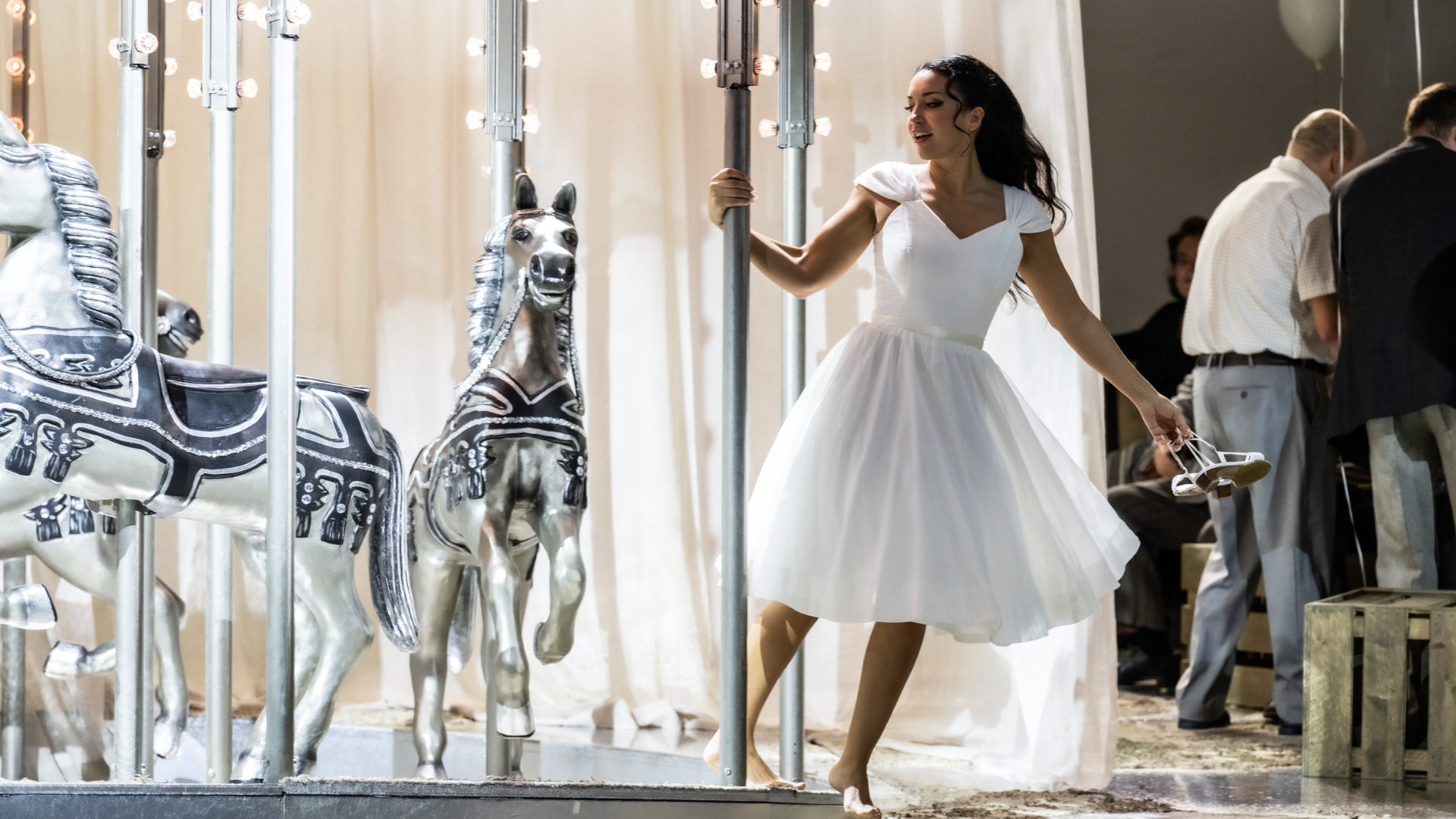
López Moreno premiered this production in Cologne, so there couldn't have been an easier replacement. This German soprano is, as I've already mentioned, a rising star: she has sung successfully in Barcelona, Verona, and Rome, among other theaters; she has also recorded the original version of Cavalleria Rusticana with Thomas Hengelbrock. Physically, she is also an excellent choice, being a young, very beautiful woman with a spectacular physique, ideal for the production. Vocally, she is a more sensitive performer, with a voice that has both lyrical and dramatic moments. In " In quelle trine morbide," she gave a rather intimate, lyrical performance, something she also did in her great final aria, " Sola, perduta, abbandonata ," from Act IV. However, the power of her voice was not always enough to overcome the orchestra behind her. One of her finest moments was in the third act, where she tackled the opening lines with a darker tone, "Tremo, pavento per te!…", ending with a heart-rending low note in "Tremo a un periglio che ignoto m'è", and in her farewell to Des Grieux before boarding the ship, "Des Grieux, fra poco lungi sarò…", where her voice again resonated with a beautiful dramatic timbre. The audience at the Teatro Real rewarded her effort with a standing ovation.
The rest of the cast was good, although they didn't have the same protagonism as the lead couple. Lucas Meachem was a well-singing and sardonic Lescaut, while Alejandro del Cerro was a competent Edmondo, though he was somewhat overshadowed by the orchestra at the beginning. The veteran Pietro Spagnoli was Geronte di Ravoir, in a comic performance with an audible voice. The cast also included the great Mikeldi Atxalandabaso as the dance instructor. Mercedes Gancedo had her moment to shine in her brief but beautiful appearance in the second act, which she handled very well.

The theater was very busy, but not full. Even so, the audience thoroughly enjoyed this beautiful opera, so well performed. There were great ovations for Fabiano, López Moreno, and Luisotti. A friend remarked that it was a difficult work to listen to, compared to the maestro's four great operas, but I found the music exquisite, foreshadowing what was to come in La Bohème and Tosca. We hope that another forty-eight years won't have to pass before we see it again at the Teatro Real: these performances have been a historic redress.


No hay comentarios:
Publicar un comentario