
Madrid, March 22, 2026.
For the past twelve years, the Teatro Real has offered Madrid audiences a cycle of Benjamin Britten operas, which, like the cycle dedicated to the operas of Léon Janaček two decades ago under the management of Antonio Moral, is proving to be a successful between critics and audiences. When the talents of stage director Deborah Warner and conductor Ivor Bolton, the Teatro Real's principal conductor until last season, have combined, the success has been even greater. In 2017, they presented a production of Billy Budd that has become a benchmark in the opera's discography. In 2021, they brought us a striking production of Peter Grimes reminiscent of the most social Ken Loach's films. Now, and hoping it's not a farewell, both British artists blend their talents again, in a season dedicated to Shakespeare, with A Midsummer Night's Dream, which Britten turned into an opera that premiered in 1960. This Shakespearean opera was already seen at the same Teatro Real in 2006, in a production by Pier Luigi Pizzi with Ion Marin conducting.
The works of William Shakespeare have fascinated the West for 400 years. And in opera, we have examples, the foremost being Verdi, who composed Macbeth, Otello, and Falstaff—three masterpieces. Rossini also had his Otello. Wagner based his opera Das Liebesverbot on Measure for Measure, and Ambroise Thomas composed his famous opera Hamlet, although it is not performed as frequently today as it once was. The magical, comical, and not-so-comedic A Midsummer Night's Dream has not escaped this fascination. Felix Mendelssohn made the most famous musical adaptation, even though it was incidental music for a theatrical performance of the play. The no less famous Carl Orff made his own adaptation for the stage, but it is primarily known for something ignoble: his music replaced Mendelssohn's classical score, which was banned by the Nazi terror because Mendelssohn was Jewish. But it is rarely heard outside of Germany, indeed it is a rarity even within German theatres itself. In more lyrical territory, Henry Purcell composed a semi-opera, The Fairy Queen, based on this work, which was recently performed at the Teatro Real. In 1960, as mentioned earlier, Benjamin Britten composed his own opera of the famous play, which has become the principal opera piece on this story. Even so, it is neither the most popular nor the most celebrated of his operatic catalogue. The music of the fairies' scenes is exceptionally beautiful, on par with his finest compositions. However, the lovers' part is not always of the same quality, and the comedy of "Pyramus and Thisby" works better in a theater than at home, where it would drag on in a single listen.
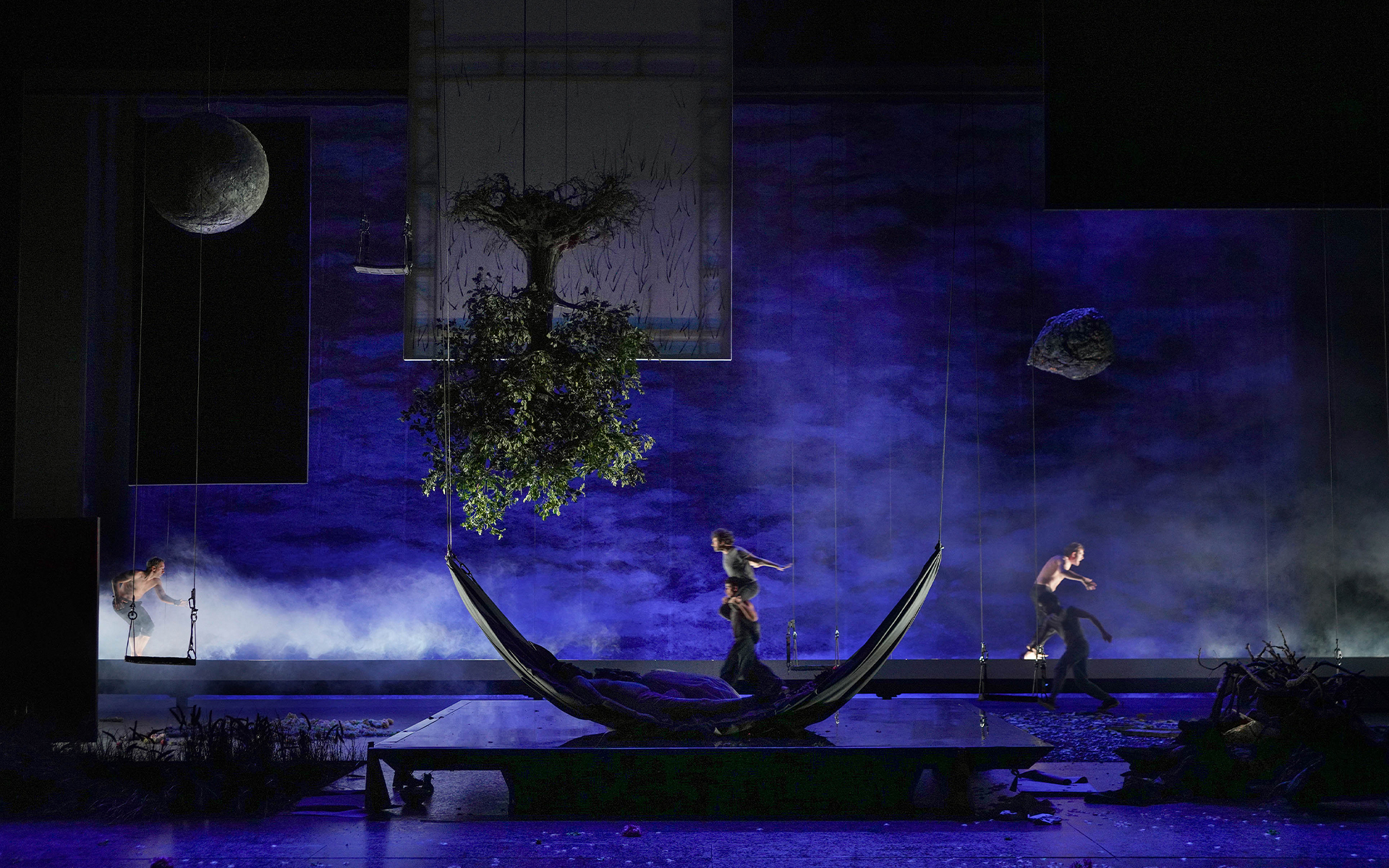
Deborah Warner's production has proven to be a success. The magic of the night and the forest is achieved with minimal set design, few props, but with excellent movement from the actors, singers, and dancers, as well as effective lighting.
Upon entering the theater, one is greeted by a blue curtain adorned with a shower of white stars, from beneath which the fairy children emerge, looking at the entering audiences. When the curtain rises, a vast platform is revealed on stage—a square with a shimmering floor. In the third act, this platform unfolds upwards, revealing a wooden interior that will serve as the stage for the play "Pyramus and Thisby". As in her other productions, Warner includes dancers who ascend and glide using flying harnesses and swings, respectively, as is the case with Puck and other fairy dancers. To one side of the square is a dark-colored lawn, and in the middle of the top of the stage, a hanging green bush hangs. The stage was illuminated with evocative navy blue and black colours, not too bright, to create a sense of night, which was successfully achieved. Luis Filipe Carvalho's costumes showcased the fairies—both the child singers and actors, as well as the dancers—in tutus that lit up, creating a magical effect. Titania and Bottom's bed is an enormous hammock covered in rose petals. The costumes are modern; the human actors are dressed as modern construction workers in hard hats and fluorescent vests, while the Athenians, Theseus, and Hippolyta (wearing a crown and a black dress, making her reminiscent of Queen Camilla) are in elegant evening gowns. The fact that the male lovers go shirtless adds to the play's eroticism. The direction of the actors is good, resulting in a hilarious scene.

Ivor Bolton returns to the Teatro Real as its former principal conductor. However, as always with Britten, his work leading the Teatro Real Orchestra was remarkable, with appropriate tempi (perhaps occasionally leaning towards the slower side) and drawing from them a sound that conveyed the magical atmosphere of the story and the score. The opening strings, specially with the mysterious sound of the double basses, were powerful from the very beginning. They maintained their high level in the beautiful end of the second act and the beginning of the third, to name just a few highlights. The other sections were equally good. The children's choir was delightful and endearing, although some voices were more prominent than others.

The cast of this opera is quite large, but it's also an ensemble piece. While some singers' musical contributions may stand out more than others, it's not a work for divas or divos (although Ileana Cotrubas did sing the role of Titania). Countertenor Iestyn Davies gave a solid performance as Oberon, and his voice was quite audible. Liv Redpath has a beautiful voice for Titania, who also has an important coloratura scene in the second act. Undoubtedly, the best singer from the cast was Bottom, sung by bass Clive Bayley, who replaced Simon Keenlyside. Bayley has a lovely voice, with its powerful timbre and considerable volume. But what stood out most was his comic interpretation of the character, giving it a grotesque and amusing touch that I wouldn't have paired with a gentleman like Keenlyside. From the rest of the cast, who were equally dedicated, Jacques Imbrailo as Demetrius, Thomas Oliemans as Theseus and Christine Rice as Hippolyta stand out, who also sang in the 2006 production. The character of Puck was played by the English actor Daniel Abelson , and by the dancer Juan Leiba , who spent half the performance suspended in the air.
While Oberon was singing his beautiful aria "Welcome Wanderer," there was a commotion in the upper balcony. Apparently, a woman stuck a candy in her throat, so a stir was caused in the mezzanine, as she required help. I remember another woman telling to her "just cough, just cough", and other people helping, but finally the problem was solved (she seems to have thrown or swallow the candy at the end, a friend told me) and the woman didn't need to move from her seat, continuing to see the performance. I felt like shouting for stopping the music for a moment because someone was in distress. But the problem was quickly resolved without any need to stop anything.

Although it wasn't Britten's most popular opera, and it certainly has its strengths and weaknesses, some of the people I spoke with enjoyed it. I'm glad I was able to give this work another chance, since twenty years ago, when it was my first Britten opera live, I found it quite boring. As the decades go by, having seen quite a few Britten operas, I can confirm that he is one of the great opera composers of the 20th century and that he appeals to both critics and audiences. And yesterday, I personally enjoyed this Shakespearean opera.


No hay comentarios:
Publicar un comentario