
Every performance of Wagner's Ring is a major event in the city where the opera house lies. However, it is truly unique when it takes place in the world's greatest temple of Italian opera: the Teatro alla Scala in Milan. Although it is the capital of Italian opera, La Scala can boast of a long Wagnerian tradition, even though until the Second World War it was primarily in Dante's language. In 1950, Wilhelm Furtwängler conducted the first major Ring cycle produced in Europe since the then recently concluded Second World War, with a legendary cast. And for the first time, it was performed at la Scala in German, which would become the norm from then on. In the 1960s, André Cluytens conducted a cycle. In the 1970s, Wolfgang Sawallisch took over, but Götterdämmerung was never staged. In the 1990s, Riccardo Muti conducted the orchestra. Between 2010 and 2013, it was performed in four separate seasons and in the latter year in its entirety in a single season to mark the composer's bicentenary. In that occasion, Argentinian maestro Daniel Barenboim conducted. Now, to commemorate the 150th anniversary of the Ring, the complete cycle is being performed again, although the individual operas have been presented separately since 2024. Wagner's epic returns to La Scala, this time with a production staged by David McVicar . From February to mid-March of this year, performances of Götterdämmerung were staged, followed by two complete cycles in a single week, as it should be performed.
The production, as expected from McVicar, feels rather classic. Certainly not classic in the Schenk's style from the 90s Met, but the action is recognizable and it doesn't take much effort to follow the plot. In this review, I am going to talk about the streamings of the separate operas, since I didn't attend any live performance. Between 2024 and 2026, each opera has been telecasted separately.
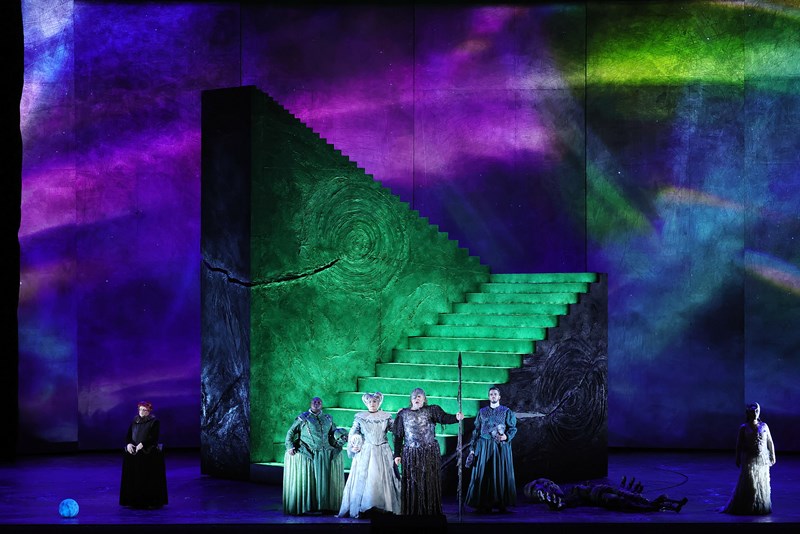
Das Rheingold blends a modern, at times minimalist, staging with Elizabethan-style costumes. The production prioritizes lighting and infrastructure over sets, though the latter are nonetheless impressive. A silver hand encircled by a silver ring is projected onto the curtain, which, when raised, reveals the Rhine, with the stage being dominated by three enormous hands upon which the Rhine maidens play. Alberich appears dressed as a Shakespearean jester, perhaps even Rigoletto, and the Rhinegold, magnificently illuminated in yellow, is represented by a dancer wearing a golden mask, which Alberich removes at the end of the scene. The second scene depicts a grand staircase, around which Loge and the gods appear in rich, flowing Elizabethan robes and masks. At least here the giants are truly giants: enormous, big-headed puppets, in which inside the singers are found. Nibelheim is an enormous skull, from which Alberich emerges and disappears, tormenting his Nibelungs and his brother Mime, also dressed as a jester. From it appear a huge serpent skeleton and a toad skeleton when Alberich uses the helmet to transform. In the Finale, the gods ascend the staircase, while a bloodied man, possibly the same one who appeared with the golden mask in the first scene, crawls across the stage.

Die Walküre progresses in its blend of fidelity and modernity. The aesthetic, quite tribal, harks back to the rustic original. In the first act, structures strongly reminiscent of an African tribal house are seen. In the center, a huge tree trunk has Nothung inside it. The characters have tattoos, accentuating their tribalism. Hunding is the same brute as always, treating his wife as a mere sex object. His men appear alongside him. In the second act, the set transforms into a dark place. A huge sphere, perhaps representing the world, is surrounded by enormous rocks. Grane appears as a horse-headed structure, manipulated by a shirtless actor. And so will the other Valkyries' horses. The third act features the most memorable scene: a beautiful starry night sky, with stars in orbital motion, and a stage dominated by a huge human face sculpted from rock. In the final scene, this rock opens to reveal a big hand, in which Brünnhilde will fall asleep, having been put on a mask and a shield. Wotan strikes his enormous spear, and a fire that changes color appears. Aided by men in long black skirts (his ravens?), he dresses a huge overcoat and a hat: the all-powerful god becomes the Wanderer, beginning his long, wandering journey across the world.

In Siegfried, the opera presents a gloomy and dark atmosphere, but it doesn't hinder the audience's understanding of the work. On this occasion, the traditional aesthetics are combined with the modern. Mime's cave, which in many ways seems to be a successor to Harry Kupfer's in Bayreuth, not because of a similarity but because of its aesthetic, has a punkish touch, with the dwarf wearing a leopard-print coat and sometimes high heels. Siegfried looks like a factory worker fresh from the factory. At least, a sword, anvil, and forge can be found. The second act, in my opinion, reveals to be a triumph. The forest is formed by a hybrid of bare trunks and skeletons, against a background illuminated in black and dark gray, creating a powerful atmosphere of darkness in the first scene. This forest is not beautiful; it is gloomy and frightening, cursed by the greed for gold guarded by Fafner, here taking the form of a large skeleton. Once again, we see the stagehands moving the dragon and the forest bird—here a small puppet—beside which stands the singer dressed in a punkish style. Alberich appears wearing a two-tone blue and red jacket and a toy crown, completely filthy, like a dethroned king. The third act is notable for its minimalism, creating a fantastical atmosphere. The scene of the Wanderer and Erda is presided over by an enormous balloon, which disappears when Siegfried arrives. The scene of the god and his heroic grandson takes place on an empty stage, now dominated by a huge projected circle that changes colors—a beautiful image created by the lighting. The Valkyrie's Rock is the same as in previous acts: an enormous hand upon which Brünhilde sleeps.

Götterdämmerung closes the cycle. On a theatrical level, it is a triumph, a visually spectacular result. The prologue shows the Norns with a great red rope, while the lighting creates beautiful atmospheres. When Siegfried departs from the Walkyries' rock, encouraged by Brünnhilde, she, upon hearing his horn, laments his departure. The scene in the palace of the Gibichungs consists of a central shield held by chains, two fetish heads hanging from it, and in the background, an enormous skull. The courtiers, as well as Gutrune, are dressed in gold. The first scene of the second act shows several of these fetishes hanging on enormous poles, around which Hagen and Alberich conspire during the night. The beautiful night lighting changes and appears resplendent in the second scene, with the entire court dressed in gold, the two main couples wearing golden masks, and the skeleton presiding over the scene, a foreshadowing of the death that will soon come for them all.

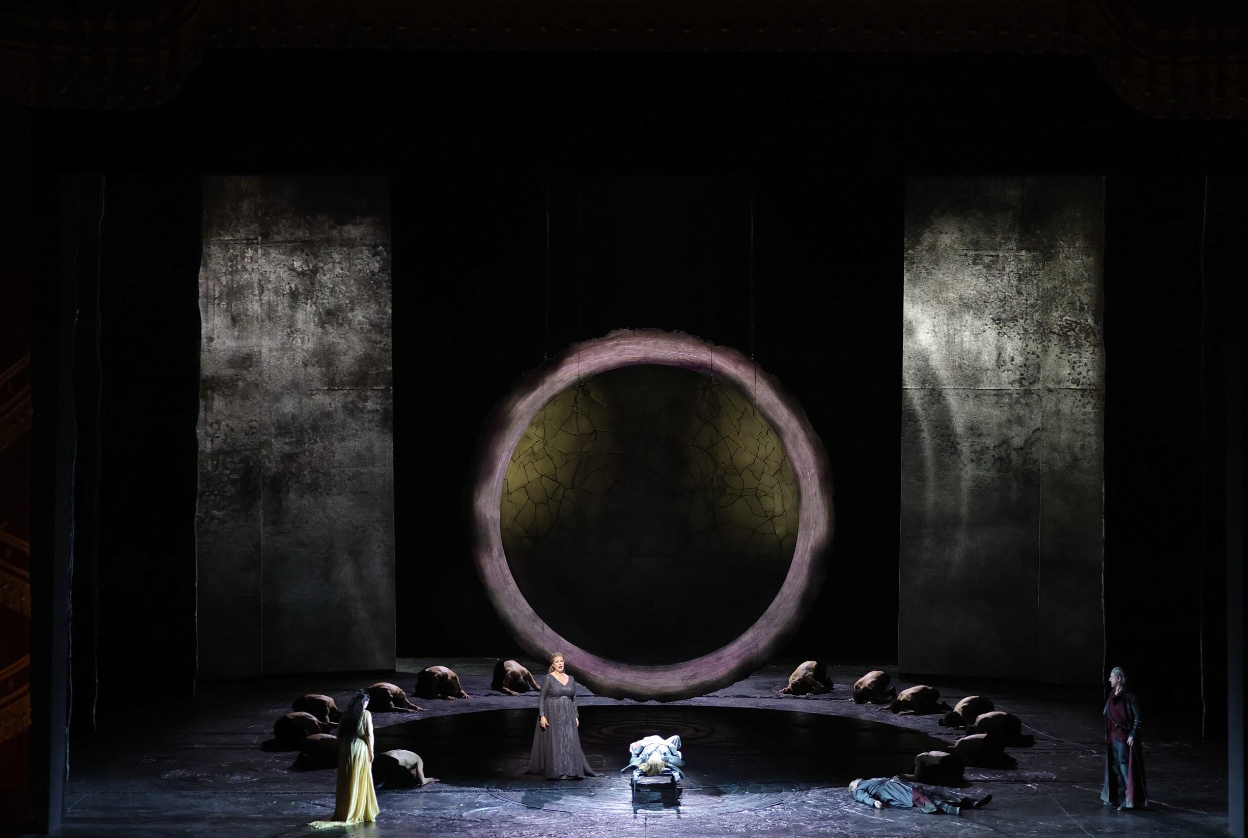
The third act is perhaps the best of the entire production. In the first scene, the Rhine maidens sing sadly and wistfully, while in the background the lighting projects a beautiful, moving blue, representing the river. Siegfried moves along the edge, illuminated in yellow, which represents the riverbank. As they leave, the curtain with the white ring is lowered, and for a brief moment, Siegfried, Gunther, and Hagen talk, until it rises and reveals the chorus. When Hagen kills Siegfried, everyone leaves, and he sings his beautiful farewell death scene alone. As the hero dies, in an empty stage, Siegmund and Sieglinde appear, mourning him as the funeral march sounds. Then, Wotan appears with his broken spear and joins the funeral procession: a family mourns their lost son, the end of their line. The curtain falls briefly, revealing enormous bars, before which Gutrune waits tensely. These bars rise as Hagen and Gunther enter with Siegfried's corpse, carried by a procession of semi-naked men in enormous black skirts, who assume a posture of mourning after leaving the body. Brünnhilde's monumental final scene begins with her entering in an imposing black gown. Towards the end of her monologue, fire animation is projected on stage, and she and the dancer representing Grane stay with Siegfried's body as a wall closes in around them. The stage lights up in blue, and the Rhinegold is seen, represented by a dancer as at the beginning, now wearing the mask that Alberich removed once, while the Rhinemaidens push Hagen away. Alberich then appears and tries to approach him, but fails and dies. The thrilling final note ends, and in absolute silence, the stage slowly darkens as the Rhinegold dances, radiant and finally free.

Simone Young is the first woman to achieve worldwide acclaim and fame as a Wagnerian conductor. At 65, the Australian female maestro has forged a career specializing in the German repertoire in general, and Wagnerian repertoire in particular. She has officially recorded the Ring Cycle for the OEHMS label, as well as a complete cycle of Anton Bruckner's symphonies. She has also recorded Hans Pfitzner's opera Palestrina on video. In 2024, she made a successful debut at the Bayreuth Festival, conducting the Ring Cycle under Valentin Schwarz's mediocre staging. She raised the bar for that production, which, after its withdrawal from the program at the end of the 2025 edition, will be missed by very few. This Scala production of the Ring Cycle, ten years after Daniel Barenboim conducted it on the same stage, should have had Christian Thielemann leading the orchestra. However, the Berlin-born conductor had to abandon the project due to health problems. Instead, both the individual performances, beginning in 2023, and the entire cycles presented this month, have featured two experienced Wagnerian conductors: one is Alexander Soddy, a rising star, and the other is Young herself, whose performance leading the La Scala Orchestra has been chosen to be immortalized on video.
In Das Rheingold, Ms. Young delivers a rather subdued performance, though the sound recording seems poor. The orchestra accompanies the singers with a slow rendition of the prelude. From the fourth scene onward, the orchestra raises the level, especially the strings. Except for a brief moment in the prelude, the brass section sounds superb. My only complaint is the fast tempos at the very end: the march with which the gods journey to their new abode loses its solemnity and majesty when conducted in this way. In contrast, in Die Walküre, either the engineer sound has improved or the orchestra seems more inspired: the strings give a fine performance of the agitated prelude to the first act, and the cello sounds magnificent. In the second act, the orchestra reaches its peak, with an excellent prelude, and the brass section is now in superb form. In the third act, the woodwinds play a melancholic interlude before the grand final duet, but the orchestra doesn't quite reach its full potential in the Magic Fire that closes the opera. In Siegfried, Young's orchestral direction builds steadily. In the second act, she delivers a brilliant rendition of the prelude, and the horn is magnificent in its solo. The third act is even better, from the electric prelude to the beautifully soft strings, almost piano-like, when Siegfried discovers that Brünnhilde is a woman, culminating in a remarkable performance. In Götterdämmerung, the orchestra reaches its peak of inspiration, and Young makes the sound even more spectacular. The performances of the most famous excerpts, such as Siegfried's Rhine Voyage and the Funeral March, are excellent, as are the preludes to the second and third acts, especially the latter, with a very special lyricism that the Italian orchestra has acquired from other, more familiar repertoires. A fitting way to close the cycle.

Michael Volle's voice sounds aged in Rheingold, but it improves midway through the opera, with a decent rendition of his aria "Abendlich strahlt der sonne auge." In Walküre, his voice, combined with his undeniable acting skills and excellent diction, improves considerably, especially in the long and poignant monologue of Act II, which he delivers with excellent and well-sung delivery. In Act III, his voice again sounds aged in the final farewell, but the performance is moving, and Volle gives a great portrayal of the god. As Siegfried's Wotan, he brings intention, experience, and stage presence. Even if the character could benefit from a bit of guttural vocalization given his age and experience, a touch of nobility is ultimately missed. Here, his Wotan is ironic and sardonic, rather than mysterious and temperamental.

Klaus Florian Vogt is the most sought-after Wagnerian tenor. Not because he is a heldentenor in the true sense of the word, but because his vocal resistance has allowed him, among other things, to tackle all the major tenor roles at the Bayreuth Festival, except for Loge (which he will sing this year), Tristan (which he has sung in Dresden), Erik, and Rienzi. His voice, with its light timbre but good projection, sounds youthful, though occasionally whitish, and could be ideal for Lohengrin, even Parsifal or Stolzing, but for the heroes of the Ring, it's another matter entirely. His Siegmund is rather in between: he has moments of lyricism, as in the second act, but in the first, he is quite uneven, except for Winterstürme, which he performs well, perhaps due to having honed the number through concerts and performances of this work. One of my concerns was seeing Vogt and Camilla Nylund as the lead couple in the cycle, because neither of them has an ideal voice for Siegfried and Brünnhilde, and the impression they give after hearing them is a textbook example of trying too hard. As Siegfried, he doesn't have the timbre for the great hero. His voice here sounds not only half-believable (as in Act II), but it ends up sounding rather bland in many moments. In the duets with Mime, his voice blends in with the dwarf's. His best moment is the Forest Murmurs, but however youthful his voice sounds, it's not enough for Siegfried. He improves slightly in Götterdämmerung, but his voice still falls short. As an actor, he somewhat compensates for his limitations, since his performance in Act III is sardonic; when he recounts his encounter with the water nymphs to Hagen and Gunther, he laughs incessantly like the mischievous young man he is. His character's death scene is very moving, when he smiles remembering Brunhilde. But it's important to remember something crucial: however beautiful, youthful, and lyrical his voice may be, it's not suitable for Siegfried.
Camilla Nylund is a soprano who gives it her all, but her voice never quite suits Brünnhilde. This voice began singing Elisabeth in Tannhäuser, where it is more appropriate. It's a lyrical interpretation, aiming for a dramatic sound. In Die Walküre, her vocal limitations and strengths complement each other, any limitation compensated by her stage presence, with a noticeable low register in the second and third acts. But if she had her ups and downs in Walküre, in the next opera she resorts to excessive vibrato and shouting, which makes her performance seem unbelievable: she seems to be scolding or haranguing Siegfried, instead of telling him how much she loves him, although in the final two minutes of the duet her attitude shifts from wary to a love ecstasy. In Götterdämmerung, she doesn't improve until the end: in the first two acts, she strains her lyrical voice, so her singing often ends on the verge of a shout. In her grand final scene she improves a little, as she performs it with solemnity, and her lyricism suits the more intimate moments well, but she is still not the right voice for Brünnhilde.

Elza van den Heever, on the other hand, is a powerful Sieglinde, with a darker, more dramatic timbre than Nylund's. Her performance is imposing. If they had swapped roles in Walküre, we would have won.
Günter Groissböck as Hunding in Walküre has a decent bass voice, but his acting is better. A deeper voice is needed, one that better reflects the brutality he brings to the role. However, as Hagen in Götterdämmerung, he improves considerably, not only because of the passion he brings to the character, but also because of his commitment to this equally brutal role (highlighted by his imposing and spectacular athletic physique). His musical performance in the third act is spectacular.
Olafur Sigurdarson, as Alberich, has a light voice for his role, which requires a deeper voice to better convey the character's malevolence. However, he compensates with his acting, creating a truly repulsive character. In Siegfried, he gives his all, embodying the character and conveying his rage and wickedness, but his lower register is lacking, resulting in a musically bland performance, making it hard to believe that he was once as powerful as Wotan. Although, he does fit the image of the vagabond that McVicar transforms the former lord of the Nibelungs into. But when Johannes Martin Kränzle sings the role in Götterdämmerung , the performance rises so dramatically that one thinks this veteran singer should have been the one to portray the dwarf throughout the entire cycle. His voice is fuller, deeper, and possesses a beautiful, dark timbre.

Okka von der Damerau is a well-sung Fricka in Das Rheingold; her light voice lends a touch of femininity to the matronly character, and she maintains the same level in Walküre. Norbert Ernst is a rather adequate Loge, with a more beautiful voice than is usually associated with the role, but he reminded me dangerously of Vogt, who will sing the role in Bayreuth. However, his performance seems more focused on singing well than acting, although with the cumbersome costume he wears, he can't do much. The veteran Wolfgang Abilinger-Sperrhacke is still a magnificent Mime after decades singing this role, thanks to his brilliant comic tenor voice and his amusingly repulsive and grotesque portrayal of the dwarf. The giants are sung by the basses Jongmin Park as Fasolt and Ain Anger as Fafner. The eminent Park is at his best, and it shows in his impeccable singing, with his dark and imposing deep bass voice. Anger's singing is good but not as Park's, but he acts better, very convincingly, and it even improves in Siegfried. Russell Braun, now a veteran, is an excellently sung and acted Gunther, with a beautiful baritone voice. The Swedish soprano Nina Stemme , the leading Brünnhilde of the last twenty years, who sang this role in the previous Ring cycle at La Scala under Barenboim, now sings Waltraute. Her voice shows considerable age, but the beautiful timbre she once possessed still shines through, despite her fatigue. Musically, she outshone Nylund in their 20-minute scene.

As for the other gods, they are all excellent: Siyabonga Maqungo with a lyrical and beautiful voice as Froh, André Schuen as an imposing Donner, and Olga Bezsmertna as a delightfully sung Freia. Bezsmertna reprises her role in Götterdämmerung as a well sung Gutrune. Christa Mayer is a nicely sung Erda, but lacks the necessary low register for the mythical character. Anna Kissjudit is much better as Siegfried, with her beautiful contralto voice—powerful, deep, and resonant—and as an actress, she conveys the character's confusion and unease. Francesca Sopromonte is surprising as the little bird of the woods, not only for her punk aesthetic reminiscent of Lisbeth Salander in Millennium, but also for her powerful and fleshy voice, far removed from the lightness and joviality of the coloratura or goldfinch sopranos who usually play this little character. As for the Rhinemaidens, Svetlina Stoyanova 's Wellgunde was particularly noteworthy . The Valkyries were all excellent. The Norns in were quite good, with Christa Mayer as the First Norn.

Once again, it was a pleasure to see The Ring again, even though it's a lengthy undertaking that always takes me about a month. I think McVicar's production, from which I expected more conservatism (I remember his beautiful Gloriana in Madrid in 2018), simply presents the play without any subplots that might make you think too much, which detracts somewhat from its entertainment value, but with a gothic and gloomy aesthetic. Even so, it's not bad at all to see a production that is somewhat reminiscent of the original drama, preferable to a modern, empty, and meaningless production. And if there's one thing this production has, it's its musical impact, leading one to think that it must have been even better live than on video.
I wish it would be shown in other theaters or in Bayreuth itself. I always thought McVicar could do a great Ring Cycle there.

No hay comentarios:
Publicar un comentario