
Madrid, May 30, 2026.
This season dedicated to William Shakespeare at the Teatro Real is reaching its conclusion, having offered, among other things, a delightful version of Benjamin Britten's A Midsummer Night's Dream last March, and Verdi's Otello in September. Now it's the turn of a classic opera, highly regarded by audiences and finely presented: Roméo et Juliette, by Charles Gounod, is coming to Madrid until mid-June. French opera has also provided examples of the fascination Shakespeare exerted: the main examples being this Gounod opera and Ambroise Thomas's Hamlet. The last time this opera was seen in the capital was in 2014 in a concert version with the legendary Roberto Alagna and Sonya Yoncheva, conducted by the legendary Michel Plasson. I almost went, but the opportunity didn't arise in the end, missing a unique chance to see the great French tenor in my city. However, I did have the opportunity to see this opera live once: in the spring of 2010, the much-missed Ópera Moncloa company performed it in the auditorium of the Complutense University's Faculty of Medicine, and later at the Moncloa Cultural Center. I don't recall being particularly impressed, except for the most famous aria, "Je veux vivre dans ce rêve," but I recognize that it is a charming work. And I have seen the great Juan Diego Flórez, a remarkable performer of this opera, singing the tenor aria "Ah, lève-toi soleil!" in several of his concerts. However, the Teatro Real didn't stage completely this opera since the 1910s!

Now it returns to the Teatro Real in a spectacular staging from the Paris Opera, directed by Thomas Jolly, dominated by an enormous and ever-present staircase, a replica of the one in the palatial Opéra Garnier in the French capital. It is also accompanied by a light show by Antoine Travert , which was booed on opening night because the flashing lights reflected off the upper levels of the theater for an extended period. It is claimed that this has been fixed. Another novelty is the choreography by Josepha Madoki , which employs the urban dance style known as waacking, creating a modern contrast to this classic story. The enormous, baroque staircase, crowned by a big gate at its top, is decorated with chandeliers. It is a revolving stage, and as mentioned before, it is present in every scene of the opera. The most intimate scenes, such as the wedding in Act III, the lovers' duet at the beginning of Act IV, and the tragic ending where Juliet lies and then the lovers fall to their deaths, take place in a boat located beneath the platform's pillars. The production has a classic feel, reinforced by Sylvette Dequest's costumes , for the first act. It then becomes more modern, but in no way jarring. As for the lighting, it becomes problematic in the festive first act, as the light show involves the entire auditorium. The lights in the third-tier boxes cast a swirling glow that circled the entire hall, and then the ball lights did the same. It wasn't exactly comfortable, despite its visual impact.
The beautiful music was conducted by Carlo Rizzi, leading the Orchestra of the Teatro Real . The maestro's conducting began a bit too loud, but gradually balanced out, achieving some beautiful orchestral introductions in Acts Two through Five. Even so, at times it overpowered the singers. The Teatro Real Choir, under the direction of José Luis Basso, once again demonstrated its excellent level. This chorus is capable of transitioning from powerful vigor to soft, breathtaking pianissimos, as its male members successfully did (something they are known for).
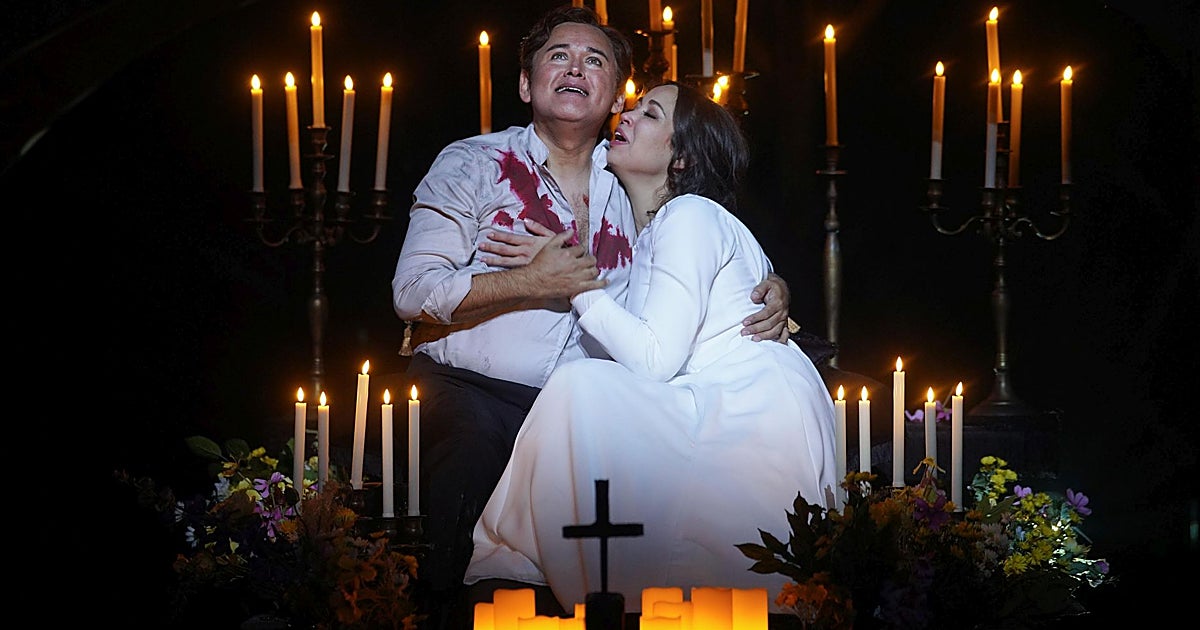
Two casts, including two Romeos and three Juliets, have been called for these performances. The first is the most anticipated, featuring two highly acclaimed artists, favorites both in the capital and aworldwide: American soprano Nadine Sierra and Mexican tenor Javier Camarena. Both singers have delighted Madrid audiences for years. Camarena, with performances in La Fille du Régiment, L'Elisir d'Amore, Lucia di Lammermoor, La Favorite, and I Puritani, has brought Madrid audiences to a state of ecstasy, requesting encores for the first three. Sierra enchanted Madrid with her successful 2022 production of La Sonnambula, and again in 2025 with a Traviata in which she sang an unforgettable third act, on both occasions alongside Xabier Anduaga.
In this performance, Sierra once again stole the show, displaying her full vocal prowess from the very beginning. Her breathtaking high notes, her dazzling coloratura, her ability to sustain notes, and her capacity to be heard throughout the theater were already present in the famous aria "Je veux vivre dans ce rêve," but these qualities not only remained but improved as the opera progressed. The highlight of the performance was undoubtedly the great poison scene and aria in Act IV, where she was absolutely magnificent, and the ovation afterwards was so outstanding that I even thought they would ask for an encore.
Camarena, for his part, improved throughout the performance. His rendition of the aria "Ah, lève-toi soleil" from the second act was gentle and very sensitive. From the third act onward, and specifically from the wedding scene, his voice reached its full potential, and the vigor he displayed from then on remained until the end of the performance. In the scene that closes the third act and ends with Tebaldo's death, his performance stood out for its dramatic intensity. He even finished with a powerful high note, which was unfortunately drowned out by the orchestra and chorus, but still perceivable. Another of the virtues of this voice is his ability to sing softly and exquisitely, as he did at the end of the second act. The chemistry with Sierra is evident, and thus in the duet of the fourth act, both acting and vocally, they conveyed a sweetly enamored couple. I would even say that in their scenes together, thanks to Sierra, Camarena shone.

As always, Roberto Tagliavini, the bass, is impressive as Frère Laurent, with his dark, fleshy and powerful voice, which conveys authority on stage.
In the rest of the large cast, we find the veteran Laurent Naouri as Capulet, Juliet's father, whose voice is quite worn, but still audible, and whose stage presence remains undiminished. The equally veteran Sonia Ganassi played the nurse Gertrude, also with a rather mature voice, though her lower register helps to portray the matronly nature of the character. Heloïse Mas stole the show in her brief scene thanks to her delightful rendition of Stephano's aria, sung with a deliciously rich voice. David Lagares also stood out with his imposing bass voice in his brief scenes as the Duke. Benjamin Appl and Maciej Kwaśnikowski were notable as Mercutio and Tybalt, respectively.

When an opera is well served, even with its flaws, enjoyment is always guaranteed. That was the feeling of the audience at the Teatro Real, which almost filled the hall, and confirmed Nadine Sierra as one of its favorite divas, rewarding her with a thunderous ovation. Performances continue until June 13, the last of which is to be telecasted to cultural centers, and on the MyOperaPlayer platform. I don't want to conclude my review without considering myself fortunate to have had the opportunity to see two stars, Camarena and Sierra, perform live at the height of their careers. This isn't the case with all major singers: Netrebko and Kaufmann have visited us in their later years. And we still await a full opera with Lise Davidsen, Jonathan Tetelman, or Benjamin Bernheim. So let's celebrate our fortune, then.

My reviews are not professional and express only my opinions. As a non English native speaker I apologise for any mistake.
Most of the photographs are from the internet and belong to its authors. My use of them is only cultural. If someone is uncomfortable with their use, just notify it to me.
Any reproduction of my text requires my permission.

No hay comentarios:
Publicar un comentario