
Madrid, June 29, 2026.
I've reached my 501th review (the honorary 500th is for the Spanish version), after almost nine years (it will turn in 25 days) of working in this blog. And I'm delighted that this number coincides with the summer's biggest opera event in Madrid, which is always a classic and popular opera. This year, that opera is Il Trovatore by Giuseppe Verdi, a true musical monument.
Verdi had a special connection with Spain. Several of his operas, such as Ernani, La Forza del Destino (whose Madrid premiere he attended), Don Carlo , and this Trovatore, are set in our country. Like Simon Boccanegra, this opera is an adaptation of a work by the Spanish Romantic playwright Antonio García Gutiérrez. The plot is explosive, a common feature of Romantic drama: a Gypsy woman loses her mother at the stake, accused of witchcraft. To avenge her, Azucena kidnaps the baby of the guilty man, the Count di Luna, and after mistakenly sacrificing her own son, believing him to be the child of her enemy, she ends up raising him as her own, naming him Manrico. Years later, the son of the old Count di Luna and his brother, the gypsy troubadour, vie for the affections of a beautiful woman, Leonora. Such a twisted plot is compensated by marvelous music, which requires a powerful quartet of lead singers, with celebrated arias and a famous gypsy chorus, in one of the most beloved operas, said to require the four best singers in the world. Azucena is the most compelling character in the plot, driving it with her tragic life and terrible revenge. Traumatized by the violent loss of her mother, from whom she could not even say goodbye, left alone in the world, this vengeful woman faces repeated exclusion: she is a woman, she is poor, and she is a gypsy. Although these circumstances do not exactly redeem this character, they do allow this outlandish drama to focus on something timeless: the pain of injustice for the loss of loved ones can lead us to unleash great tragedies and commit immense evil. Being an empoverished gypsy could be risky in 15th century, but still carries exclusion in the 21th century.
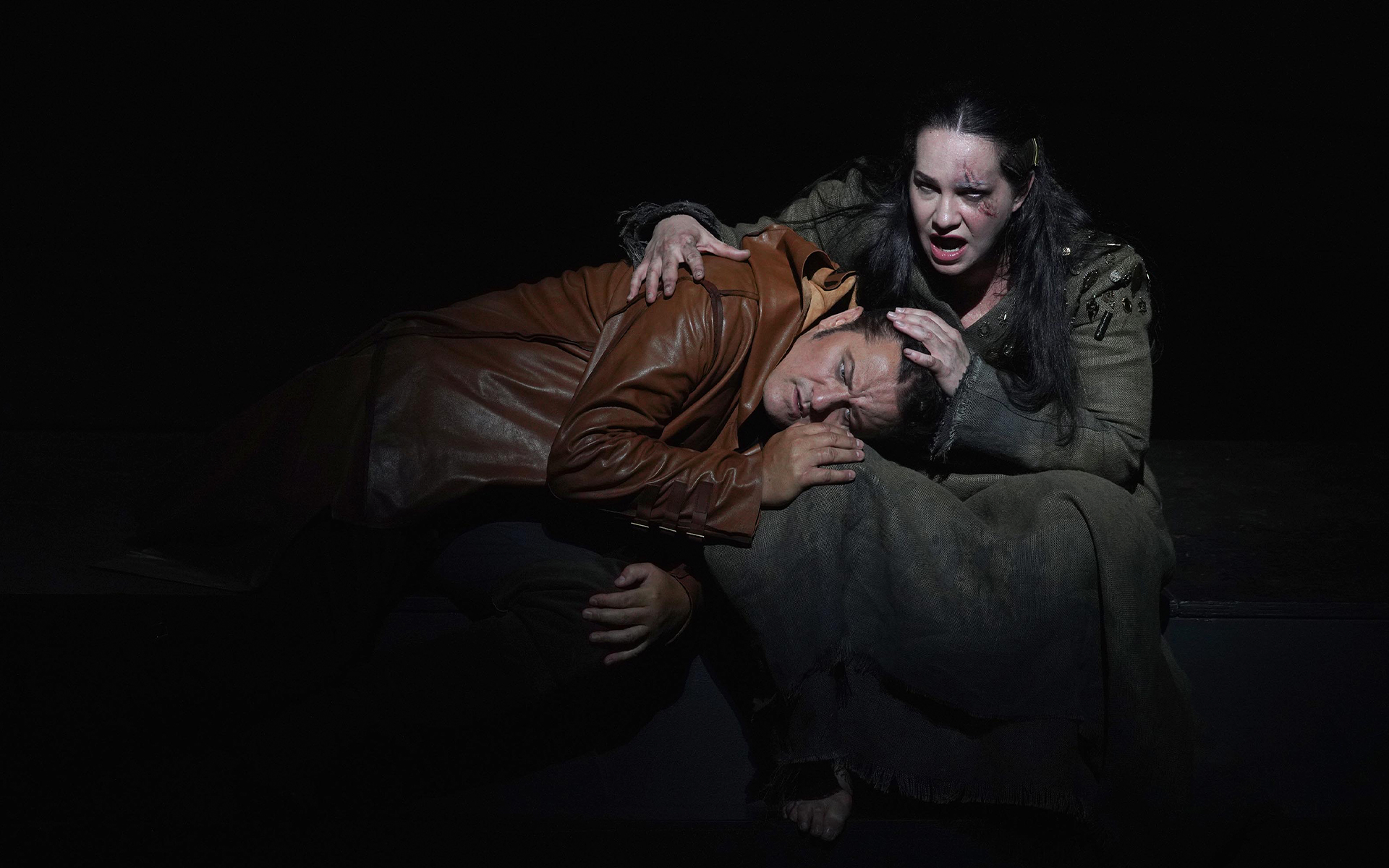
Verdi gives her two important numbers in the second act and a long duet with her son in the fourth, and she closes the opera by shouting "Sei vendicata, o madre" at the end of the second act. Il Trovatore is a recurring work in the Teatro Real schedules and the Madrid theaters that have programmed this opera throughout the 20th century. At the modern Teatro Real, it was seen in 2001, with José Cura, who was booed during the performance and had to withdraw from the production; in 2007, when I saw it for the first time, Roberto Alagna was scheduled to sing the role but ultimately canceled and was replaced by Francisco Casanova, accompanied by Fiorenza Cedolins and the legendary Dolora Zajick as Azucena. For this return, the staging Francisco Negrín is revived, which premiered here in 2019, characterized by its dark minimalism, although the aesthetics and setting do not distract from the main plot. To describe it, I refer to what I said in my review at the time, about the performance I saw with Francesco Meli, Lianna Harotounian, Ludovic Tezier and Ekaterina Semenchuk:
"Negrín's production pretends to show how the ghosts of the past are able to tie and determine fatally the destiny of the protagonists. For that reason, we see on stage the ghosts of Azucena's mother and son as relevant characters. The action takes place in a metallic, cold and dark space, intensifying the plot and making it more opressive and unbreathable. In the inner zones the chorus is placed, and the chorus remain unseen in many moments. There are two big poles making a cross in the scene, sometimes dividing properly the stage, for example in the convent scene. This raw minimalism tries to delve on Azucena's tragedy, but despite the effectiveness of the ghosts' apparitions, its coldness and ugliness can be boring and even irrelevant.
The scene begins with Azucena invocating the fire (emerging real flames from a table) ,and in the top of the scene, we see her mother. Then, we see Ferrando telling the story to some children around him. In the second Act we see in the gipsy chorus the men singing in their inner zones and the women making some gestures of witchcraft. We see Azucena's child. During most of the duets with Manrico, she sings to her child ghost than to her living adopted child. There is a costume contrast, with the Count's henchmen dressing in dark leather and Manrico's men dressing with brown leather. In the Act four, we see Azucena's mother holding Manrico and Leonora with a chain, before her daughter does. At the end, Azucena is moving a pole while to the middle of the scene while she asks for her son, and the fire is projected on stage and the flames emerging from the table for the last time."
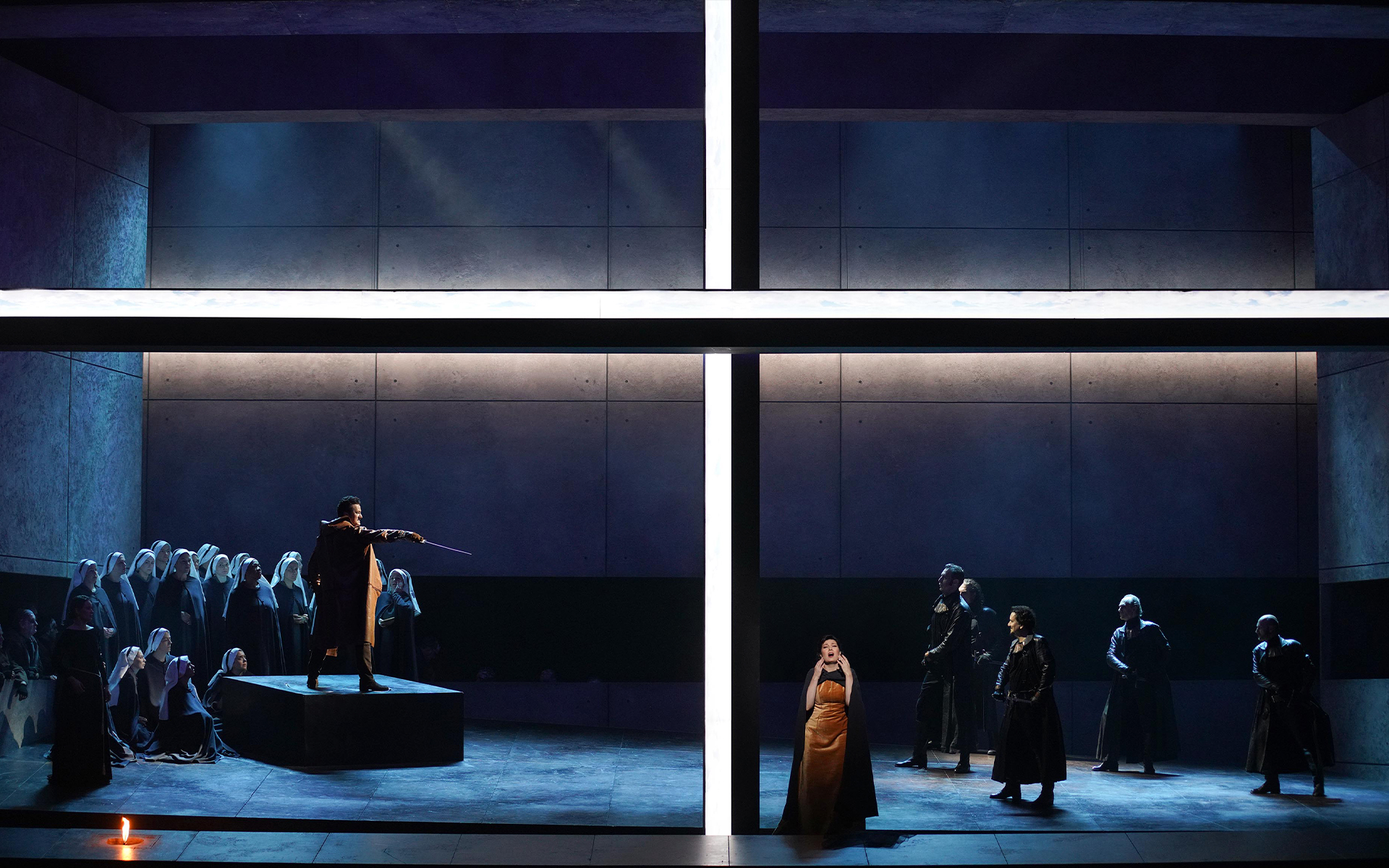
Seven years later, the production still has the same effect. It's not annoying, but it doesn't stand out either. It allows you to follow the story, but in a work with such a vibrant narrative of tension and intrigue, so much emptiness and darkness, rather than intensifying the action, actually slow it down. It feels like a soviet-realistic concrete paradise. The male gypsies seem to have been transformed into Nosferatu. The real fire emanating from that table is visually effective, but it soon becomes forgotten. It's not believable that in Act 2, while Leonora says she finally has Manrico by her side and still can't believe it, she's doing so while leaning against a column, from a considerable distance from him. Or that at the end of the opera, Azucena—and before her, her mother—pulls on a chain that Manrico and a dying Leonora are also pulling on, as a visual manifestation of how she now literally holds the reins of the story.
The Italian maestro Nicola Luisotti conducts the Teatro Real Orchestra in these performances, alternating with François López-Ferrer, son of Jesús López-Cobos, the legendary music director of the Teatro Real between 2002 and 2010. Luisotti conducted Il Trovatore at this same theater in 2007, and on this occasion, as usual, he delivers a passionate, powerful, and agile interpretation of the work. Luisotti doesn't simply coordinate the voices; he compels the orchestra to impose their sound. And he succeeds: theatrical tension is felt. The strings didn't sound subdued, but rather vigorous throughout the performance. The clarinet had its moments in Count di Luna's aria and in the beautiful yet somber introduction to Act IV. The Teatro Real Choir, led by José Luis Basso , experienced some difficulties in the first part. But this wasn't due to anything attributable to them, but rather to the challenging production. In the first act, the male section sang within the sets, which acted as a kind of prison, stifling their powerful sound—a limitation that affected the celebrated gypsy chorus in the second act. From the second scene of that act onward, the women finally appeared on stage, and sang the brief chorus of nuns in a marvelous pianissimo, almost like sacred music. At the beginning of the third act, the men were finally able to display their powerful voices and acting abilities.

Once again, several casts have been assembled to sing this great opera at the Teatro Real, a total of four ensembles featuring some of the finest voices of our time. In this review, we will examine the first one, and we will do the second one soon.
Polish tenor Piotr Beczała returned to the Teatro Real as a vigorous Manrico. I wouldn't call him perfect, but what he did deliver, he did with full vocal power. Even before he appeared, in the "Deserto sulla terra" that he sang offstage, his voice was exquisitely beautiful. He maintained this level of performance for almost the entire show, surviving the difficult "Ah sì ben mio" and the "Pira" in Act three. His musical and dramatic commitment was unwavering, and Act four was sung passionately.
Marina Rebeka is vocally in good form as Leonora, able to unleash powerful high notes and display some coloratura, but at the same time, she is musically cold. Thus, she was good in "Tacea la notte placida," but in the cabaletta "Di tale amor," she unleashed two spectacular high notes that astonished the audience. Then, in her great scene in Act IV, she again displayed her powerful high notes in "D'amor sull'ali rosee," but she was better at the end of the "Miserere" that follows the famous aria.
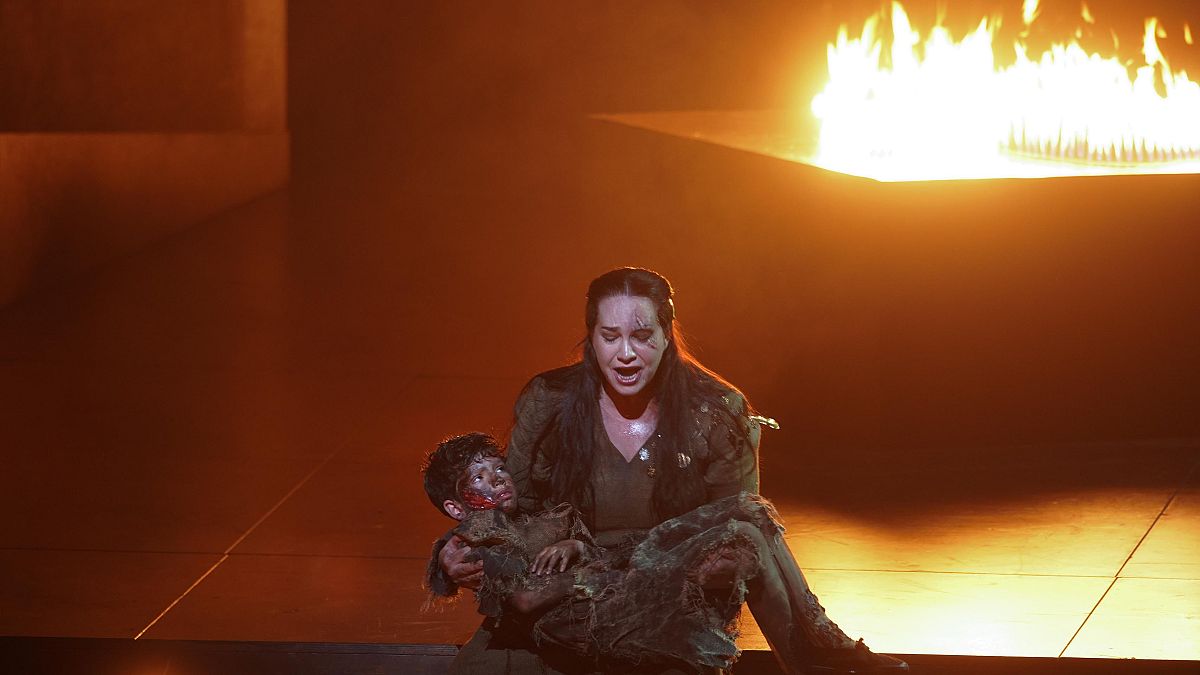
Ksenia Dudnikova was an excellent Azucena. Her voice filled the hall, sounding rich and full, and her low notes, typical of the Slavic school, were breathtaking. Her performance was musically stunning, although in "Stride la vampa," some of the high notes seemed a bit cried. It didn't detract a superb performance, which included an electrifying rendition of the aria "Condotta ell'era in ceppi."
Artur Ruciński, a regular at the Teatro Real, was a well-sung Count de Luna, a villain who musically displays a touch of nobility and beauty in his singing. His Count is a bad person, but not a repulsive brute; rather, he is an educated man consumed by resentment and hatred. His rendition of "Il Balen del suo sorriso" was beautiful, moving, and sung with sensitivity.
Krysztof Baczyk's Ferrando was sometimes difficult to hear. His voice was deep, but with a rough timbre. Rocío Faus sounded like a great Inés, with a beautiful voice for such a small role. The same can be said of the notable tenors Fabián Lara as Ruiz and Moisés Marín as the messenger, whose voices deserved more substantial roles.
As it was opening night, it was honored by the attendance from the local jet set, as the paparazzi camped outside, and the elegant cars lining up after the end of the show. However, the most important thing is that at the end of the performance, the theater was a party: the entire cast received standing ovations, especially Dudnikova, Rebeka, and Beczala, who got the loudest applause. Also, as is customary, there was almost unanimous booing of Negrín (I recently learned he was the great-grandson of the 1930s President Juan Negrín) and his team when they came out to take their bows.

Like in 2021 with their unforgettable performances of Tosca, which I think about when thinking about the three amazing casts called for this set, the Teatro Real is pleasing its audience with them. For the remaining casts, Saioa Hernández, Vittorio Grigòlo, Yusif Eyvazov, Anita Rachevilshvili or Juan Jesús Rodríguez will sing this opera. Sadly, Anna Netrebko has withdrawn from her four scheduled performances because of vocal fatigue. Nevertheless, the vocal feast will continue in Madrid until July 20.


No hay comentarios:
Publicar un comentario