
Every year that I comment on the live stream of the Bayreuth Festival's opening night, I celebrate another year of blogging. This year marks my ninth. For these nine years, I have tried, through this humble blog, to convey to readers the vibrant atmosphere of Madrid's operatic scene, hoping that in doing so, the world will learn a little more about the grandeur of the operatic productions in the capital, and the passion with which we Madrileños love opera. Once again, thanks to the generosity of the Bayreuth Festival, Stage+, German television, and finally the internet, millions of Wagnerians and music lovers around the world can enjoy the magic of each new production on the Green Hill, year after year.
This year, 2026, is special because the Bayreuth Festival celebrates its 150th anniversary. The unwavering will of Richard Wagner, who was revolutionizing opera, transforming it into a total art form, led him to build a theater where he could put his visionary musical and theatrical ideas into practice. The small and charming city of Bayreuth was chosen. Thus, in 1876, he made history with the first performance of the complete cycle of The Ring of the Nibelung, in a theater with seating capacity that mimicked that of Greek-Roman amphitheaters. With its structure, it was the spectacle itself, not the great families and their luxurious attire, what truly mattered. Wagner died seven years later, but his revolutionary theater would acquire an importance for his country that went far beyond music, for better and for worse. The Bayreuth Festival would become the main sanctuary of a religion that was at its zenith: German nationalism, with fatal consequences decades later. Since the Second World War, the Festival would return to the Wagnerian spirit, but from an unexpected approach for the still nationalist public: that of a constant and increasingly radical artistic experimentation.
For the festival's sesquicentennial, its current artistic director and the composer's great-granddaughter, Katharina Wagner, has opted for a quite special, as well as daring, celebration: nine performances of Rienzi, the early grand-opéra that the maestro disowned, in its program. The Festival, and with it the operatic tradition, has reduced the Wagnerian canon— which recognizes his grandiose and revolutionary musical style—to ten of his thirteen complete operas, from The Flying Dutchman (his fourth opera) to Parsifal (his thirteenth and last). Rienzi, Wagner's third opera, however, enjoyed great popularity during his lifetime and was frequently performed in Europe until the Second World War. In fact, it was the first Wagnerian opera seen in Spain, in 1876 at the Teatro Real in Madrid. Today it is a rarity and does not enjoy the same popularity as the canon, not even among the most ardent Wagnerians. It is a work that, although it has many great moments, in which one can hear hints of the grandeur to come, suffers from others where it is noticeable that Wagner's music had not yet reached its full maturity. Furthermore, by adopting conventions of the then-fashionable but now outdated genre of grand opera, it includes too many choruses, dances, and military marches, making it excessively long. This could explain why the fabulous overture and, to some extent, the tenor's prayer in Act Five are the only known excerpts from this opera today.
It seems impossible to discuss this opera today without mentioning a tragic coincidence: it was a favorite of the abhorrent Nazi dictator and genocidal leader Adolf Hitler. As a teenager, in January 1905, Hitler attended a performance of Rienzi with his friend August Kubizek. The future tyrant was captivated by this grandiose opera, which tells the story of a medieval Roman nobleman who, in an attempt to liberate his people from the tyranny of the aristocrats, becomes a leader seeking to restore Rome to its former glory. Years later, he would tell Kubizek that "in that hour it began," referring to his devastating political mission. Ironically, the historical Rienzi, Cola di Rienzo, would become the very kind of tyrant he wished to combat and was ultimately overthrown. And we all know how Hitler and the Germany he sought to "restore" to its former grandess, ended up. Because of Hitler, we cannot know the original version of Rienzi, because the original manuscript was given to him for his fiftieth birthday, and it perished with him during the Battle of Berlin. In Wagner's work, the people overthrow Rienzi, and he dies cursing this "degenerate"(a favorite word of the Nazis) people, unworthy of him. Hitler committed suicide, abandoning the people he led to disaster, believing they were no longer the superior people for whom he had fought so hard. It is always annoying to mention the Rienzi-Hitler connection, but circumstances around its first and only staging at the Festspielhaus made it necessary, because this theater that was a cultural sanctuary for the Nazis; and which, in its umpteenth—and necessary—exercise of atonement, held a concert-lecture in homage to the Jewish artists persecuted by the Nazis, with music by Mahler and Haas. Furthermore, the German press has sensationalized this unfortunate coincidence in all its headlines, reducing it to "Hitler's favorite opera".
EnricoNawrath_web.JPG)
Despite everything, Rienzi is more than a renegade work. The fascinating story of this medieval Roman nobleman corrupted by power, accompanied by its powerful music, gains immensely when staged.
Although the festival organized performances in 2013—marking the Wagner bicentennial—conducted by Christian Thielemann with the Leipzig Gewandhaus Orchestra, those took place in a stadium, the Oberfrankenhalle. So, this marks the first time the opera has been performed on the stage of the Festspielhaus. These performances are a reason for joy, given Rienzi's relevance to the early history of Wagnerism, to finally see it performed at Wagner's theater, with its brilliant chorus and orchestra, and at the same time a shame that it is only being performed this year. For this unique occasion, an all-female team has been assembled for its production. Hungarian stage directors Alexandra Szemerédy and Magdolna Parditka have taken the plot of Rienzi and, in a parallel with its history, transposed the action to the present day. In a polarized and increasingly unequal world like ours, new Rienzis rise to power promising to restore lost greatness, appealing to sensationalism to win people over. As a result, this opera surprisingly proves to adapt very well to a modernization, which the directors have successfully achieved. The Rome of Misses Szemerédy and Parditka is a poor and unequal city, where tension hangs in the air. In this production, we witness the rise and fall of a tyrant and his people in a world of social media and violence.

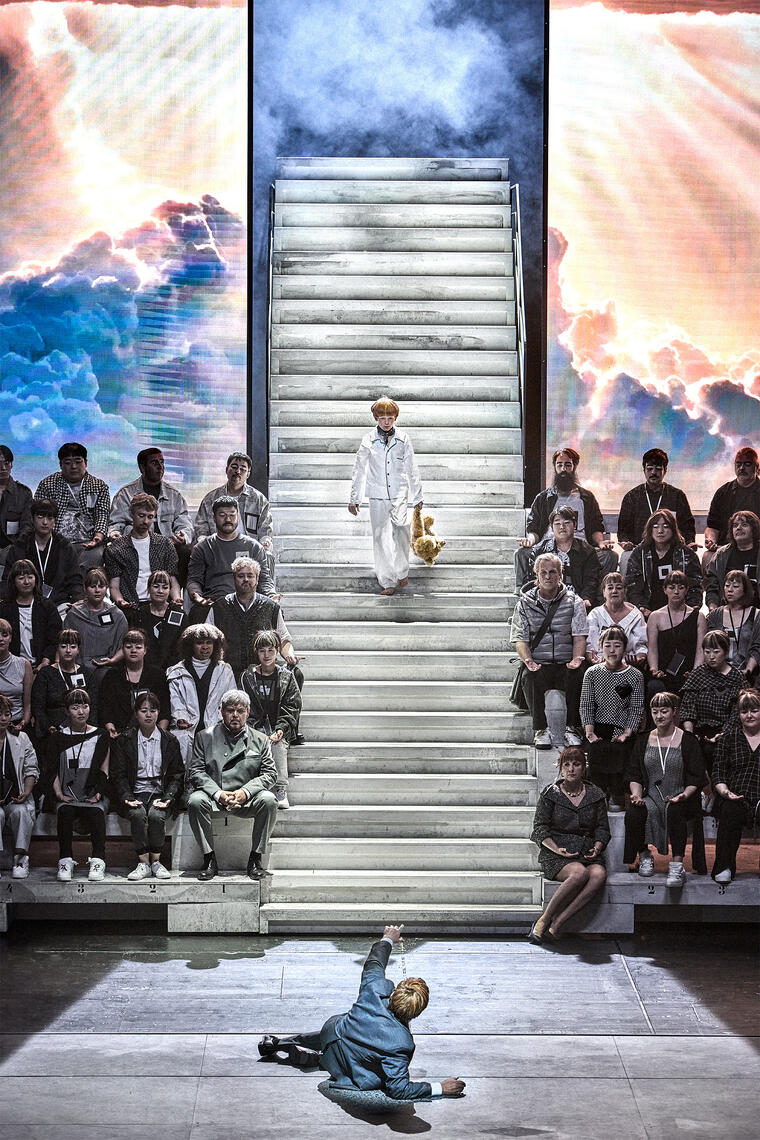
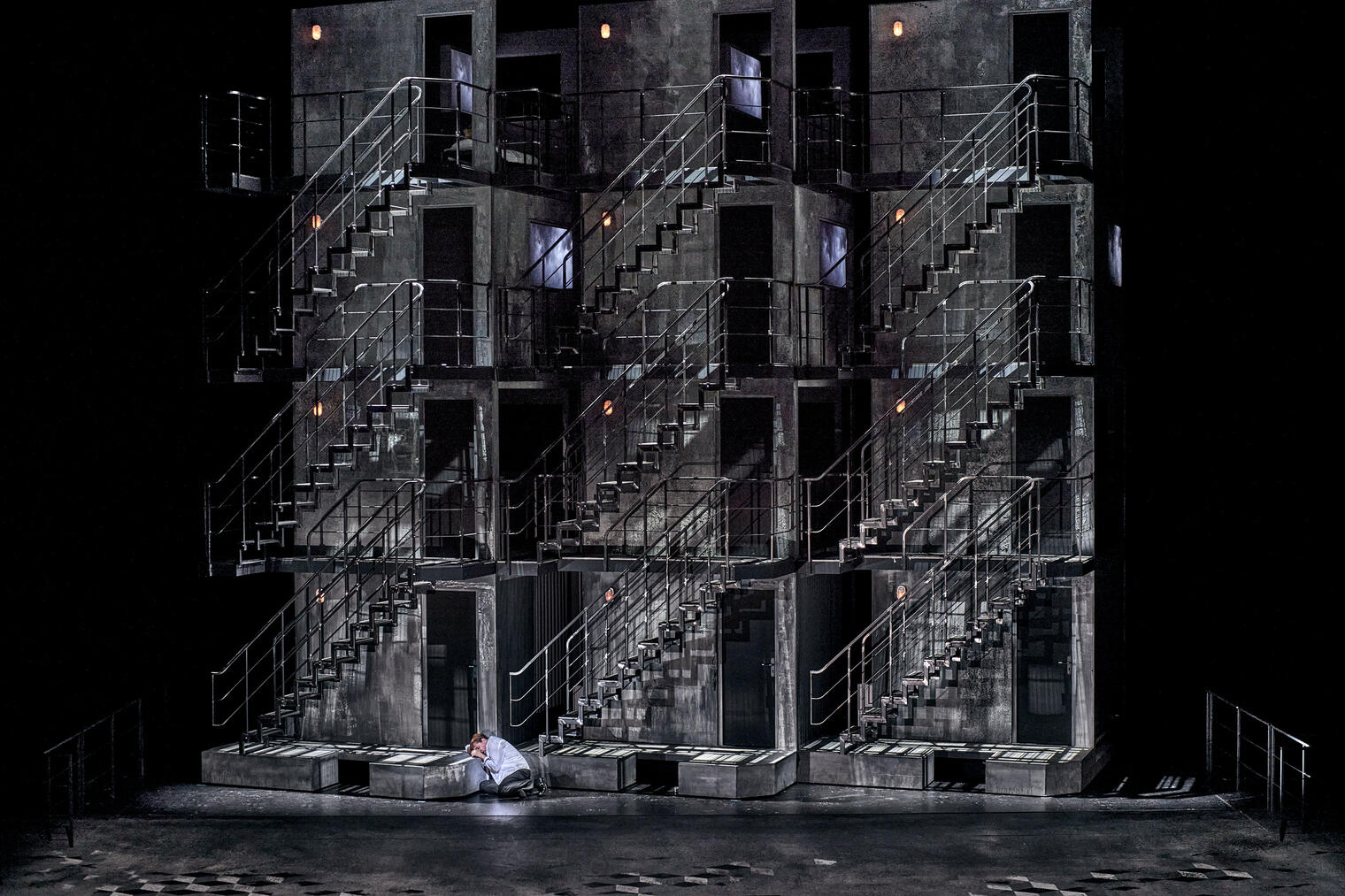
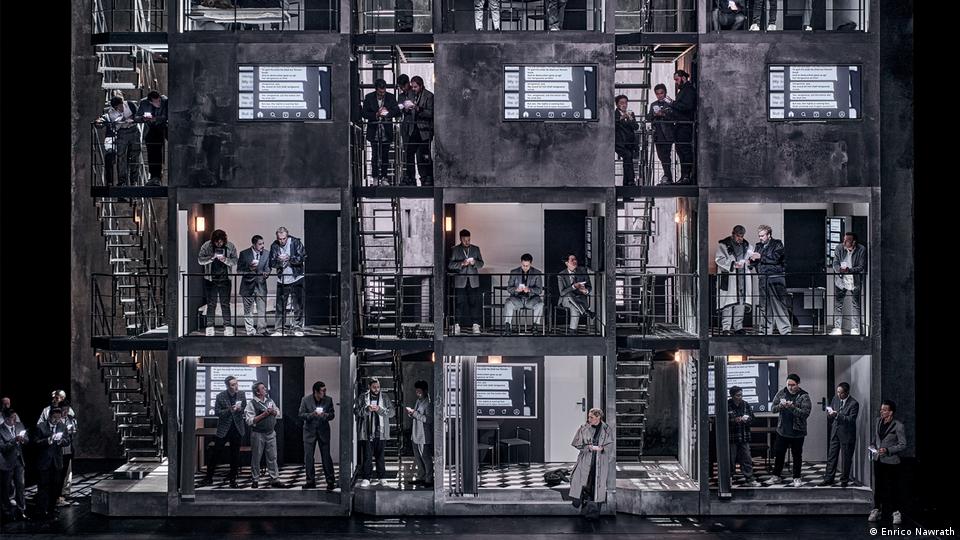
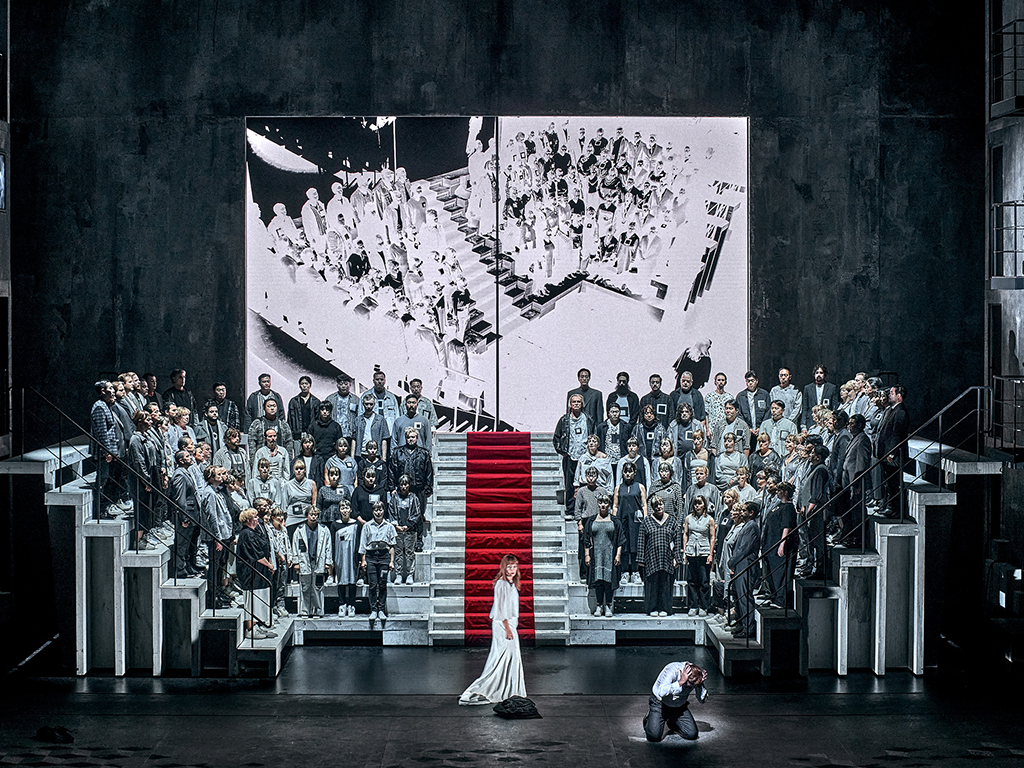
The curtain rises shortly after the overture begins, revealing a three-room house. Rienzi lives there with his sister Irene and their frail son. Rienzi works in his office; halfway through the piece, the son dies. The upper and lower floors are then illuminated, revealing a gray building, typical of Eastern European Bloc countries, with several televisions displaying social media comments and news reports. The screens show people commenting on Rienzi and Irene's incestuous relationship. The first act is a political rally featuring Rienzi, Orsini, and Colonna, who are running for office. They are surrounded by reporters with cameras and people glued to their smartphones. While the organ plays, we see the Romans voting. Rienzi wins the election, as shown on a screen displaying the results and the seats won in the Roman Curia. It must be said that all the news reports on television, as well as the banners supporting the candidates, are in English, which contrasts sharply with the opera being sung in German. The second act depicts the Curia and a staircase where Rienzi's dead son appears, while offstage the Messenger of Peace sings, as if in this version, he were appearing as the ghost of his son. Between some scenes, a wall covered with propaganda posters in English, German, and Latin about the political situation appears. The ballet is the highlight of this act. It is a comic pantomime from the Bayreuth Festival itself, directed by a child dressed as a gilded statue by Ottmar Hörl, featuring actors in costumes from the Ring, Lohengrin, Tannhäuser, Tristan, Die Meistersinger von Nürnberg, and Parsifal. This pantomime includes an imitation of the intermissions, with a food stand and restrooms that mimic those of the theater itself, and even the fanfares.

The third act shows Irene and Adriano living together as a couple, as the Romans prepare for war. A rebellion, led by Orsini and Colonna, requieres the conscription of even child soldiers, and a mother is seen bidding farewell to her recruited son. The rebellion ends with the weary and dirty Romans receiving medals, the rebels being executed (which displeases Adriano, because his father is shot), and the aforementioned mother weeping over her son's body before receiving his military uniform. The fourth act begins, surprisingly, with Rienzi's prayer, which should open the fifth. Rienzi, drunk and holding a bottle, attempts suicide before launching into his famous song. We return to the Curia, where the child soldier's mother is seen applauding disgusted, but Rienzi is not the same man as in the second act; every time he hears the Te Deum, he collapses. Adriano even tries to shoot him from a building, but Irene is standing nearby. In Act Five, during the brothers' duet, they self-harm. At the end, Rienzi is seen at the top of the steps, collapsing with a cry of pain, while the Curia collapses, and Irene does not die, but embraces Adriano, free to love him after the death of her domineering brother, whom she had grown weary of throughout the opera.
Rienzi is a work that is usually performed in abridged form. Wagner himself prepared a shortened version to be performed in a single day, which is the edition of the classic EMI recording with René Kollo. The closest we have to hearing what Wagner premiered, is Edward Downes' recording for the BBC, which lasts 280 minutes. On this occasion, a "Bayreuth edition" has been prepared, which has reduced the work to three and a half hours, preserving most of the vocal parts. Nathalie Stutzmann , a regular at the Festival, conducts the Bayreuth Festival Orchestra. One of the things that generated anticipation was how this music would sound with this orchestra. The result is as expected: a perfect match. Ms. Stutzmann conducts with verve and dramatic flair, excellent in the overture, the ballet, and the marches, reflecting the martial atmosphere of the music. The strings were excellent in Rienzi's famous aria, here repositioned by the stage directors. The Bayreuth Festival Chorus , conducted by Thomas Eitler-de Lint, maintained a high musical level, especially in their scenes from the second act, and the breathtaking chorus in the fourth act, the only case of Latin Gregorian chant used in Wagner's operas.

Andreas Schager has held the throne of the heldentenors for many years, and along with Vogt, he is the principal tenor of Bayreuth. Moreover, the role is not unfamiliar to him; he sang it in Madrid in 2012 with great success. However, on this occasion, his voice sounded somewhat tired and vibrant, which affected his famous prayer aria, where he struggled a bit. Nevertheless, his stage experience and musical resources (attacking phrases in piano to manage his voice) allowed him to pull off the performance.
Gabriela Scherer plays Irene, Rienzi's sister and partner. In this version, Irene is not the virtuous and virginal young woman of the libretto, but a mature woman tired of her brother, with whom she has had a child, and who seems to be dominated by him (an allusion to the relationship between Hitler and his niece Geli Raubal, or even a mock on that of Donald and Melania Trump?). Scherer's dark voice -inherited from her mezzo-soprano days- may be better suited to the more dramatic parts, in addition fitting the image the directors create for her, but it strips the character of all lyricism, in addition to her rather not so pleasant highest notes.
Jennifer Holloway was an excellent Adriano, well acted and sung.
The rest of the supporting cast is formed by Bayreuth regulars, and their level is consistently excellent. Vitali Kowaljow's voice sounds a bit aged as the Cardinal, while Michael Nagy and Andreas Bauer Kanabas are well-sung Orsini and Colonna, respectively. Matthias Stier was an excellent Baroncelli, with a beautiful and promising spieltenor voice. Cecco del Vecchio was sung by a remarkable Michael Kupfer-Radecky , and Victoria Randem has a very sweet voice as the Messenger of Peace.
The performance was a resounding success, judging by the enthusiastic applause and the critical acclaim. This was also due to the exceptional nature of the event: Rienzi is only scheduled to be programmed this year, as it has been stated. We hope not, and we also hope that it will return in future editions. It's true that Wagner didn't want it in Bayreuth, that it isn't easy for many Wagnerians due to its length and grandeur, but it gains considerably live and with a stage production. Even so, the orchestra and chorus are a perfect fit, and this is already the Rienzi of the 21st century, thanks to the superb stagecraft and musical quality. Those who attend these performances at the Festspielhaus are fortunate... and the rest of the world looks on with a touch of envy on them.

AS TO THE rIENZI PERORMANCE WHICH AFFECTED THE YOUNG hITLER, I REFER YOU TO mONTE STONES' BOOKAs to the Rienzi performance which affected the young Hitler, I refer you to Monte Stone's book "Hitler's Wagner: A Very Thin Book ". Well worth readingHitler's Wagner: A Very Thin Book Hitler's Wagner: A Very Thin Book.
ResponderEliminar