
Madrid, April 14, 2026. Opening night.
The four main languages of opera are Italian, French, German, and Russian. Perhaps English could be added as the fifth one due to its large output in the 20th and 21st centuries, but if I had to stick to what has become part of the operatic repertoire, I would have to put Czech language in that position. The Czech Republic, when it was Bohemia and Moravia, and part of the Austro-Hungarian Empire, gave birth to its most important classical composers, who have given us many great operas: Antonín Dvořák with his Rusalka; Leoš Janáček with his brilliant theatrical operas such as Jenůfa, Katia Kabanova, The Cunning Little Vixen, From the House of the Dead, and The Makropoulos Affair; Hans Krása with his children's opera Brundibár (although it is usually performed in the vernacular of the country where it is staged); and Bedřich Smetana, considered the father of Czech music and known for the beautiful piece The Moldau, from the symphonic poem My Country, and for The Bartered Bride, the first great opera in this Slavic language.
The Teatro Real has staged all the aforementioned operas, including Rusalka in recent times with the diva Asmik Grigorian, and during the 2000s, Janáček's operas delighted audiences. However, a classic like The Bartered Bride has only been seen twice in the capital, as the playbill indicates: once in 1924 with the Czechoslovak National Opera at the Teatro Real itself, before its closure due to structure wreck the following year, and again in 1973 by the Belgrade Opera on tour at the Teatro de la Zarzuela. Meanwhile, in much of the Western operatic world, it was known, until the 1970s, by its German translation, Die verkaufte braut, although at the Met it was sung in English. This comic opera, with elements of Czech nationalist music, comes to the Teatro Real under the direction of Laurent Pelly, an expert in comic operas and a regular at this venue.
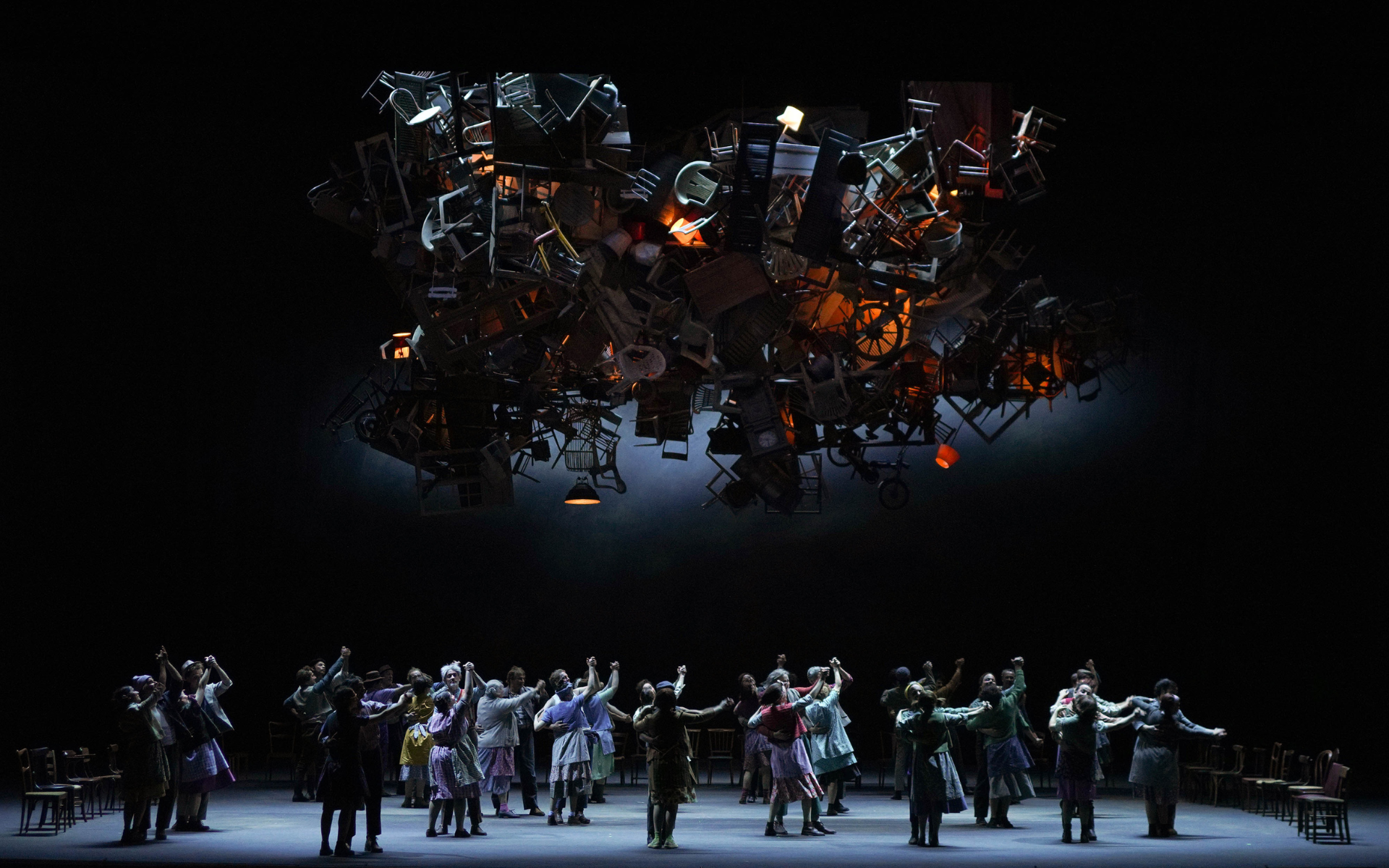
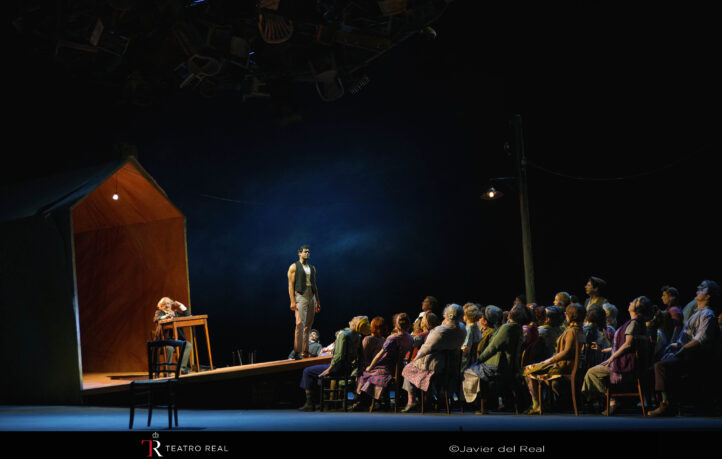
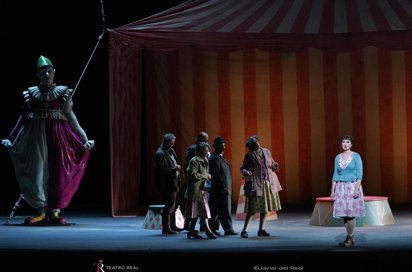
Pelly hadn't visited us for two years, since his dark production of Die Meistersinger von Nürnberg. This time, his vision of Smetana's opera is quite minimalist, reminiscent of his staging of the aforementioned Wagnerian work, which evolves into the colorful circus. Pelly manages to make the audience laugh, but much of the production is indeed dark and sparsely set, as if he wanted to draw us into the characters' feelings and, at the same time, the difficulties and oppressive social environment that tries to force her to marry a man she doesn't love. But it is still a comedy, and the result is guaranteed fun. The first act shows an empty stage, while above, suspended in the air, are a hodgepodge of chairs and bicycles. The chorus and the characters are dressed as working-class people from any town or neighborhood in a timeless era (the 1950s or 60s), albeit in various colors. Jeník sometimes resembles a kind of John Travolta in Grease, but in a working-class version. In the second act, a huge hut appears, very similar to the one in the same act of the Meistersinger production. Vasek arrives on a bicycle. The third act shows the comedians dancing in their colorful costumes and setting up the circus tent, though it eventually collapses. To the left of the stage is a huge statue of a clown. Above the circus stalls, Marenka laments her fate, while her family tells her she must accept Vasek. At the end, the chorus dances, celebrating Jeník and Marenka's marriage, while Kecal flees in humiliation.
Gustavo Gimeno leads the Teatro Real Orchestra with a performance that begins with a very forte sound, at the beginning to the overture. Nevertheless, the strings sound wonderful throughout the entire performance. Their tremolo is particularly prominent in the overture. Throughout the rest of the work, the orchestra sounds inspired, especially in the dances and circus numbers of the third act. Although there are moments when the orchestral volume puts the singers at a disadvantage. The Teatro Real Chorus, directed by José Luis Basso, once again demonstrates its full musical and dramatic potential, especially in the second act, where the male section showcases its powerful voices, without diminishing the equally potent female chorus.

As for the cast, the lead pair of Svetlana Aksenova as Mařenka and Pavel Cernoch as Jeník improved as the performance progressed. Aksenova has a dramatic-timbred voice and displays impressive high notes, although some in the first act sounded strained. She was good in the second and third acts. I would like to see her in more dramatic roles. Cernoch was very good in the second act with his lyrical voice, and his portrayal of the charismatic fiancé was convincing, further enhanced by his physical attractiveness. Gunter Groissböck, an athletic bass, is unrecognizable here as the matchmaker Kecal, with glasses, a bald head, and a paunch. Groissböck has a powerful voice with a beautiful timbre, despite lacking a bit of lower voice, but his funny acting carries the performance. His voice is very well suited to the comic role of Kecal. He had not been seen at the Teatro Real since he sang Boris Godunov in 2012, when Gerard Mortier was the artistic director.
However, the best performer of the evening, the most complete, was Mikeldi Atxalandabaso with his portrayal of the stuttering and rather unattractive Vašek. His singing is impeccable, with a beautiful timbre; voice is clearly heard throughout the hall, successfully navigating the difficult challenge of singing while stuttering, and as an actor, he perfectly captures the awkwardness of his character. One of the best spieltenors in the world is Spanish, and we Spanish opera goers can be proud of that. Among the rest of the cast, Rocío Pérez stands out as the dancer, and tenor Jaroslav Březina as the lead comedian. This Czech tenor sang in the Spanish premiere of Janáček's "Osud" at the Teatro Real back in 2003.

The gossip press reports that local celebrity and Julio Iglesias ex-wife Isabel Preysler wore a €7,000 outfit for the occasion, and that several promiment local aristocrats and celebrities attended this premiere performance too. But what truly matters is that the beauty of this opera, its excellent staging, and great cast was greatly appreciated by the opening night audience, even though the theater wasn't at full capacity, despite deserving it. The most important numbers were applauded. At the end of the performance, there were standing ovations for everyone: the cast, conductor Gimeno, and director Laurent Pelly and his team.
I believe that alongside Ariadne et Barbebleue, and I Masnadieri, this Bartered Bride is placed among the best of this current season at the Teatro Real.


No hay comentarios:
Publicar un comentario