lunes, 6 de julio de 2026

ESP/ENG: El fin de una era: David Afkham se despide con la Novena Sinfonía de Gustav Mahler en el Auditorio Nacional.


For English, please scroll down.

Madrid, 27 de junio de 2026. 

El triste momento ha llegado, y con él el fin de una era. Durante doce años, el alemán David Afkham ha llevado a la Orquesta Nacional de España a una época gloriosa. La ha convertido en la orquesta referencial para el repertorio germánico en la capital. Años de interpretaciones gloriosas con inolvidables interpretaciones de Mahler, Bruckner, Strauss, Wagner, Schönberg (magníficos Gurrelieder en 2018), Britten, Shostakovich... y la lista no terminaría. Para despedirse, el maestro alemán cierra temporada con la apasionada, etérea y visceral Novena Sinfonía de Gustav Mahler. A partir de septiembre, el testigo lo recogerá el estadounidense Kent Nagano, una leyenda viva de la dirección orquestal, con una trayectoria de décadas, ampliamente documentada en disco. Después de estos tres conciertos de despedida, Afkham llevará a la ONE y a Mahler a Granada, y luego interpretarán a Falla, Ravel y Rodrigo en los Proms de Londres, donde los británicos escucharán por primera vez a nuestra orquesta. Aunque deje el puesto, el director germano volverá de vez en cuando, aunque ya como director invitado. El Auditorio estaba casi lleno, por lo popular que es Mahler y por despedir al maestro. Poco antes de empezar, en las pantallas de los subtítulos aparecía una dedicatoria a las víctimas del reciente terremoto en Venezuela, a quienes rindió tributo el concierto. 

La Novena sinfonía de Gustav Mahler fue compuesta en una época de gran creatividad y al mismo tiempo de ansiedad para el músico. Estrenada la Octava sinfonía con gran éxito, y concluida La Canción de la Tierra, Mahler había entrado en una nueva fase de su creatividad, alcanzando la plenitud de su estilo musical, más wagneriano que nunca, pero también más introspectivo y melancólico que nunca. La Décima sinfonía, de haberse concluido, habría supuesto una evolución que ya daba señales en esta Novena. Mahler compuso está obra tan poderosa, desde la tranquilidad de una aldea tirolesa, durante sus vacaciones estivales. También en esta época se produce su salida de la Ópera de Viena, ciudad que le dio la espalda y que estaba al mando del alcalde antisemita Lueger, la muerte de su hija y la infidelidad de su esposa.  A lo largo de cuatro movimientos, en los que se pasa de un estado inicial de belleza, de romántica felicidad; a un estado final etéreo, celestial, místico, de transfiguración del ser en el cuarto y último movimiento; que concluye rozando la imperceptibilidad. 

Con esta obra se midió la ONE al frente de Afkham, quien dio una lectura lírica, melancólica, con momentos espectaculares, con la tristeza de la próxima despedida. El primer movimiento empezó tímido aunque poco a poco el sonido se hizo más espectacular, y así los instrumentos de viento, algunos manteniendo notas durante bastante tiempo, como dice la partitura, brillaron. A partir del tercero, la orquesta tomó el sonido definitivo que haría del cuarto y último, el gran Adagio, una interpretación para el recuerdo. Fue en él en el que la orquesta deslumbró, con unas cuerdas potentes, vigorosas, que cerraron la obra como un hilo fino de belleza, fundiéndose con el éter, en un susurro, una caricia que termina sin que uno lo note. El problema fue que en este último movimiento, mientras sonaba esta maravillosa música, sonaron un montón de teléfonos móviles, lo que dificultó bastante el disfrute.

Al final del concierto, el público se puso en pie y ovacionó al maestro, y en la pantalla de subtítulos se leía "Gracias David, y hasta pronto". Afkham salió varias veces a saludar, recibiendo un ramo de flores, visiblemente emocionado.

Todavía recuerdo la primera vez que le en vivo. Fue en el año 2012, cuando en el programa Ibermúsica, invitado por mi amigo Antonio Manada del Campo, le vi interpretar la Inmolación de Brunilda, con una Iréne Theorin en la cúspide de su carrera, y la Séptima Sinfonía de Shostakovich, al frente de la Mahler Jugendorchester. Tal derroche de talento era difícil de creer en un joven que arrastraba a otros jovencitos a la pasión de estas obras. No pensé que le vería madurar como artista en nuestra ciudad capital. Me considero feliz de haberlo hecho. Espero verle de nuevo dirigir algún día.


ENGLISH: The end of an era. David Afkham's farewell with the Mahler's Ninth Symphony at the Auditorio Nacional.

Madrid, June 27, 2026.

The sad moment has arrived, marking end of an era. For twelve years, the German conductor David Afkham has led the Spanish National Orchestra into a glorious period. He has established it as the best orchestra for the Germanic repertoire available in the capital. These have been years of magnificent performances—unforgettable renditions of works by Mahler, Bruckner, Strauss, Wagner, Schoenberg (a magnificent rendition of Gurrelieder in 2018), Britten, Shostakovich... the list goes on. To bid farewell, the German maestro closes the season with Gustav Mahler’s Ninth Symphony—a work that is at once passionate, ethereal, and visceral. Starting in September, the baton will be taken up by Kent Nagano, the American living legend of conducting with a career spanning decades and extensively documented on recordings. Following these three farewell concerts, Afkham will take the orchestra and Mahler’s music to Granada; subsequently, they will perform works by Falla, Ravel, and Rodrigo at the BBC Proms in London, marking the first time British audiences will hear our orchestra. In addition, Afkham will return from time to time as a guest conductor in future seasons. The auditorium was nearly full, drawn by Mahler’s popularity and the desire to bid farewell. Just before the performance began, the subtitle screens displayed a dedication to the victims of the recent earthquake in Venezuela.

Gustav Mahler’s Ninth Symphony was composed during a period of great creativity—and simultaneous anxiety—for the musician. Having premiered the Eighth Symphony to great acclaim and completed Das Lied von der Erde, Mahler had entered a new creative phase, reaching the full maturity of his musical style: more Wagnerian than ever, yet also more introspective and melancholic than ever before. Had the Tenth Symphony been completed, it would have represented an evolution already foreshadowed in this Ninth. Mahler composed this powerful work amidst the tranquility of a Tyrolean village during his summer holidays. This period also saw his departure from the Vienna Opera—a city that had turned its back on him, ruled by the antisemitic mayor Karl Lueger—as well as the death of his daughter and his wife's infidelity. The work unfolds across four movements, transitioning from an initial state of beauty and romantic bliss to a final state—in the fourth and concluding movement—that is ethereal, celestial, and mystical, representing the transfiguration of the self and ending on the verge of imperceptibility.

The ONE (Spanish National Orchestra) performed this work under Afkham’s baton; he delivered a lyrical, melancholic rendition —punctuated by spectacular moments—that was imbued with the sadness of an impending farewell. The first movement began tentatively, though the sound gradually grew more spectacular; the woodwind instruments—some sustaining notes for extended periods, as the score dictates—truly shone. By the third movement, the orchestra had found the definitive sound that would make the fourth and final movement—the amazing Adagio—a performance to remember. It was the moment when the orchestra dazzled, with powerful, vigorous strings bringing the work to a close like a fine thread of beauty, dissolving into the ether—a whisper, a caress that fades away almost imperceptibly. The only issue was that, during this final movement, the experience was significantly marred by the ringing of numerous mobile phones.

At the concert's conclusion, the audience rose to give the conductor a standing ovation, while the surtitle screen displayed the message: "Thank you, David, see you soon." Afkham returned to the stage several times to take a bow, visibly moved as he accepted a bouquet of flowers.

I still remember the first time I saw him perform live. It was in 2012, as part of the Ibermúsica series—thanks to an invitation from a friend, playing Brünnhilde’s Immolation Scene -featuring Iréne Theorin at the peak of her career - and Shostakovich’s Seventh Symphony with the Mahler Jugendorchester. It was hard to believe such a wealth of talent existed in a young man who was inspiring other young people to play with such passion and energy these majestic works. I never imagined I would witness his artistic maturation here in our capital city. I am delighted to have done so. I hope to see him conduct again someday.


Las fotografías escénicas y vídeos no son de mi autoría, si alguien se muestra disconforme con la publicación de cualquiera de ellas en este blog le pido que me lo haga saber inmediatamente. 

Cualquier reproducción de este texto necesita mi permiso.

My reviews are not professional and express only my opinions. As a non English native speaker I apologise for any mistake.

Most of the photographs are from the internet and belong to its authors. My use of them is only cultural. If someone is uncomfortable with their use, just notify it to me.

Any reproduction of my text requires my permission. 

jueves, 2 de julio de 2026

Electrifying Verdi amidst the void: an all-star Trovatore at the Teatro Real.


Madrid, June 29, 2026.

I've reached my 501th review (the honorary 500th is for the Spanish version), after almost nine years (it will turn in 25 days) of working in this blog. And I'm delighted that this number coincides with the summer's biggest opera event in Madrid, which is always a classic and popular opera. This year, that opera is Il Trovatore by Giuseppe Verdi, a true musical monument.

Verdi had a special connection with Spain. Several of his operas, such as Ernani, La Forza del Destino (whose Madrid premiere he attended), Don Carlo , and this Trovatore, are set in our country. Like Simon Boccanegra, this opera is an adaptation of a work by the Spanish Romantic playwright Antonio García Gutiérrez. The plot is explosive, a common feature of Romantic drama: a Gypsy woman loses her mother at the stake, accused of witchcraft. To avenge her, Azucena kidnaps the baby of the guilty man, the Count di Luna, and after mistakenly sacrificing her own son, believing him to be the child of her enemy, she ends up raising him as her own, naming him Manrico. Years later, the son of the old Count di Luna and his brother, the gypsy troubadour, vie for the affections of a beautiful woman, Leonora. Such a twisted plot is compensated by marvelous music, which requires a powerful quartet of lead singers, with celebrated arias and a famous gypsy chorus, in one of the most beloved operas, said to require the four best singers in the world. Azucena is the most compelling character in the plot, driving it with her tragic life and terrible revenge. Traumatized by the violent loss of her mother, from whom she could not even say goodbye, left alone in the world, this vengeful woman faces repeated exclusion: she is a woman, she is poor, and she is a gypsy. Although these circumstances do not exactly redeem this character, they do allow this outlandish drama to focus on something timeless: the pain of injustice for the loss of loved ones can lead us to unleash great tragedies and commit immense evil. Being an empoverished gypsy could be risky in 15th century, but still carries exclusion in the 21th century.

Verdi gives her two important numbers in the second act and a long duet with her son in the fourth, and she closes the opera by shouting "Sei vendicata, o madre" at the end of the second act. Il Trovatore is a recurring work in the Teatro Real schedules and the Madrid theaters that have programmed this opera throughout the 20th century. At the modern Teatro Real, it was seen in 2001, with José Cura, who was booed during the performance and had to withdraw from the production; in 2007, when I saw it for the first time, Roberto Alagna was scheduled to sing the role but ultimately canceled and was replaced by Francisco Casanova, accompanied by Fiorenza Cedolins and the legendary Dolora Zajick as Azucena. For this return, the staging Francisco Negrín is revived, which premiered here in 2019, characterized by its dark minimalism, although the aesthetics and setting do not distract from the main plot. To describe it, I refer to what I said in my review at the time, about the performance I saw with Francesco Meli, Lianna Harotounian, Ludovic Tezier and Ekaterina Semenchuk:

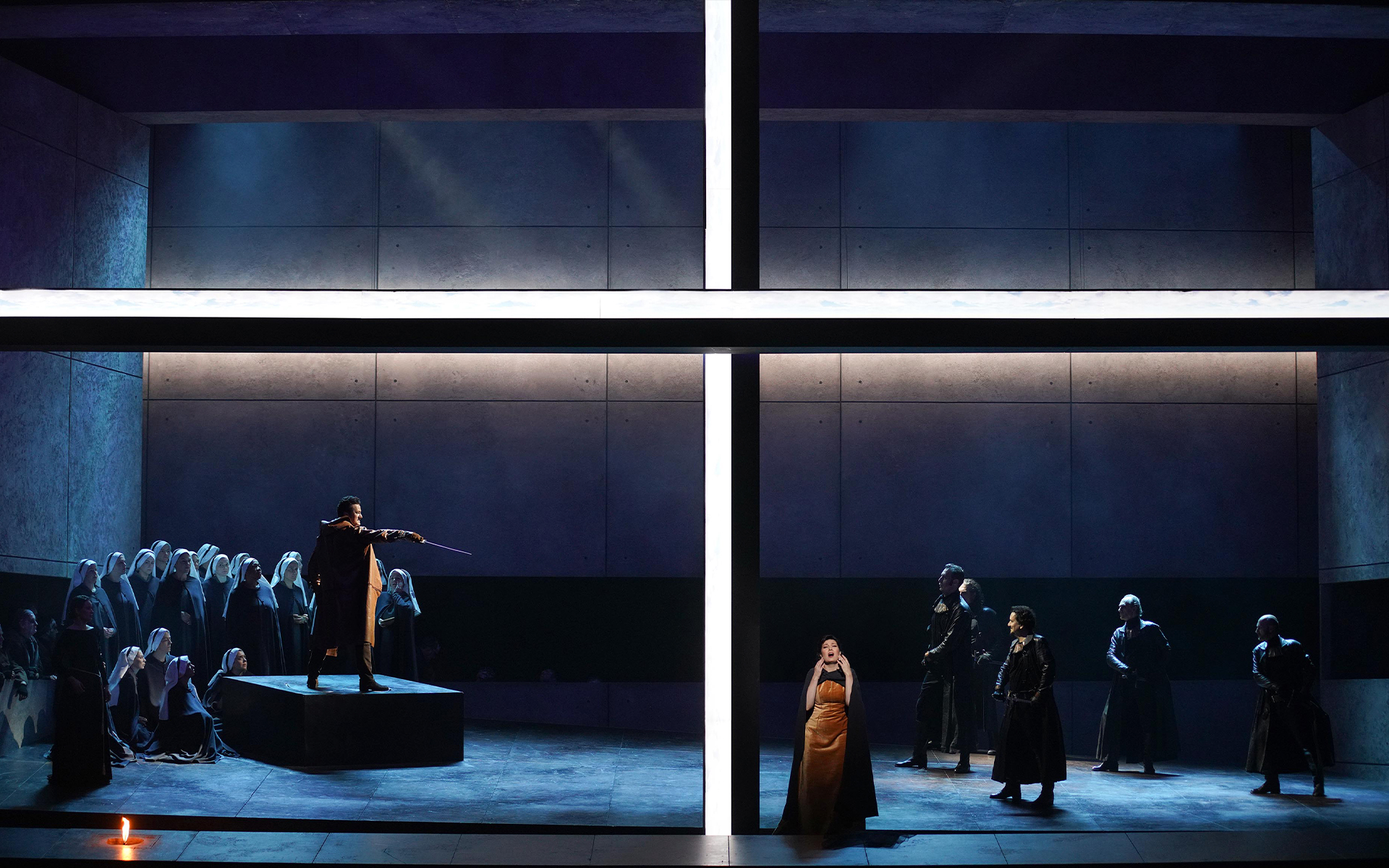
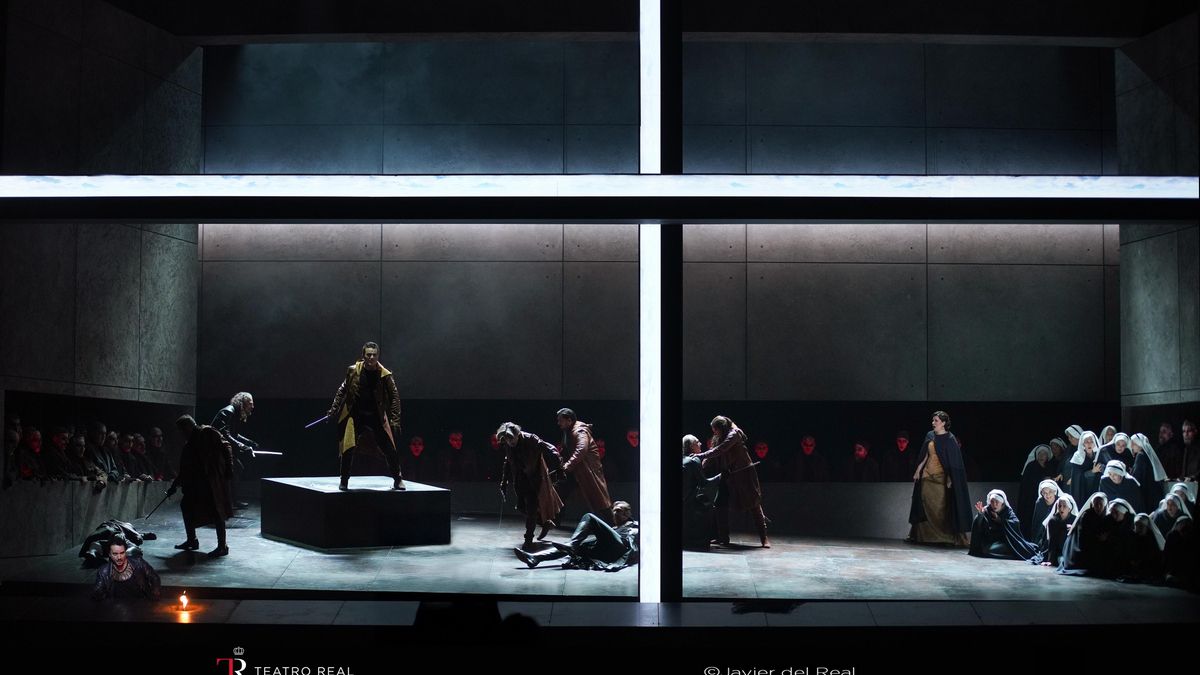
"Negrín's production pretends to show how the ghosts of the past are able to tie and determine fatally the destiny of the protagonists. For that reason, we see on stage the ghosts of Azucena's mother and son as relevant characters. The action takes place in a metallic, cold and dark space, intensifying the plot and making it more opressive and unbreathable. In the inner zones the chorus is placed, and the chorus remain unseen in many moments. There are two big poles making a cross in the scene, sometimes dividing properly the stage, for example in the convent scene. This raw minimalism tries to delve on Azucena's tragedy, but despite the effectiveness of the ghosts' apparitions, its coldness and ugliness can be boring and even irrelevant.

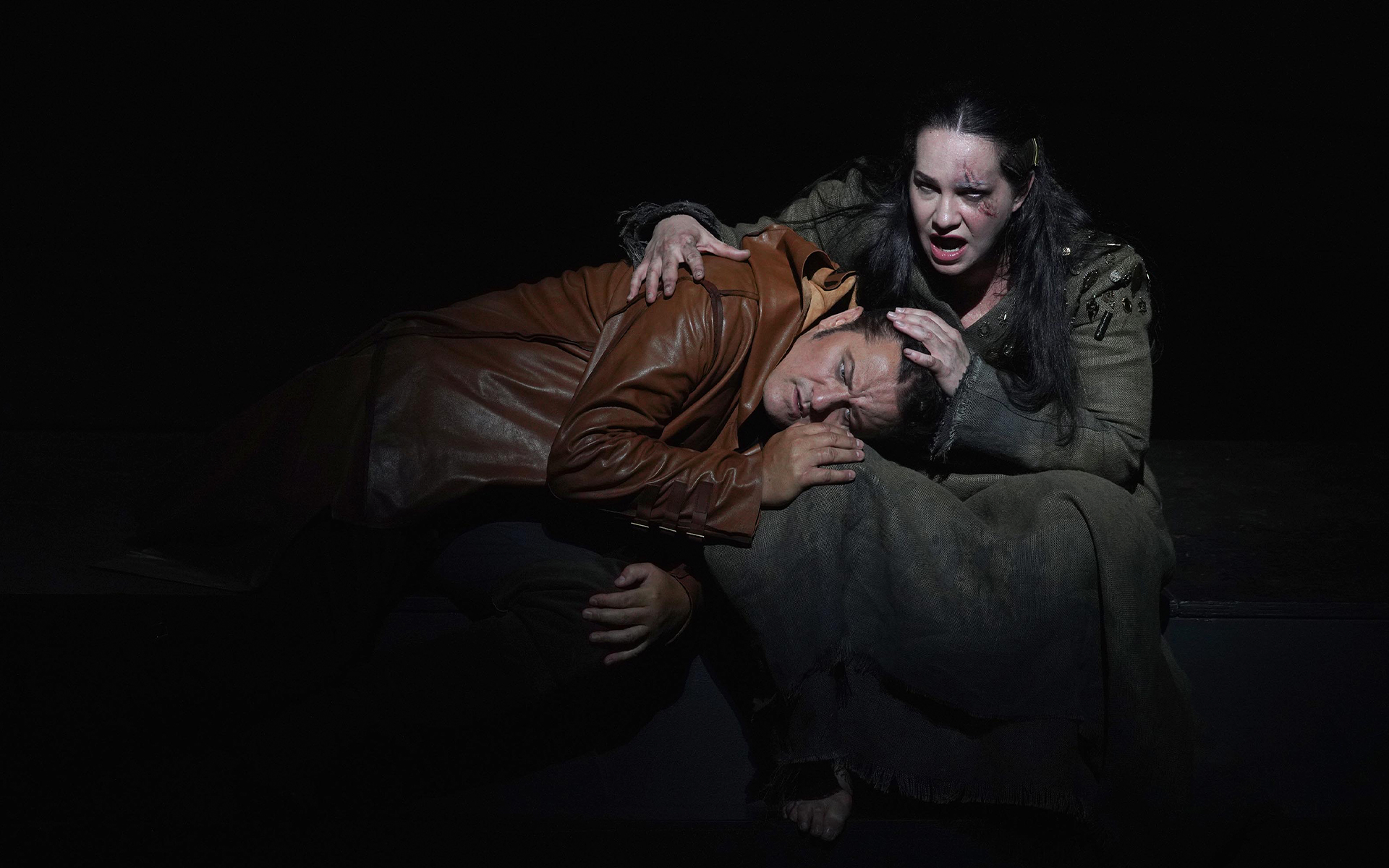
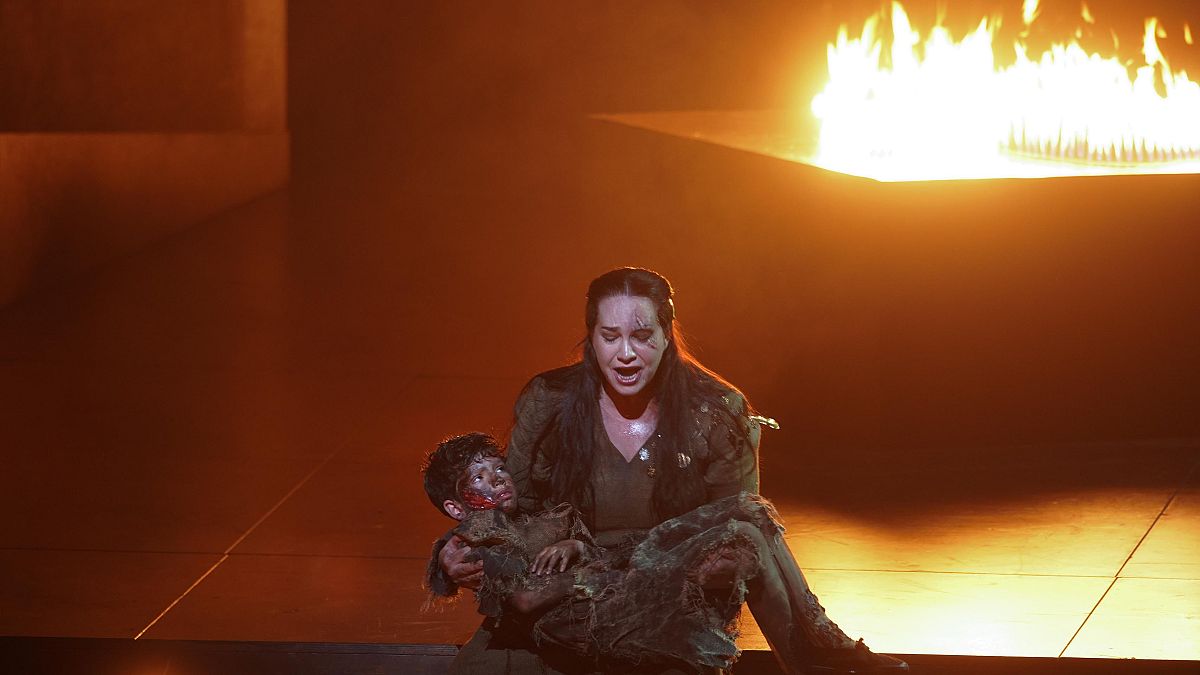
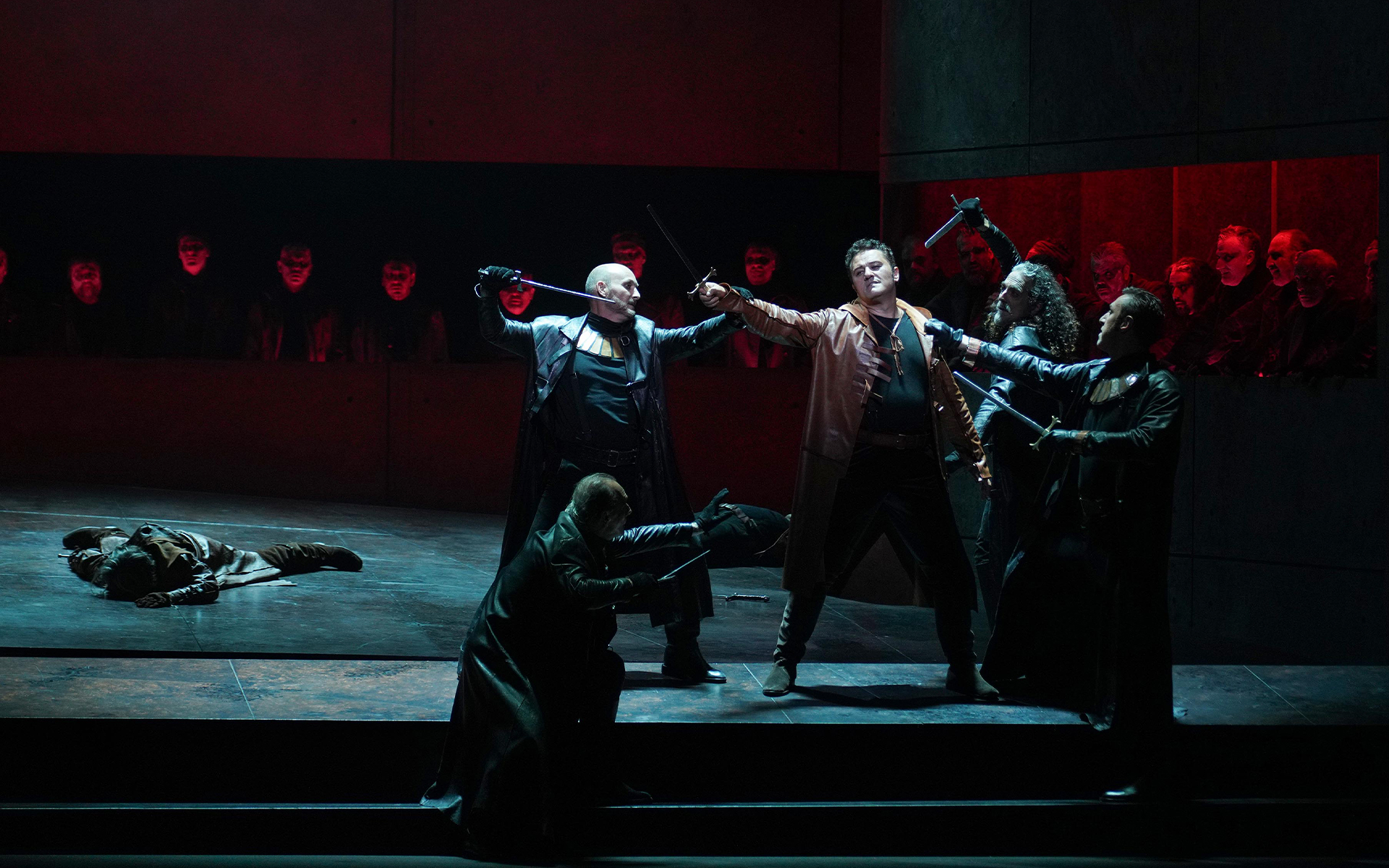
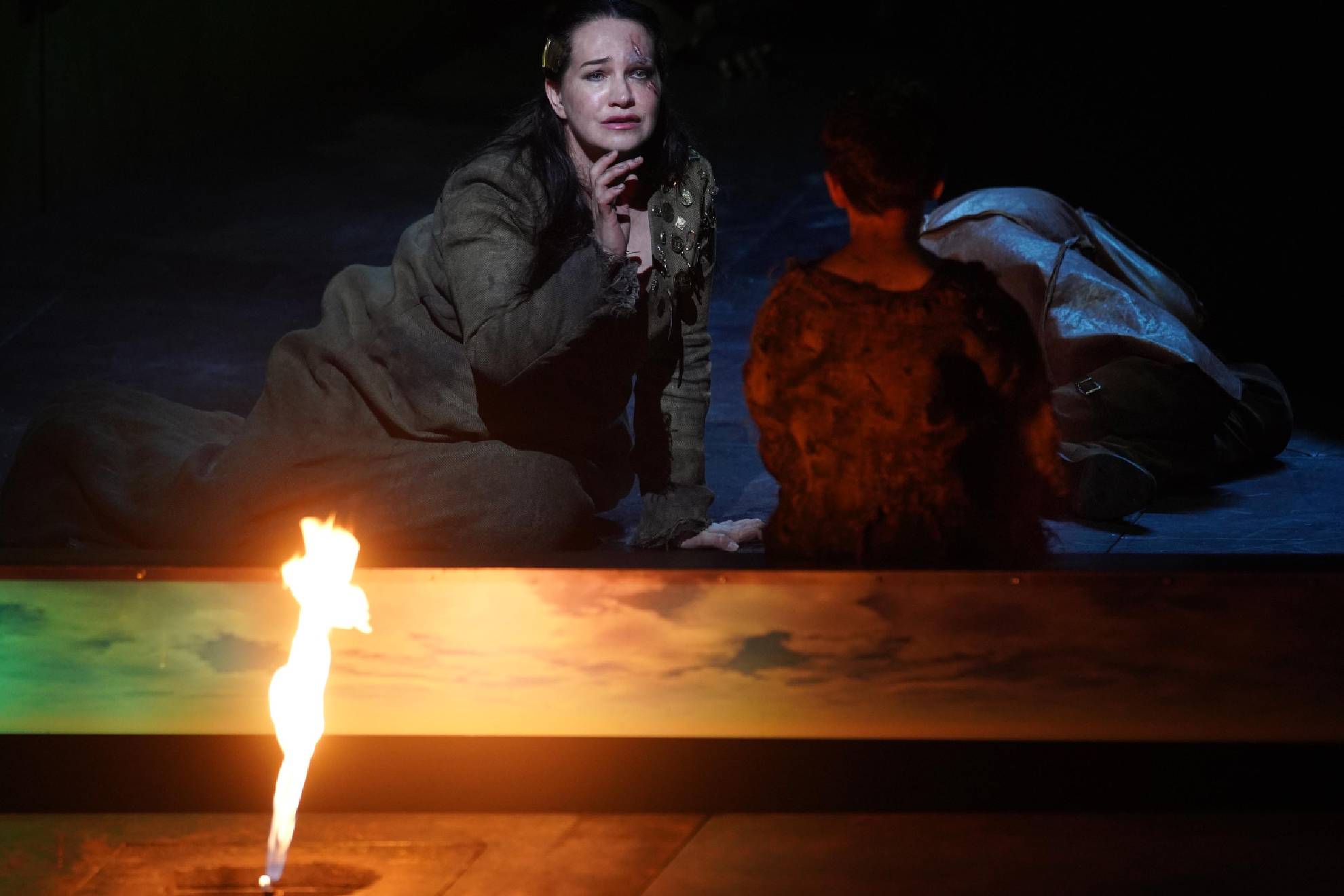
The scene begins with Azucena invocating the fire (emerging real flames from a table) ,and in the top of the scene, we see her mother. Then, we see Ferrando telling the story to some children around him. In the second Act we see in the gipsy chorus the men singing in their inner zones and the women making some gestures of witchcraft. We see Azucena's child. During most of the duets with Manrico, she sings to her child ghost than to her living adopted child. There is a costume contrast, with the Count's henchmen dressing in dark leather and Manrico's men dressing with brown leather. In the Act four, we see Azucena's mother holding Manrico and Leonora with a chain, before her daughter does. At the end, Azucena is moving a pole while to the middle of the scene while she asks for her son, and the fire is projected on stage and the flames emerging from the table for the last time."

Seven years later, the production still has the same effect. It's not annoying, but it doesn't stand out either. It allows you to follow the story, but in a work with such a vibrant narrative of tension and intrigue, so much emptiness and darkness, rather than intensifying the action, actually slow it down. It feels like a soviet-realistic concrete paradise. The male gypsies seem to have been transformed into Nosferatu. The real fire emanating from that table is visually effective, but it soon becomes forgotten. It's not believable that in Act 2, while Leonora says she finally has Manrico by her side  and still can't believe it, she's doing so while leaning against a column, from a considerable distance from him. Or that at the end of the opera, Azucena—and before her, her mother—pulls on a chain that Manrico and a dying Leonora are also pulling on, as a visual manifestation of how she now literally holds the reins of the story.

The Italian maestro Nicola Luisotti conducts the Teatro Real Orchestra in these performances, alternating with François López-Ferrer, son of Jesús López-Cobos, the legendary music director of the Teatro Real between 2002 and 2010. Luisotti conducted Il Trovatore at this same theater in 2007, and on this occasion, as usual, he delivers a passionate, powerful, and agile interpretation of the work. Luisotti doesn't simply coordinate the voices; he compels the orchestra to impose their sound. And he succeeds: theatrical tension is felt. The strings didn't sound subdued, but rather vigorous throughout the performance. The clarinet had its moments in Count di Luna's aria and in the beautiful yet somber introduction to Act IV. The Teatro Real Choir, led by José Luis Basso , experienced some difficulties in the first part. But this wasn't due to anything attributable to them, but rather to the challenging production. In the first act, the male section sang within the sets, which acted as a kind of prison, stifling their powerful sound—a limitation that affected the celebrated gypsy chorus in the second act. From the second scene of that act onward, the women finally appeared on stage, and sang the brief chorus of nuns in a marvelous pianissimo, almost like sacred music. At the beginning of the third act, the men were finally able to display their powerful voices and acting abilities. 

Once again, several casts have been assembled to sing this great opera at the Teatro Real, a total of four ensembles featuring some of the finest voices of our time. In this review, we will examine the first one, and we will do the second one soon.

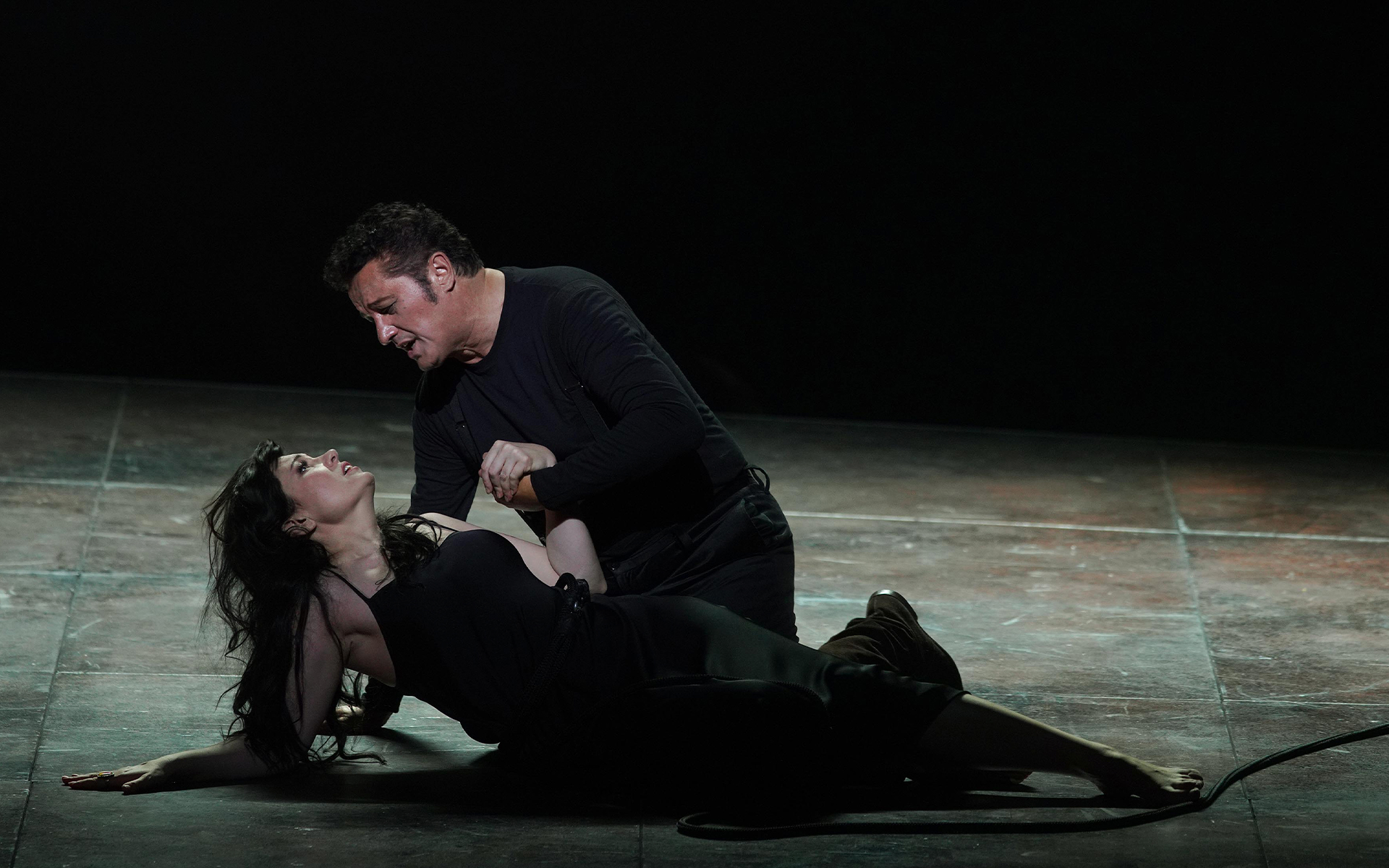
Polish tenor Piotr Beczała returned to the Teatro Real as a vigorous Manrico. I wouldn't call him perfect, but what he did deliver, he did with full vocal power. Even before he appeared, in the "Deserto sulla terra" that he sang offstage, his voice was exquisitely beautiful. He maintained this level of performance for almost the entire show, surviving the difficult "Ah sì ben mio" and the "Pira" in Act three. His musical and dramatic commitment was unwavering, and Act four was sung passionately.

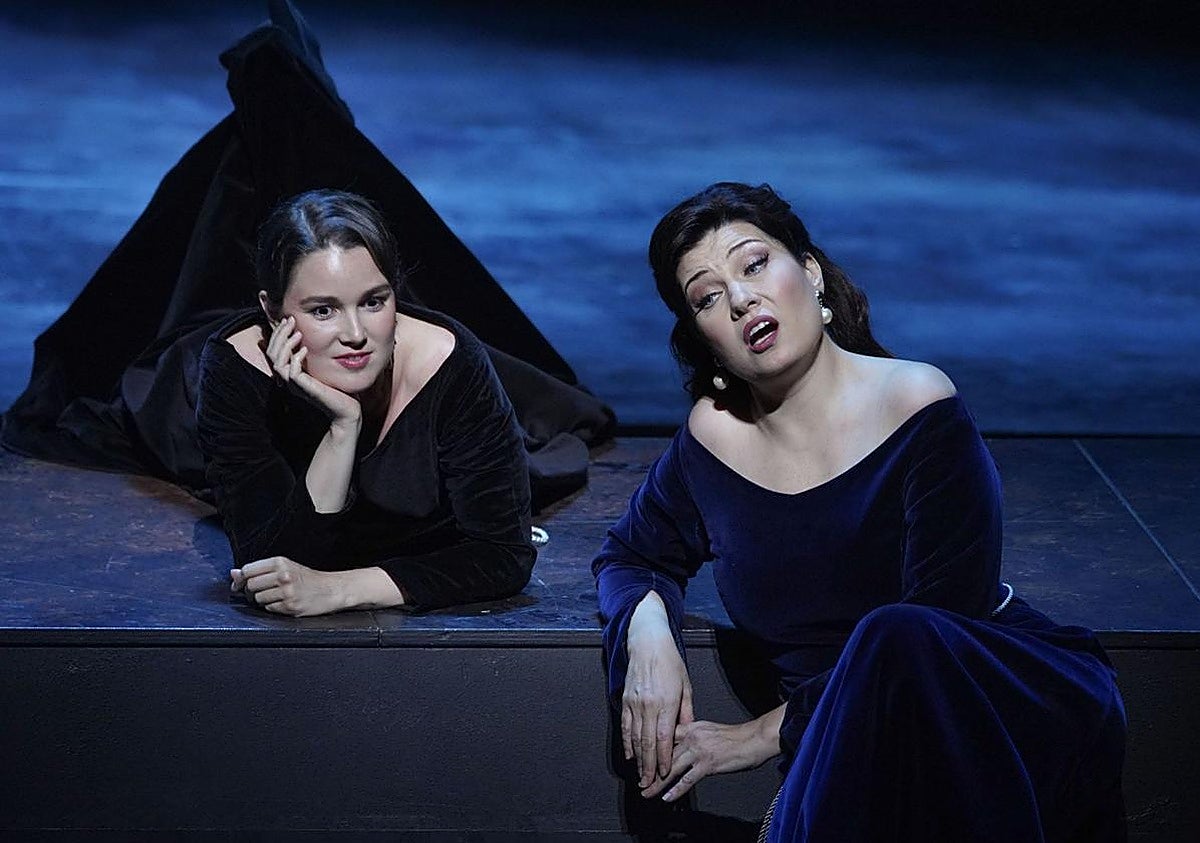
Marina Rebeka is vocally in good form as Leonora, able to unleash powerful high notes and display some coloratura, but at the same time, she is musically cold. Thus, she was good in "Tacea la notte placida," but in the cabaletta "Di tale amor," she unleashed two spectacular high notes that astonished the audience. Then, in her great scene in Act IV, she again displayed her powerful high notes in "D'amor sull'ali rosee," but she was better at the end of the "Miserere" that follows the famous aria. 

Ksenia Dudnikova was an excellent Azucena. Her voice filled the hall, sounding rich and full, and her low notes, typical of the Slavic school, were breathtaking. Her performance was musically stunning, although in "Stride la vampa," some of the high notes seemed a bit cried. It didn't detract a superb performance, which included an electrifying rendition of the aria "Condotta ell'era in ceppi."

Artur Ruciński, a regular at the Teatro Real, was a well-sung Count de Luna, a villain who musically displays a touch of nobility and beauty in his singing. His Count is a bad person, but not a repulsive brute; rather, he is an educated man consumed by resentment and hatred. His rendition of "Il Balen del suo sorriso" was beautiful, moving, and sung with sensitivity. 

Krysztof Baczyk's Ferrando was sometimes difficult to hear. His voice was deep, but with a rough timbre. Rocío Faus sounded like a great Inés, with a beautiful voice for such a small role. The same can be said of the notable tenors Fabián Lara as Ruiz and Moisés Marín as the messenger, whose voices deserved more substantial roles.

As it was opening night, it was honored by the attendance from the local jet set, as the paparazzi camped outside, and the elegant cars lining up after the end of the show. However, the most important thing is that at the end of the performance, the theater was a party: the entire cast received standing ovations, especially Dudnikova, Rebeka, and Beczala, who got the loudest applause. Also, as is customary, there was almost unanimous booing of Negrín (I recently learned he was the great-grandson of the 1930s President Juan Negrín) and his team when they came out to take their bows. 

Like in 2021 with their unforgettable performances of Tosca, which I think about when thinking about the three amazing casts called for this set, the Teatro Real is pleasing its audience with them. For the remaining casts, Saioa Hernández, Vittorio Grigòlo, Yusif Eyvazov, Anita Rachevilshvili or Juan Jesús Rodríguez will sing this opera. Sadly, Anna Netrebko has withdrawn from her four scheduled performances because of vocal fatigue. Nevertheless, the vocal feast will continue in Madrid until July 20.


My reviews are not professional and express only my opinions. As a non English native speaker I apologise for any mistake.

Most of the photographs are from the internet and belong to its authors. My use of them is only cultural. If someone is uncomfortable with their use, just notify it to me.

Any reproduction of my text requires my permission. 

miércoles, 1 de julio de 2026

Fuego vocal en medio de una gran nada: estupendo Trovatore veraniego en el Teatro Real.


Madrid, 29 de junio de 2026.

He llegado, a la crítica número 500, después de casi nueve años de actividad, los que cumpliré en un mes. Y me complace que esa cifra se corresponda con el acontecimiento lírico del verano en Madrid, que siempre se corresponde con una ópera clásica y popular. Este año, esa ópera es Il Trovatore, de Giuseppe Verdi, todo un monumento musical.

Verdi tenía un vínculo especial con España. Varias de sus óperas como Ernani, La Forza del Destino ( acuyo estreno en Madrid asistió), Don Carlo y este Trovatore, transcurren en nuestro país. Esta ópera, al igual que Simon Boccanegra, es una adaptación de una obra del dramaturgo romántico español Antonio García Gutiérrez. La trama es volcánica, algo habitual en el drama romántico: una gitana pierde a su madre en la hoguera, acusada de brujería. Para vengarse, secuestra al bebé del culpable, el conde de Luna, y tras sacrificar por error a su propio hijo, pensando que se trataba del hijo de su enemigo, termina criando a este, llamándolo Manrico. Años más tarde, el hijo del viejo Conde de Luna, y su hermano el trovador gitano, se disputan los amores de una bella mujer, Leonora. Una historia tan liosa es compensada con una música maravillosa, para un cuarteto protagonista de enjundia, con arias célebres y un famoso coro de gitanos, en una de las óperas más queridas por el público, de la que se dice que requiere los cuatro mejores cantantes del mundo. Azucena es el personaje más interesante de la trama, la que dirige la misma con su trágica vida y su terrible venganza. Traumatizada por la violenta pérdida de su madre, de la que no pudo ni despedirse, y quedándose sola en el mundo, esta mujer ávida de venganza es varias veces excluída: es mujer, es pobre y es gitana. Aunque estas circunstancias no blanquean ni redimen precisamente a este personaje, sí consiguen que este rocambolesco drama se centre en algo intemporal: el dolor ante las injusticias o la pérdida de nuestros seres queridos, puede llevarnos a desatar grandes tragedias y hacer un mal enorme. Más aún si se se es pobre y se es gitano, algo peligroso para la vida en el siglo XV, y aún una fuente de exclusiones en el XXI. 

Verdi le da dos números importantes en el segundo acto y un largo dúo con su hijo en el cuarto, y se encarga de cerrar la obra cuando grita "¡estás vengada, oh madre!" al final del acto segundo. Il Trovatore es una obra recurrente en la historia del Teatro Real y de los teatros madrileños que han programado esta ópera a lo largo del siglo XX. En el Real moderno, se vio en 2001, con un José Cura que fue abucheado en plena función, teniendo que retirarse de la producción; en 2007, cuando la vi por primera vez, para la que Roberto Alagna estaba previsto pero al final canceló y le sustituyó Francisco Casanova, acompañado de Fiorenza Cedolins y la mítica Dolora Zajick como Azucena.  Para este regreso, se vuelve a contar con la producción de Francisco Negrín, estrenada en 2019 en este mismo teatro, caracterizada por su oscuro minimalismo, aunque la estética y la ambientación no distraen del argumento principal. Para describirla, recurro a lo que dije en mi crítica de entonces, sobre la función que vi con Francesco Meli, Lianna Harotounian, Ludovic Tezier y Ekaterina Semenchuk:

"La producción de Negrín, tal y como dijo en la prensa, busca mostrar en escena cómo los fantasmas del pasado son capaces de atar y condicionar a los personajes. Para ello, hace aparecer a la madre y al verdadero hijo de Azucena, como unos personajes más de la acción. La acción tiene lugar en un espacio metálico, frío, que intensifica el patetismo y el lado más oscuro de la obra hasta hacerla irrespirable. En las zonas inferiores  hay espacios donde el coro, tan importante en la obra, canta sin estar del todo visible en varias escenas. Además, en determinados momentos hay dos postes que se cruzan formando una cruz, y que dividen el escenario de forma eficiente, como en la escena del convento. Este minimalismo salvaje intenta que nos concentremos en la tragedia de Azucena, pero en algunos momentos resulta aburrido: los efectos dramáticos que crean las apariciones de los fantasmas  no compensan el feísmo de la producción que en ocasiones termina por aburrir o por volverse irrelevante.

Nada más abrirse el telón, vemos a Azucena invocando el fuego en una mesa de donde salen llamas reales, y a su madre en lo alto del escenario. Ferrando cuenta su narración a unos niños mientras el coro canta escondido. En el segundo acto se ve al verdadero hijo de Azucena como la segunda aparición espectral y de gran peso, ya que en los dúos con Manrico ella habla más con el fantasma de su hijo biológico que con su hijo adoptivo, un reflejo de su locura. El coro de gitanos es un momento interesante, con las mujeres haciendo hechizos mientras los hombres cantan casi fuera de escena. Un contraste de vestuario tiene lugar entre los hombres del Conde de Luna, vestidos de cuero negro y los de Manrico, vestidos de cuero natural. En el tercer acto se ve al Conde rabiar mientras se ve a Manrico y Leonora juntos en una torre. En el dúo final se ve a la madre de Azucena sujetar con unas cadenas a los amantes, como un anticipo de sus trágicos finales antes de pasarle la cadena, es decir decidir el destino de la pareja, a su hija. Al final se ve a Azucena proclamar su triunfo final mientras empuja uno de los paneles que hacen la cruz mientras el fuego se proyecta al fondo del escenario y las llamas salen de la mesa omnipresente."

Siete años más tarde, la producción sigue generando el mismo efecto. No molesta, pero tampoco destaca. Permite seguir la historia, pero en una obra con una historia tan efervescente de tensión e intrigas, tanto vacío y tanta oscuridad más que intensificar, ralentizan. Parece un paraíso de hormigón. los gitanos parecen haber sido transformados en Nosferatu. El fuego real emergente de esa mesa es efectivo a nivel visual pero uno se olvida de él. No es creíble que mientras Leonora dice que al fin tiene a su lado a Manrico y aún no se lo cree, lo esté haciendo apoyándose en una columna a considerable distancia de él. O que al final de la ópera, Azucena - y antes su madre- tira de una cadena de la que tiran Manrico y una moribunda Leonora, como una manifestación visual de cómo ella lleva las riendas, ahora literalmente, de la historia.

El maestro italiano Nicola Luisotti dirige a la Orquesta del Teatro Real en estas funciones, alternándose con François López-Ferrer, hijo de Jesús López-Cobos, el mítico director musical del Teatro Real entre 2002 y 2010. Luisotti dirigió el Trovatore en este mismo teatro en 2007, y en esta ocasión, como de costumbre, da una lectura apasionada, fuerte y ágil de la obra. Luisotti no se conforma solo con concertar las voces, sino que hace que la orquesta se esfuerce por tener su momento. Y lo consigue: hay tensión teatral. Las cuerdas no sonaron apagadas, sino vigorosas en toda la función. El clarinete tuvo sus momentos en el aria del Conde de Luna y en la bella y al mismo tiempo sombría introducción del acto cuarto. El Coro del Teatro Real, al frente del maestro José Luis Basso, tuvo algunos inconvenientes en la primera parte. Pero no por nada que se les pueda atribuir, sino a la inconveniente producción. En el primer acto, los hombres cantaban dentro de los decorados, que eran como una especie de cárcel que aprisionaba su vigoroso sonido, algo que afectó al célebre coro de gitanos del segundo acto. A partir del segundo cuadro de dicho acto, por fin aparecieron en escena, y las mujeres cantaron el breve coro de religiosas en un pianissimo maravilloso, casi de música sacra. Al inicio del tercer acto, los hombres pudieron por fin exhibir sus poderosas voces y su capacidad actoral. 

De nuevo, varios repartos han sido convocados para cantar esta gran ópera en el Real, hasta un total de cuatro elencos con varias de las mejores voces del momento. En esta crítica reseñaremos el primero.

El tenor polaco Piotr Beczała regresa al Real como un vigoroso Manrico. No podría decir que perfecto, pero lo que mostró, lo hizo a plena voz. Ya desde antes que apareciera, en el "Deserto sulla terra" que canta fuera de escena, se advertía un canto bellísimo. Así se mantuvo durante casi toda la función, sobreviviendo al difícil "Ah sì ben mio" y a la "Pira" del tercer acto (lástima que no se diera la repetición). Había entrega musical y actoral.

Marina Rebeka está en forma vocal, y se puede permitir soltar agudos potentes y hacer alguna exhibición de coloratura, pero al mismo tiempo es musicalmente fría. Así, en el "Tacea la notte placida" estuvo bien, pero la cabaletta "Di tale amor" se permitió soltar dos agudos espectaculares que asombraron al público. Luego en su gran escena del acto cuarto volvió a mostrar su potente agudo en el "D'amor sull'ali rosee", pero estuvo mejor al final del "Miserere" que sigue a la famosa aria. 

Ksenia Dudnikova fue una excelente Azucena. La voz corre por la sala, parece carnosa, y los graves, típicos de la escuela eslava, estremecen. Su actuación fue musicalmente impactante, aunque en el "Stride la vampa", algunos agudos parecían fuera de control. Nada que empañara una función estupenda, con una electrizante versión del aria "Condotta ell'era in ceppi".

Artur Ruciński, habitual en el Real, dio un Conde de Luna bien cantado, un villano que musicalmente muestra algo de nobleza y de belleza en el canto. Su Conde es una mala persona, pero no es un bruto repulsivo, sino un hombre educado consumido por el rencor y el odio. Su interpretación de "Il Balen del suo sorriso" fue bella, emotiva y cantada sensiblemente. 

Krysztof Baczyk fue un Ferrando al que costó oir en ocasiones. Una voz con grave, pero de timbre tosco. Rocío Faus sonó como una gran Ines, con una voz preciosa para tan corto personaje. Y lo mismo les pasa a los notables tenores Fabián Lara como Ruiz y Moisés Marín como el mensajero, con voces que merecerían personajes de más relevancia.

Al tratarse de la función de estreno, la jet set madrileña se dio cita en el teatro, a juzgar por las noticias de la prensa rosa al día siguiente, los paparazzi parados en la puerta principal, y los coches elegantes a la salida del espectáculo. Sin embargo, lo importante es que al acabar la obra la sala era una fiesta: ovaciones a todo el elenco, especialmente a Dudnikova, Rebeka y Beczala, quien fue el que más recibió. También como es habitual, hubo un abucheo casi unánime a Negrín (me enteré hace poco que era bisnieto del presidente Juan Negrín) y su equipo al salir a saludar. 

Esta vez el Real lo ha vuelto a hacer: no hace historia, pero nos ofrece una ópera maravillosa, con lo mejor que hay para interpretarla. Y el disfrute está garantizado. Hacía tiempo que no se veían tantas estrellas en la ópera del verano, quizá desde esa Tosca legendaria de 2021, en plena pandemia. Esperamos con ansia las funciones de Anna Netrebko a partir de la próxima semana.


Las fotografías y vídeos no son de mi autoría, si alguien se muestra disconforme con la publicación de cualquiera de ellas en este blog le pido que me lo haga saber inmediatamente. Cualquier reproducción de este texto necesita mi permiso.