viernes, 4 de septiembre de 2026

Walhalla and Wotan in Madrid: Bayreuth Festival Orchestra and Nicholas Brownlee succeed at the Teatro Real.


Madrid, September 3, 2026.

Each year, at the end of the Bayreuth Festival season, its chorus and orchestra disband, so their members can return to their original ensembles (comprising the best orchestras in Germany and the rest of the world). Its productions are also rarely seen in other opera houses. Part of the magic of the Green Hill is that its artistic excellence is confined within the four walls of the theater designed by Richard Wagner, so people from all over the world come year after year to experience it there. Given these circumstances, a tour by the festival's temporary company might seem almost impossible. However, it  happened in some occasions. And of those, two have taken place in Spain. 

In April 1955, the Bayreuth Festival productions of Parsifal, Tristan und Isolde, and Die Walküre, directed by Wagner's grandson, Wieland Wagner, visited the Gran Teatre del Liceu in Barcelona, ​​the Wagnerian capital of Spain. They featured the legendary conductor Joseph Keilberth (who led the Bamberg Symphony Orchestra, as the festival orchestra was not yet formed), the Festival Chorus directed by Wilhelm Pitz, and the cast was formed by legend singers such as Hans Hotter, Ramón Vinay, Martha Mödl, Ludwig Weber, Wolfgang Windgassen, Gustav Neidlinger, Gerhard Stolze, Hermann Uhde, Georgine von Milinkovic, and Gré Brouwenstijn, in addition to the excellent supporting cast. Fifty-seven years later, in September 2012, the orchestra, choir and the full casts of that year's festival returned to the same Barcelona coliseum to perform Der Fliegende Holländer, Tristan und Isolde and Lohengrin in concert version. 

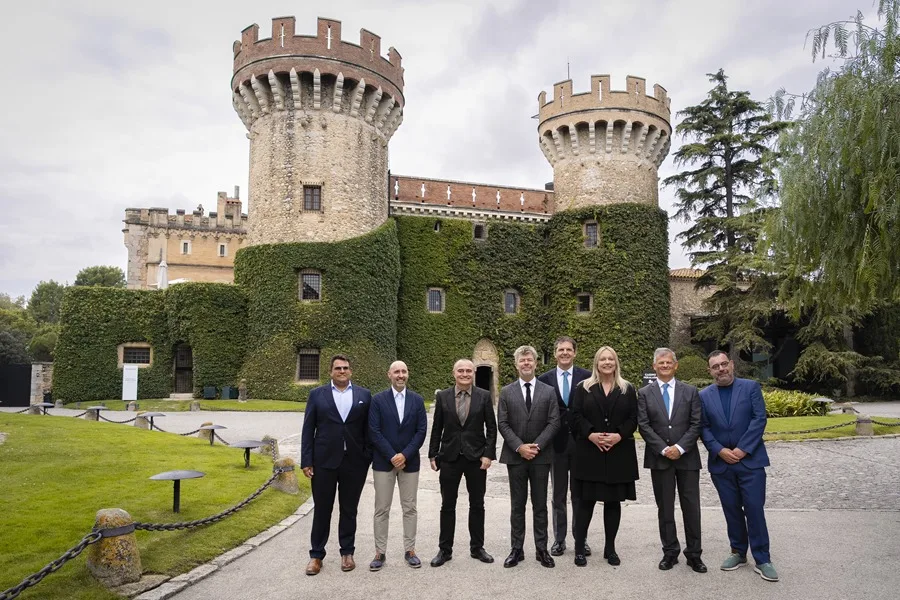
Late 2025: Katharina Wagner, Pablo Heras-Casado and the impresarios posing in the Peralada Castle, announcing the Spanish tour.

If there is one thing to be acknowledged about the festival's artistic director and the composer's great-granddaughter, Katharina Wagner, it's her efforts to bring the institution into the 21st century. Among these reforms is taking the orchestra on tour to other cities more frequently than before. In 2021, the orchestra toured Paris, Cologne, and Riga; and in recent years, in Grafenegg, Austria. Frau Wagner has expressed her admiration for Spain on several occasions: she staged Tannhäuser and Lohengrin here. At the end of 2025, Spanish Wagnerians received suprising news: to mark its 150th anniversary, the Bayreuth Festival Orchestra would tour five Spanish cities—Barcelona, ​​Santander, Seville, Madrid, and Valencia—to perform a selection from The Ring of the Nibelung after the festival's conclusion. A photograph of Ms. Wagner and the artistic directors of those five theaters at Peralada Castle serves as a memento. 

As expected, the Teatro Real hosted the Madrid concert, scheduled for September 3rd. For the first, and hopefully not the only, time, the festival orchestra visited the capital. However, it wasn't the first attempt: in 1899, the theater's then-manager, the legendary Luis París, tried to bring the Festival to the Teatro Real to perform six cycles of the Ring. This would have made Madrid the first city outside of Bayreuth to stage the complete cycle, and moreover, in German—a rarity at a time when all operas in Spain were sung in Italian. Despite the uncertain feasibility of this enterprise, the press reported on the undertaking, and even non-seated suscriptions were sold. Wagner was all the rage in the city's highest intellectual circles, and it was thought that it might be possible. But the Teatro Real's lack of funds and a lack of agreement with German artistic agents ultimately doomed the attempt.

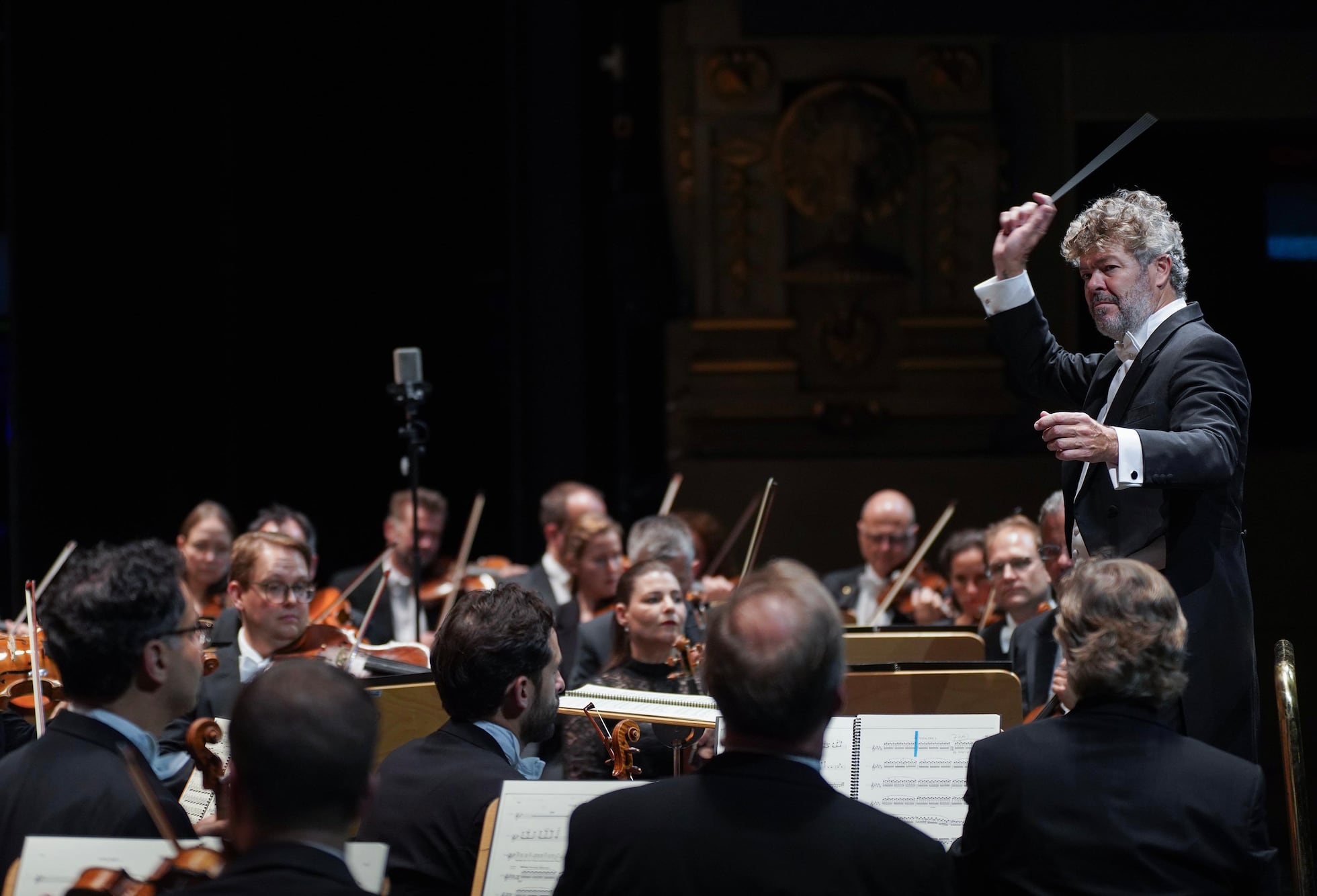
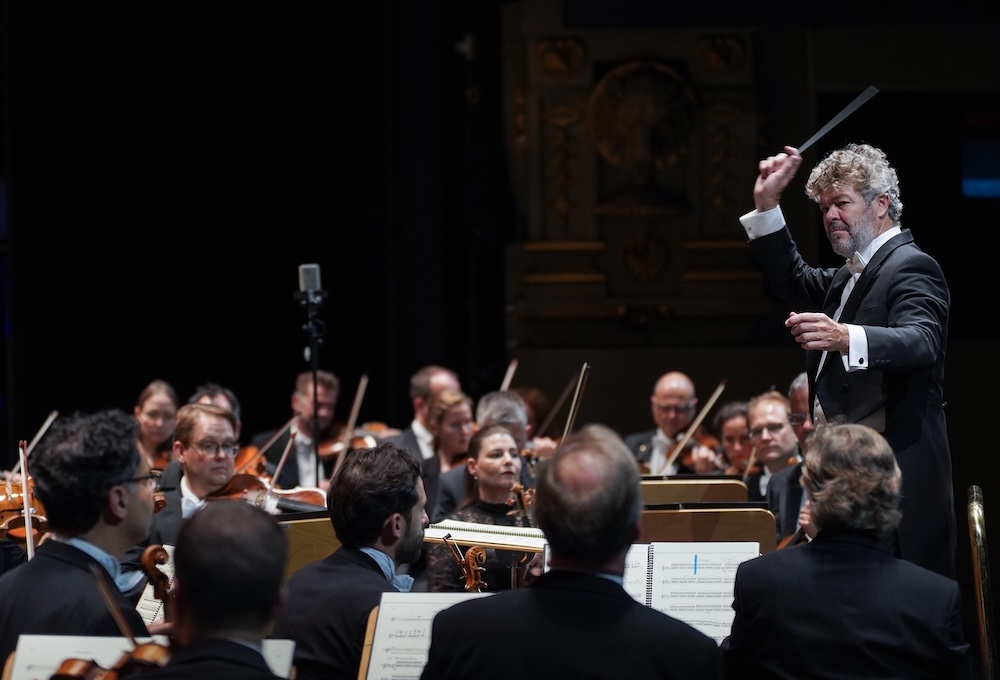
With tickets sold out months ago (they went on sale last November), the event was a must-see for Wagnerians and opera lovers in the city. As previously mentioned, the program consisted of the most celebrated excerpts from the tetralogy. Throughout the tour, the orchestra is under the baton of Pablo Heras-Casado, a regular conductor of the Wagnerian repertoire at the Teatro Real (having conducted the Ring, Der Fliegende Holländer, and Die Meistersinger von Nürnberg), and highly regarded in Bayreuth after his successful debut conducting Parsifal there in 2023, leading it until 2026. In 2028, Heras-Casado will conduct the new Ring production at the festival. Three singers, well-known and highly acclaimed at the Green Hill, performed some of the excerpts: tenor Klaus Florian Vogt, soprano Catherine Foster, and bass-baritone Nicholas Brownlee. The program was as follows: 

Das Rheingold:

Etnrance of the gods to Valhalla, with the aria "Abendlich strahlt der Sonne Auge", sung by Nicholas Brownlee.

Die Walküre:  

"Ein Schwert verhieß mir der Vater", sung by Klaus Florian Vogt.

"Leb' wohl du kühnes herrliches Kind!", sung by Nicholas Brownlee.

Siegfried: 

The Murmurs of the Forest, orchestral.

«Ewig war ich…» and the rest of the final duet, sung by Catherine Foster and Klaus Florian Vogt.

Götterdämmerung:

Dawn and Siegfried's Journey on the Rhine, orchestral

 "Brünnhilde, heilige Braut!", sung by Klaus Florian Vogt, and Funeral March

 "Starke Scheite schichtet mir dort...", sung by Catherine Foster.

Encore: The Ride of the Valkyries, orchestral, from Die Walküre.

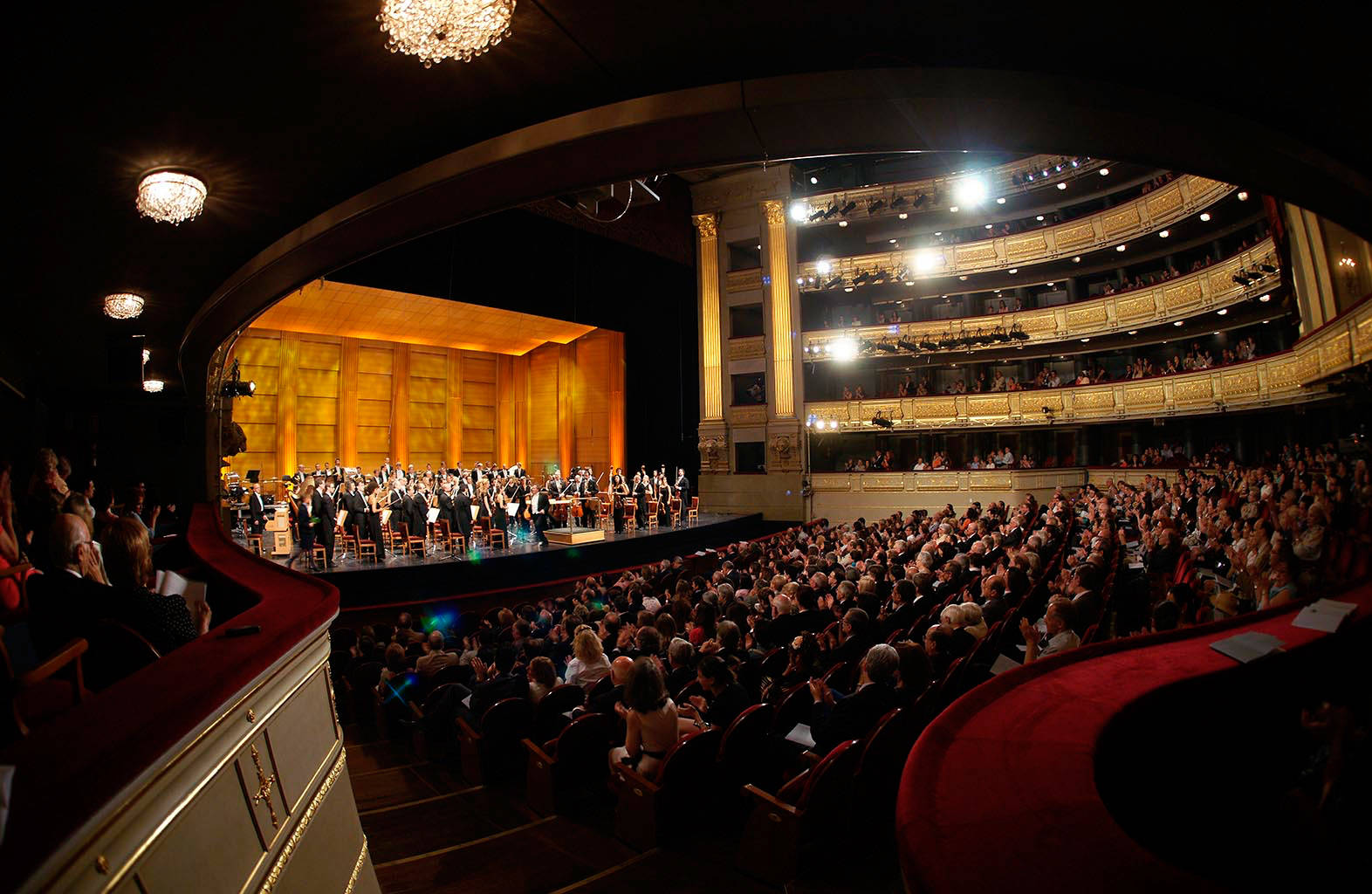
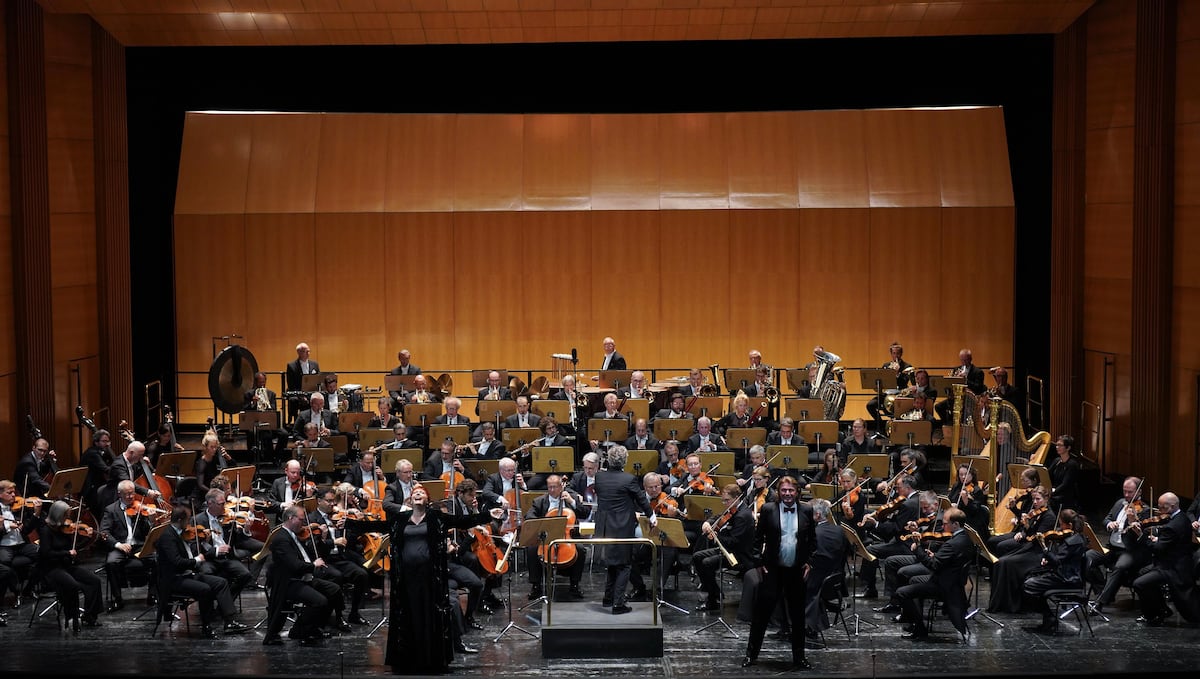
After leaving the scorching sun outside, the Teatro Real main hall welcomed the audience with empty music stands and a concert version set illuminated in warm, golden light. As the lights dimmed, an increasingly common practice in concert performances, the orchestra members entered as the audience applauded enthusiastically, and then Heras-Casado began the concert.

Expectations for the concert were high, not only because of the unique nature of the event, but also because this is the best available orchestra for Wagner. Those of us who don't usually travel for opera are accustomed to seeing this composer's operas performed by competent national orchestras, so thanks to this concert, we could finally witness this excellence live without having to travel to Bayreuth. If we only had to judge the quality of the instruments and the musicians' performance alone, then expectations are more than fulfilled. However, in my seat on the seventh floor in the highest zones, the sound didn't reach as far as in the lower sections. In fact, when I had the opportunity to move to the gallery on the fourth floor, the difference was striking.

The orchestra began with the finale of Das Rheingold, the strings opening the piece with a soft piano sound, answered by the powerful brass, which played Donner's invocation. The wind instruments, in general, were spectacular, and so was the percussion. The strings showcased their powerful tremolo in the tenor's first aria. During Wotan's long Farewell scene, the strings sounded melancholic and intimate, while the brass was as spectacular as usual. In addition, in the Magic Fire music that closes the piece, the excellent glockenspiel deserves special mention. I venture to say that the best orchestral moment of the first part was Siegfried's Forest Murmurs. The strings began as a whisper, ideal for such descriptive music. Here, the woodwinds shone; both clarinets and flutes were excellent, and once again the glockenspiel sounded wonderful, as did the French horns.

The second half was the one I enjoyed the most, as the sound reached the area where I had moved much better. And it was then when I could finally appreciate, savor that spectacular sound, so far superior to what we usually hear in Madrid, and exactly as I remembered it from my 2024 Tannhäuser performance at the Festspielhaus. This part was dedicated to Götterdämmerung. The cellos at the beginning of the first piece sounded velvety, and the orchestra gradually swelled, offering a playful interpretation of Siegfried's journey up the Rhine. Orchestrally, the best was yet to come. Because the performance of the Funeral March was perhaps the best moment of the concert, as the orchestra attacked with powerful tutti that resonated deep within the listener. It was a memorable performance due to its impactful percussion, and the powerful brass, preceded by intense strings, which shone during Siegfried's death, the preceding number. Brunhilde's Immolation was also powerful. Even so, the second best moment of the night came with the only encore: the Ride of the Valkyries, with an electrifying performance by each and every one of its members, who received an outstanding ovation at the end of the piece.

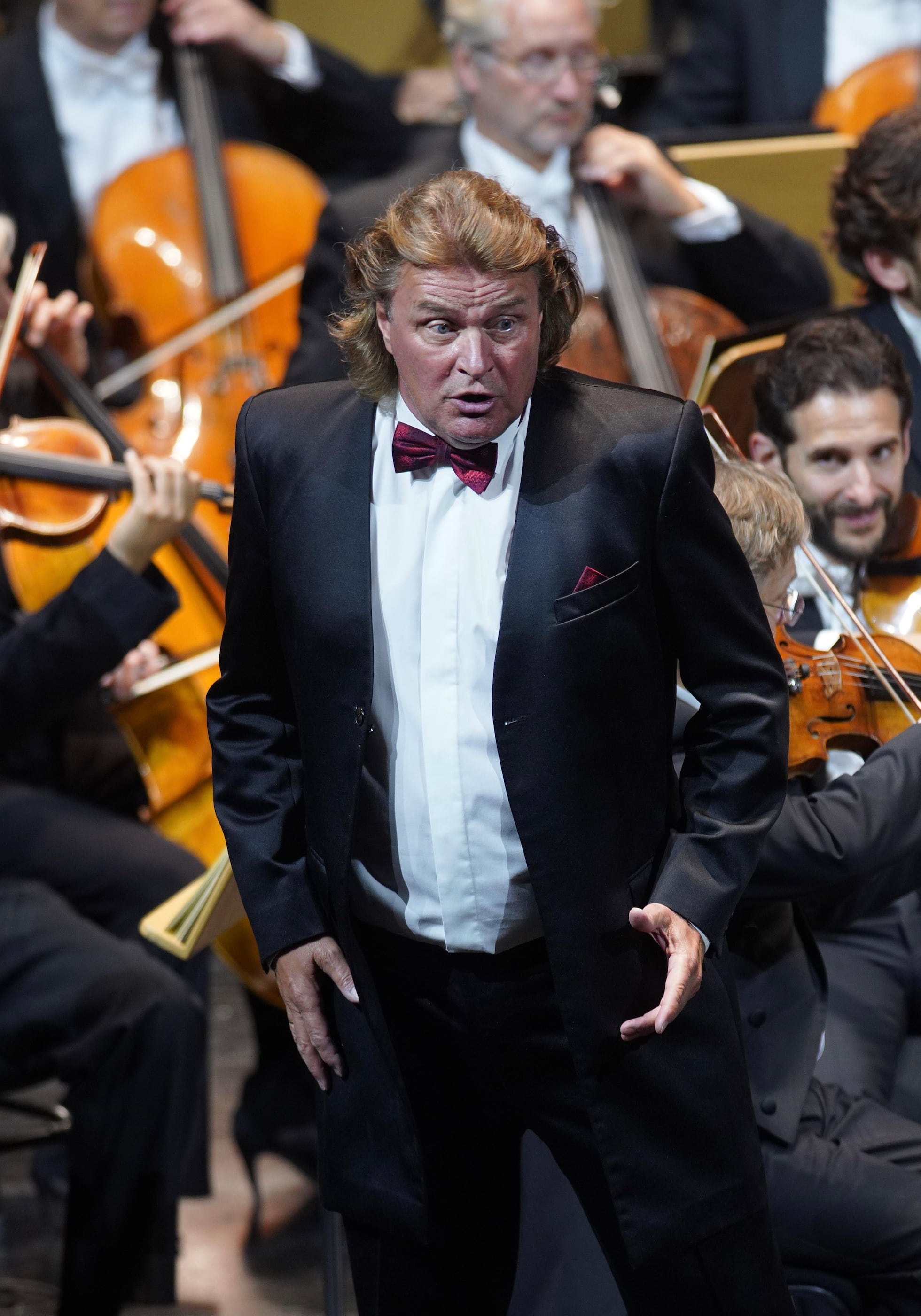
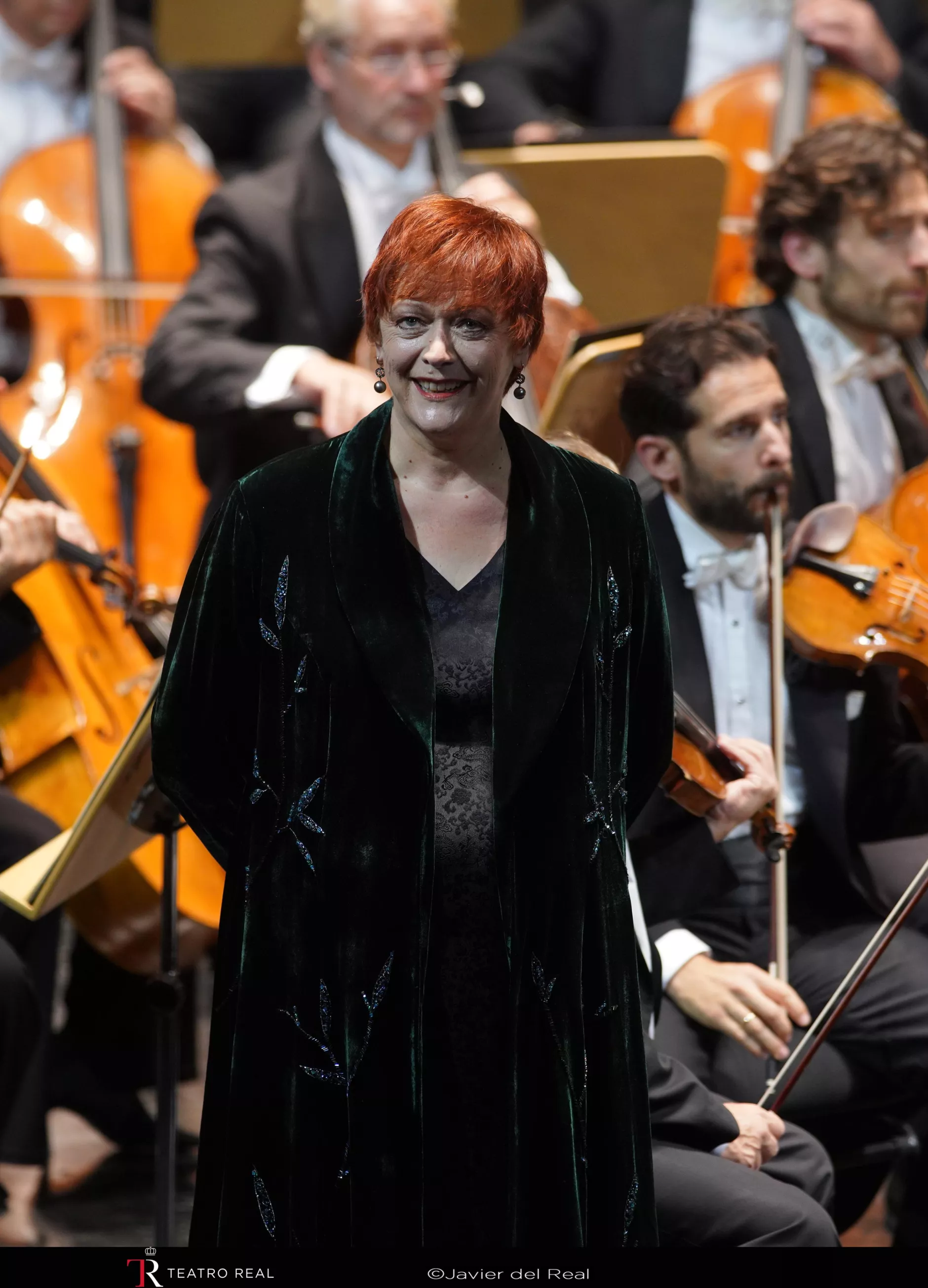
As for the three soloists, there was a clear winner: the American bass-baritone Brownlee, for whom this tour is proving to be a personal triumph. His powerful voice, which can be heard throughout the hall due to its generous volume, even overpowered the powerful orchestra. It is a voice at its prime, with a superb lower register, powerful high notes as in "so grüss ich die burg" at the end of Das Rheingold, or in the famous final words of the farewell in Die Walküre, and a dramatic intonation at times, as in "der freier als ich der gott" shortly before in the same piece. Brownlee debuted the role a few years ago, and there is no doubt, he is the Wotan of our time.


Vogt, the indispensable lyric tenor of the Bayreuth Festival, had three pieces. The first one was the powerful aria "Ein schwert verhiess mir der Vater" from Die Walküre, in which he discovers the sword Nothung. This tenor has a somewhat lyric timbre, although quite light for the heldentenor roles he usually sings, as he lacks the necessary vocal range. Live, his voice has a generous volume, and he tries to convey all the nuances he can, within the limitations of his instrument. Even so, in roles like Siegmund or Siegfried, Mr. Vogt's performance is inconsistent, as remarkable moments alternate with others where his voice sounds too weak for the required characterization. This happened in his first appearance, because after the somewhat strenuous "Wälse, Wälse," he delivered a weak "Wo ist dein schwert?", clearly highlighting this contrast. His duet with Brunhilde sounded more youthful and lyrical, especially with some remarkable (though I still find it lacking in intensity) "Sei mein, sei mein." However, his performance of Siegfried's death in the second part was an improvement, with a more dramatic and committed interpretation, a more lyrical approach to this number.

As an aside, the concert versions increasingly feature theatrical gestures from the soloists. For example, in Siegfried and Brünnhilde's love duet, the singers moved around, looked at each other, and embraced as if they were on stage. The same happened in Siegfried's death scene, but it began in a way I found amusing: when the orchestra starts attacking, and since it represents Hagen's attack on Siegfried from behind with his spear, Mr. Vogt performed it as well. But viewed from above, it looked as if the poor guy had suffered a sudden low back pain attack before collapsing to the ground and performing his number.


Between 2013 and 2025, Foster was the principal Brünnhilde at the Bayreuth Festival, with her rather lyrical voice (like her predecessor at Bayreuth, the British soprano Anne Evans, more than thirty years earlier), a deep understanding of the character, and great commitment. However, although she still possesses these qualities, her voice is already showing signs of fatigue. In her famous aria "Ewig war ich" her voice seemed to wobble a bit, and her high notes now sound a bit more shouted. However, in her great moment, Brünnhilde's Immolation, she was much better. Her lyrical timbre and middle register sounded excellent, and she also managed to convey both the solemn and introspective aspects of her character's long monologue. Even the high notes in the final part of it were improved.

The tour is proving to be a resounding success at every stop: the audience's enthusiasm is visible, especially for the orchestra and for Brownlee. This was certainly the case in Barcelona and Santander. The same would have happened in Seville, had it not been for a power outage in the theater area that forced the concert to be suspended halfway through. And in the capital, it was no different from the first two cities for the audience: after each number, and especially after Wotan's farewells, the duet between Brunhilde and Siegfried, and the final encore, the ovations were thunderous. The reviews, however, were mixed: they praised the opportunity to see this glorious orchestra, but found ups and downs in the singing and conducting.

I am still surprised by the fact that, despite the sold-out sign having been up for some time, in the second part of the show, there were numerous empty seats in the stalls and on the first floor, quite a contrast to the stands and the upper balcony, which were packed to capacity. Many local wagnerians and operagoers attended the concert, so just entering the Teatro Real, I met several acquaintances, specially in the intermission wasn't really a pause: I walked all over the theatre meeting people who wanted to comment the show. I am mostly shy, but in that moment I felt like a celebrity.

Only the Valencia concert remains, but all of us who attended these concerts will remember them forever. Even with their ups and downs—because in the first half, at times, I felt like I was witnessing a luxury gig, but the second half was pure ecstasy. I hope they will delight us again, although it won't be anytime soon. Hearing that orchestral level, the best for Wagner, is a true gift; it also confirms Spain's important place on the world Wagnerian map.

Regarding the attempt to bring the Bayreuth Festival to Madrid in 1899, Enrique Mejías' article has been a reference: 

“«Bayreuth en Madrid» (1899): un capítulo del wagnerismo madrileño”, en Javier Marín López, Germán Gan Quesada, Elena Torres Clemente y Pilar Ramos López (eds.): Musicología global, musicología local, España, Sociedad Española de Musicología (SEdeM), 2013, pp. 1421-1442.


My reviews are not professional and express only my opinions. As a non English native speaker I apologise for any mistake.

Stage photographs belong to the Teatro Real. My use of them is only cultural. If someone is uncomfortable with their use, just notify it to me.

Any reproduction of my text requires my permission.

Wagner, por su mejor intérprete, en la capital: la Orquesta del Festival de Bayreuth, de gira en el Teatro Real.


Madrid, 3 de septiembre de 2026.

Cada año, al terminar la temporada correspondiente del Festival de Bayreuth, su coro y su orquesta, formados con los mejores músicos de Alemania y Austria, se disuelven para que sus miembros vuelvan a sus formaciones de origen. Sus producciones tampoco suelen verse en otros teatros. Forma parte de la magia de la colina verde, el que su excelencia artística se limite entre las cuatro paredes del teatro ideado por Richard Wagner, y que gente de todo el mundo vaya año tras año a experimentarlo allí. Dadas esas circunstancias, una gira de la temporal compañía del festival podría parecer imposible. Sin embargo, ha habido ocasiones en que ello ha ocurrido. Y de esas ocasiones excepcionales, dos han tenido lugar en España. 

En abril de 1955, las producciones de ParsifalTristán e Isolda y La Valquiria del Festival de Bayreuth y dirigidas por el nieto del maestro, Wieland Wagner, visitaron el Gran Teatre del Liceu de Barcelona, la capital wagneriana de nuestro país. Junto a ellas, participaron el mítico director de orquesta Joseph Keilberth (quien dirigió a la Orquesta Sinfónica de Bamberg, al no haber aún orquesta del festival en abril), el Coro del Festival dirigido por Wilhelm Pitz, y los no menos míticos artistas habituales del festival como Hans Hotter, Ramón Vinay, Martha Mödl, Ludwig Weber, Wolfgang Windgassen, Gustav Neidlinger, Gerhard Stolze, Hermann Uhde, Georgine von Milinkovic, y Gré Brouwenstijn, además de los excelentes secundarios. Cincuenta y siete años después, en septiembre de 2012, la orquesta, el coro y los elencos completos del festival de ese año, volvieron al mismo coliseo barcelonés, para interpretar El Holandés Errante, Tristán e Isolda y Lohengrin en versión concierto

Si algo se le debe reconocer a la directora artística del festival y bisnieta del compositor, Katharina Wagner, es el intentar que la institución entre en el siglo XXI. Y entre esas reformas está, el sacar a la orquesta de gira a otras ciudades, con más frecuencia que antes. En 2021, la orquesta estuvo de gira en París, Colonia y Riga; y en los últimos años en Grafenegg, Austria. Doña Katharina ha manifestado en alguna ocasión su admiración por España: aquí escenificó Tannhäuser y Lohengrin. A finales de 2025, los wagnerianos españoles nos encontramos con una gran sorpresa: con motivo de su 150 aniversario, la Orquesta del Festival de Bayreuth haría una gira por cinco ciudades españolas: Barcelona, Santander, Sevilla, Madrid y Valencia, para interpretar una selección de El Anillo del Nibelungo una vez terminado el festival. Para el recuerdo, la fotografía de la señora Wagner y los directores artísticos de esos cinco teatros, en el castillo de Peralada. 

Como no podía ser de otro modo, el Teatro Real ha albergado el concierto madrileño, fechado para el 3 de septiembre. Por primera, y esperamos que no única vez, la orquesta del festival visita la capital. Aunque, no fue el primer intento: en 1899, el empresario del teatro de entonces, el mítico Luis París, intentó traer al Festival al Real para interpretar seis ciclos del Anillo, lo que habría convertido a Madrid en la primera ciudad fuera de Bayreuth en representarlo completo y además en lengua alemana, algo raro en una época donde en España todas las óperas se cantaban en italiano. Sin saber si se lograría, la prensa se hizo eco de esta empresa, y hasta abonos sin entrada se vendieron. Wagner estaba de moda en los más refinados círculos intelectuales de la ciudad y se pensó que podría ser posible. Pero la falta de liquidez del Real y la falta de entendimiento con los agentes artísticos alemanes, dieron con el intento al traste.

Con las entradas agotadas desde hace meses (salieron a la venta en noviembre del año pasado), el evento era una cita ineludible, para wagnerianos y operófilos de la ciudad. Como ya se ha dicho antes, el programa ha constado de los fragmentos más célebres de la tetralogía. Para toda la gira, la orquesta cuenta con la dirección orquestal de Pablo Heras-Casado, habitual del repertorio wagneriano en el Real (habiéndonos dirigido el Anillo, el Holandés Errante y Los Maestros Cantores), y muy valorado en Bayreuth desde que dirigiera con éxito la producción de Parsifal que allí se ha visto entre 2023 y 2026. En 2028, Heras-Casado dirigirá la nueva producción del Anillo en el festival. Tres cantantes, muy conocidos y aplaudidos en la colina verde, interpretan algunos de los fragmentos: el tenor Klaus Florian Vogt, la soprano Catherine Foster, y el bajo-barítono Nicholas Brownlee. El programa ha sido el siguiente: 

El Oro del Rin:

Entrada de los dioses al Walhalla, con el aria «Abendlich strahlt der Sonne Auge», cantado por Nicholas Brownlee.

La Valquiria:  

«Ein Schwert verhieß mir der Vater», cantado por Klaus Florian Vogt.

«Leb’ wohl du kühnes herrliches Kind!», cantado por Nicholas Brownlee.

Sigfrido: 

Los Murmullos del Bosque, orquestal.

«Ewig war ich…» y resto del dúo final, cantado por Catherine Foster y Klaus Florian Vogt.

El Ocaso de los dioses:

Amanecer y viaje de Siegfried por el Rin, orquestal

 «Brünnhilde, heilige Braut!», cantado por Klaus Florian Vogt, y Marcha Fúnebre

 «Starke Scheite schichtet mir dort…», cantado por Catherine Foster.

Bis: La Cabalgata de las Valquirias, orquestal, de La Valquiria.

Tras dejar en la calle un sol abrasador, la sala del Teatro Real recibía al espectador con los atriles vacíos, con el decorado de versión concierto iluminado con una luz cálida de tonos dorados. Al apagarse las luces, algo cada vez más común en las versiones de concierto, entraron los músicos de la orquesta, recibidos con un fuerte aplauso, y a continuación, el maestro Heras-Casado dio inicio al concierto.

Las expectativas con el concierto eran altas no solo por la singularidad del evento, sino porque esta es la mejor orquesta posible para Wagner, y acostumbrados los que no solemos viajar por razones líricas, a ver a este compositor interpretado por competentes orquestas nacionales, por fin podíamos ver esta excelencia en vivo, sin tener que viajar a Bayreuth. Ya solo por la calidad de sus instrumentos, y el desempeño de sus músicos, dichas expectativas estaban más que cumplidas. Sin embargo, en mi asiento en la séptima planta, no llega el sonido como en zonas más bajas. De hecho, cuando tuve la oportunidad de cambiar de asiento a la tribuna en la cuarta planta, la diferencia fue brutal.

La orquesta empezó con el final de el Oro del Rin, con las cuerdas iniciando la pieza con un sonido en piano, siendo respondidas por el poderosísimo metal, que interpretaba la invocación de Donner. El viento en general, es espectacular, así como la percusión. Las cuerdas dieron cuenta de su poderoso trémolo en la primera intervención del tenor. Durante los largos adioses de Wotan, las cuerdas sonaron melancólicas, íntimas, y el metal impactante como siempre. Sin embargo, en la música del fuego mágico que cierra la pieza, hay que destacar el excelente glockenspiel. Me arriesgo a decir que el mejor momento orquestal de la primera parte fueron los murmullos del bosque de Sigfrido. Las cuerdas empezaron como un susurro, ideal para esta música tan descriptiva. Aquí el lucimiento fue para la madera, tanto clarinetes como flautas fueron excelentes, y de nuevo el glockenspiel volvió a sonar maravillosamente, así como las cálidas trompas.

La segunda parte fue la que más disfruté debido a que el sonido llegaba mejor a la zona donde me había cambiado. Y fue aquí, donde por fin pude apreciar, saborear esa sonoridad tan espectacular, tan superior a lo que habitualmente escuchamos, y que era tal y como lo recordaba cuando estuve en el Festspielhaus hace dos años, viendo Tannhäuser. Esta parte estaba dedicada a El Ocaso de los Dioses. Los violonchelos en el inicio de la primera pieza sonaron aterciopelados, y la orquesta fue creciendo hasta dar una lectura juguetona, del viaje de Sigfrido por el Rin. A nivel orquestal, lo mejor estaría por llegar. Porque la interpretación de la Marcha Fúnebre fue quizá el mejor momento del concierto, la orquesta atacando con unos tutti que se metían en los huesos del espectador. Fue una interpretación memorable debido a su impactante percusión, junto al poderoso metal, precedido por unas cuerdas intensas, las cuales brillaron intensamente durante la muerte de Sigfrido, el número previo. La Inmolación de Brunilda fue también poderosa. Aun así, el segundo mejor momento de la noche vino con la única propina: la cabalgata de las valquirias, con una interpretación elecrizante de todos y cada uno de sus miembros, ovacionados con fuerza al terminar la pieza.

En cuanto a los tres solistas, hubo un claro vencedor: el bajo-barítono estadounidense Nicholas Brownlee, a quien esta gira le está reportando un triunfo personal. Su poderosa voz, que se deja oír en toda la sala, debido a su generoso volumen, superó incluso a la potente orquesta. Es una voz en su mejor momento, con un grave estupendo, unos agudos poderosos como en "so grüss ich die burg" en el final del Oro del Rin, o en las famosas palabras finales los famosos adioses en La Valquiria, y una entonación por momentos dramática, como en "der freier als ich der gott" poco antes en la misma pieza. Brownlee ha debutado el rol hace unos pocos años, y no queda duda, es el Wotan de nuestros días.

Klaus Florian Vogt, el indispensable lírico tenor del Bayreuth actual, ha tenido tres intervenciones. La primera es la potente aria "Ein schwert verhiess mir der Vater", de La Valquiria, en la que descubre la espada Nothung. Este tenor tiene una voz peculiar, con un bello timbre lírico, aunque ligero para los roles de heldentenor que canta habitualmente, sin tener esa tesitura. En vivo su voz tiene un caudal generoso, y trata de representar todos los matices que puede, dentro de lo que le permite su instrumento. Aun así, en roles como Siegmund o Siegfried, el señor Vogt da una de cal y otra de arena, porque momentos notables se alternan con otros en los que la voz suena floja. En su primera intervención le pasó, porque tras unos esforzados "Wälse, Wälse", le siguió un flojo "Wo ist dein schwert?", que dejó claro este contraste. Más juvenil y más lírico sonó en el dúo con Brunilda, especialmente con unos notables (porque me sigue faltando intensidad) "Sei mein, sei mein". Sin embargo, mejoró su intervención en la muerte de Sigfrido en la segunda parte, con una interpretación más dramática y entregada, en una aproximación más lírica de este número.

Como anécdota, las versiones de concierto muestran cada vez más ademanes de representación por parte de los solistas. Así, en el dúo de amor de Sigfrido y Brunilda, los cantantes se movían, se miraban. se abrazaban como si fuera en una función. En la muerte de Sigfrido, fue lo mismo, pero empezó de una forma que me pareció divertida: cuando la orquesta empieza atacando, y dado que representa el ataque de Hagen con su lanza a Sigfrido por la espalda, el señor Vogt lo interpretó igualmente. Y así, visto desde arriba, parecía que al pobre le había dado un repentino ataque de lumbalgia, antes de caer al suelo y representar su número.

Entre 2013 y 2025, Catherine Foster ha sido la Brunilda principal en el Festival de Bayreuth, con su voz más bien lírica (como su antecesora en Bayreuth, la también británica Anne Evans, hace más de treinta años), con un profundo conocimiento del personaje y una gran entrega. Sin embargo, aunque aún tiene esas cualidades, la voz ya presenta signos de cansancio. En su famosa aria "Ewig war ich" y en el siguiente dúo con Sigfrido, la voz por momentos parecía zozobrar, así como los agudos suenan ahora un poco más gritados. Sin embargo, en su gran momento, la Inmolación de Brunilda, estuvo mucho mejor. Su timbre lírico y su centro sonaron muy bien, y además supo transmitir el lado solemne, así como el  introspectivo, de su largo monólogo. Incluso los agudos en la parte final del mismo fueron mejores.

La gira está siendo un éxito rotundo en todas sus paradas: el entusiasmo del público se une al de las críticas entusiastas de la prensa, de estos ya históricos conciertos; especialmente para la orquesta y para Brownlee. Así ha sido en Barcelona y Santander. En Sevilla habría sucedido lo mismo, de no haber sido porque un apagón en la zona del teatro, obligó a suspender el concierto a la mitad. Y en la capital no ha sido diferente de las dos primeras ciudades: después de cada número, y muy especialmente tras los adioses de Wotan, el dúo de Brunilda y Sigfrido, y la propina final, las ovaciones fueron atronadoras. Aun así, no deja de sorprenderme el hecho de que, aun colgando el cartel de no hay entradas desde hace tiempo, en la segunda mitad podían verse numerosos asientos vacíos en el patio de butacas y en la primera planta, todo un contraste con la tribuna y el paraíso, que estaban a rebosar. 


Ya solo queda el concierto en Valencia, pero todos los que hemos asistido a estos conciertos, los recordaremos para siempre. Aun con sus altibajos, porque en la primera parte por momentos tenía sensación de estar frente a un bolo de lujo, pero en la segunda fue un éxtasis total. Ojalá volvieran a deleitarnos, aunque no será ni a medio plazo. Escuchar ese nivel orquestal, el mejor para Wagner, es todo un regalo; que además confirma a España en un lugar importante en el mapa wagneriano mundial.


Sobre el el intento de traer al Festival de Bayreuth a Madrid, en 1899, el artículo de Enrique Mejías ha sido una referencia: 

Mejías García, Enrique. «Bayreuth en Madrid» (1899): un capítulo del wagnerismo madrileño”, en Javier Marín López, Germán Gan Quesada, Elena Torres Clemente y Pilar Ramos López (eds.): Musicología global, musicología local, España, Sociedad Española de Musicología (SEdeM), 2013, pp. 1421-1442

Las fotografías y vídeos no son de mi autoría, si alguien se muestra disconforme con la publicación de cualquiera de ellas en este blog le pido que me lo haga saber inmediatamente. Cualquier reproducción de este texto necesita mi permiso.

Las fotografías escénicas son propiedad del Teatro Real.